Narrative of Samantha Fremont

An essay by Samantha Fremont, as provided by Regina Clarke
Art by Katie Nyborg


(Editor’s Note: Since Ms. Fremont left before completing her graduate studies, the following document, proved now to indeed have been written in her own hand, is of relevance only because it was found in the Spheren collection. Its content is specious and derivative, at best.)

“I am greatly chastened by events that have recently beset me.” Those words appeared suddenly on the page. How could I have missed seeing them before? For a year I had pored over the papers and journals of Dr. Richard Spheren looking for information to complete a study of his work. There had been a curious gap, a period of several months during which he had inexplicably disappeared. His wife had awoken one morning to find him gone, and woken up another day, three months later, to find him beside her, snoring lightly. He claimed no memory of the lapse of time.

I couldn’t accept his assertion of amnesia. In reading about him I’d discovered a like mind, someone whose reflections seemed to accord with my own, and I wanted, above all, evidence of uncommon reality. I worked under the assumption that Spheren had been hiding something, and that it had to be connected with his primary work, research into what he termed “magnetic transference.” The term itself was vague and hinted of outdated mesmerism. But I felt certain that he must have discovered something important and that he’d spent those three months exploring whatever it was. No doubt he was aware that the scientific community would not receive his conclusions with approval and so chose not to reveal them. As a community, it is profoundly conservative even now.

He had only filled half the page in that journal and dated it the same day he had reappeared to his wife. “Were I able to share what I have learned,” he continued, “I would have to describe such an alteration of perception as to challenge all previous assumptions about the nature of reality.”

The closed stacks that held most of his papers were situated on the third floor of the university library. Outside the window where I sat reading that fateful passage I could see new foliage opening, as the pale, light green leaves of the maple tree brushed against the glass. Beyond the outline of the east wing I could follow the course of the wind as a hawk glided effortlessly in the morning air. Between me and the creature lay wood, a piece of glass, a tree, some stonework, an invisible atmosphere–but what else? Except for the agreement of those around me at any given moment, how did I know that what I saw was real? Old questions, many answers, depending on one’s point of reference. Was that what Spheren meant? Some version of Plato’s shadows in the cave? No. I felt that was too easy. He was troubled in some way, apprehensive about it all.

Nowhere in the pages was there a repetition of the passage or any hint of what the words about reality meant. That is, until I read the final paragraph of his last journal, dated July 14, 1894. From there I collected the clearest insight I would have into the man, and began my own investigation deeper into his world, one that would take me at least as far as Spheren had gone–and, as I must admit, somewhat further.

Narrative of Samantha Fremont


To read the rest of this story, check out the Mad Scientist Journal: Winter 2014 collection.


Samantha Fremont spent most of her graduate studies in philosophy, focusing on phenomenology. Her dissertation was tentatively titled “Fallacies in Husserl’s Full Noema,” with an emphasis on why transcendental perspectives cannot possibly define all objects as subjective experience. Her work could very well have provided significant contributions to current theory, if she had not allowed her obsession with Dr. Richard Spheren and his curious explorations into consciousness to divert her attention. Her disappearance was a more a relief to the thesis committee than a source of concern.


Regina Clarke has a doctorate in English and has worked as a technical writer in high tech, focusing on network management systems, virtual protocols, augmented reality, and military surveillance software. Her stories have appeared in Thrice Fiction, Kzine, Bewildering Stories, Subtle Fiction, and Over My Dead Body!, among others. Her passion is for mysteries, film noir, science fiction B-grade movies, and biographies of writers. It pleases her no end to live in the Hudson River Valley, not very far from where Rod Serling grew up. She has a brilliant, green, eclectus parrot–Harry– who talks a great deal about himself.


Katie Nyborg’s art, plus information regarding hiring her, can be found at http://katiedoesartthings.tumblr.com/
Posted in Fiction | Tagged , , , | 1 Comment

Hot! Fresh! Now! Autumn 2013

Hey look! We have another collection!

Mad Scientist Journal: Autumn 2013


In addition to collecting another three months of stories, we have exclusive fiction featuring Antoinette McCormick, Alexis A. Hunter, and Folly Blaine, mad science advice from Dr. Synthia, and our ever charming mad scientist classifieds! It’s available on Amazon and Smashwords, or you can add it to your to-read pile on Goodreads!

Posted in Administrative | Comments Off on Hot! Fresh! Now! Autumn 2013

Little Gods

An essay by Nathan Orbos, as provided by Mathew Allan Garcia
Art by Scarlett O’Hairdye


ONE

Let’s talk, shall we? You and I. I want to clear the air. There are things that’ve been on my mind for a few millennia. You’re old enough to know the truth. You’re ready to accept it.

Who am I? I am the object of your fear. I am the thing you’ve been trained to hate since you were able to be trained to do anything. Why? Well, let’s just say that my eyes were too large, my smile too wide for my face, my ideas too convincing. I can’t help it. I’m just a happy guy. I like to smile, and I get overly excited sometimes, I admit.

I’m going off topic now. This isn’t about me. It’s about you. Let me just go right on ahead and say it: Things are bad. And worse things are about to happen. They’ve been there all along. Long ago when my brother and I disagreed about how things were going here. On Earth.

So let’s talk. Let’s talk about how this happened. How you’re going to fix this.

First, the elephant in the room: I’m Lucifer. Yes, Beelzebub, The King of Darkness, Legion, all that jazz. Now I know your opinion of me is low. I get it. But put that aside for a second. Just for a second. Hear me out this once.

I promise you will not be possessed simply for reading this. You will not get a bad case of diarrhea and vomit split pea soup. God will not send you straight to hell for entertaining my ideas. Relax.

We’re all friends here.

Little Gods


To read the rest of this story, check out the Mad Scientist Journal: Winter 2014 collection.


Nathan Orbos is a normal man. While under anesthesia for a terminal illness he began hearing voices that he, upon waking, set on writing down. His collected words would later be known as The Book of Lucifer.


Mathew Allan Garcia lives with his wife in Hesperia, California. He has four dogs, as well as countless demons that he has yet to exorcise onto paper. His work can be found mostly in his head, as well as First Stop Fiction, and Mused Literary Review. He has been writing for as long as he can remember.


Scarlett O’Hairdye is a burlesque performer, producer and artist. To learn more, visit her site at www.scarlettohairdye.com.


This story originally appeared in B O D Y Literature.

Posted in Fiction | Tagged , , | Comments Off on Little Gods

Mendant’s Maggots

A Paper Presented to the League of Astrobiological Studies, 2015–Highlights from the Journal of Dr. Louise Mendant: First Investigations into “Mendant’s Maggots” by Dr. Bryce Ellicott, as provided by Dr. J.A. Grier
Art by Leigh Legler


As the scientific community is now aware, “Mendant’s Maggots”–once thought to be fictional creatures–have recently been proven to truly exist. The last remnants of this intriguing species were recovered from the burned and long ignored laboratory of Dr. Louise Mendant. Dr. Mendant’s original reports and papers dealing with these small creatures were dismissed as whimsy. Our laboratory has, however, recovered viable specimens, and thanks to funding through NASA and the NSF, we have reinitiated those studies begun by Dr. Mendant.

We feel it fitting to present here highlights from her experimental journal. Lost more than one hundred years ago, the journal is a thought-provoking account of the procedures followed by this renowned scientist. While no doubt many of her entries remain fanciful and unsophisticated by present day standards, the journal helps to emphasize the importance of these highly unusual creatures. We beg the forgiveness of readers for any difficulties with the text. The original journal was smudged and smoke damaged, and some passages were lost entirely.


Dr. Louise Mendant’s Experimental Journal

June 21, 1895

I was thrilled to be presented today with the only surviving sample of the small green grubs retrieved from Hartford Estate. You will recall these grubs were found inside of a dark rock the young Master Hartford was using for lawn bowling. Knowing my interest in unusual animals and plants of all kinds, the boy’s father, Daniel Hartford, presented the grubs and their rocky home to me this morning. He seemed both unhappy and relieved to be rid of them. I know of his own deep interest in science, and his reluctance to part with the small beasts was tangible. Alas, his wife Jenna has been complaining of headaches since the time the rock split open on a particularly good throw last week. Since she rather irrationally blames the rock, Daniel was forced to hand it over to me. It is to my gain, and I promised to share my results with him as frequently as possible. He begged to be allowed to peek in on my work from time to time, and this request I granted with enthusiasm.


July 1, 1895

As was reported to me by Daniel Hartford, the small green grubs seem to require no food or water to survive, but die within minutes if removed from the surface of the black rock. This makes study quite difficult. A grub can be pulled away and placed under a microscope, but only for mere moments, and then it must be immediately returned to the rock. With caution and patience, I have been able to sketch the larger structures. They are of the same approximate size and shape as common maggots, yet are bright green.


July 3, 1895

Daniel visited me in my laboratory today, and we both spent time simply staring upon the maggots and pondering their significance. How amazing to find a creature that, like a plant, does not seem to need to eat! Perhaps this green color is indeed the same chemical found in plants, and they metabolize in the same fashion. Yet, even plants require water. Daniel left at sundown, but I worked well into the night.


July 8, 1895

The maggots continue to show no interest in food or water, decayed or otherwise. No offering of any kind has been ingested, although they do seem to have mouth-like structures. Their only activity is to wander over the surface of the inside of the rock in repeating patterns. This no doubt involuntary, repetitive activity leads me to believe they are leaving behind some sort of chemical trail, much in the way ants might follow one another in a long line. Still, the patterns are fascinating, and I find myself watching the maggots wander for hours, and scarcely notice the time passing.


Mendant's Maggots

I immediately recognized drawings of the patterns the maggots make when they move, and was about to compliment Daniel on his accuracy when Jenna interrupted. Apparently they had been drawn by her son, and not by Daniel at all. Jenna accused Daniel of “wasting the boy’s time and energy” by teaching him these “useless patterns.”


To read the rest of this story, check out the Mad Scientist Journal: Autumn 2013 collection.


Dr. Ellicott is Director of Studies of Extremeophile Life at the Cumberland Astrobiological Laboratory.


Dr. J.A. Grier is a planetary scientist, poet, and wine lover. She spends her time penning odd articles, reading strange stories, comparing vintages, and looking at impact craters on other worlds. She throws a fabulous Halloween party every year where one room is decorated entirely in eyeballs. Her babblings can be found at www.onewritersmind.blogspot.com and @grierja on Twitter.


Leigh’s professional title is “illustrator,” but that’s just a nice word for “monster-maker,” in this case. More information about them can be found at http://leighlegler.carbonmade.com/.

Posted in Fiction | Tagged , , , , | Comments Off on Mendant’s Maggots

That Man Behind the Curtain: November 2013

And now, our November in review. Because everyone likes math on Christmas Eve. This got a little delayed due to assorted holiday season shenanigans. I hope y’all enjoy it.

The Money Aspect

Amounts in parentheses are losses/expenses.

Hosting: ($17.06)
Stories: ($55.00)
Art: ($200.00)
Advertising: $0.00
Paypal Fees: ($8.05)
Donations: $0.00
Ad Revenue: $0.57
Book Sales: $11.60
Total: ($260.97)
QTD: ($260.97)
YTD: ($3,625.92)
All Time: ($6,941.97)

As per usual, I try to list costs for art and stories under the month that the stories run on the site rather than when I pay them. I also cover Paypal expenses when paying authors and artists.

It was what I’ve come to recognize as a fairly typical month. No great shake-ups. No great booms of success. One thing I’m trying to do is minimize the amount of Paypal fees I’m covering. I’ve been using my PayPal Mastercard for sending most payments, but if I maintain a balance on my Paypal account it removes the transfer fee.

Submissions

In November we received 9 submissions, of which we accepted 6. That’s 66.67% for the month. Our all-time acceptance rate is 55.91%.

This gives us enough content for the site through the beginning of March 2014.

Traffic

Traffic dropped further in November. We had a total of 845 visits, another drop from our low September numbers. Our traffic consisted of 574 unique visitors and 1,527 page views. Our highest daily traffic was 57 visits.

November’s search engine term of the month is “remain woefully understudied.” Because clearly they understand how tragic fringe science is.

That’s all I’ve got to say for now.

Posted in Administrative | Comments Off on That Man Behind the Curtain: November 2013

Shooting Stars and Schadenfreude

An account by Doctor Maximilian von Borcke, as provided by Sean Patrick Hazlett
Art by Scarlett O’Hairdye


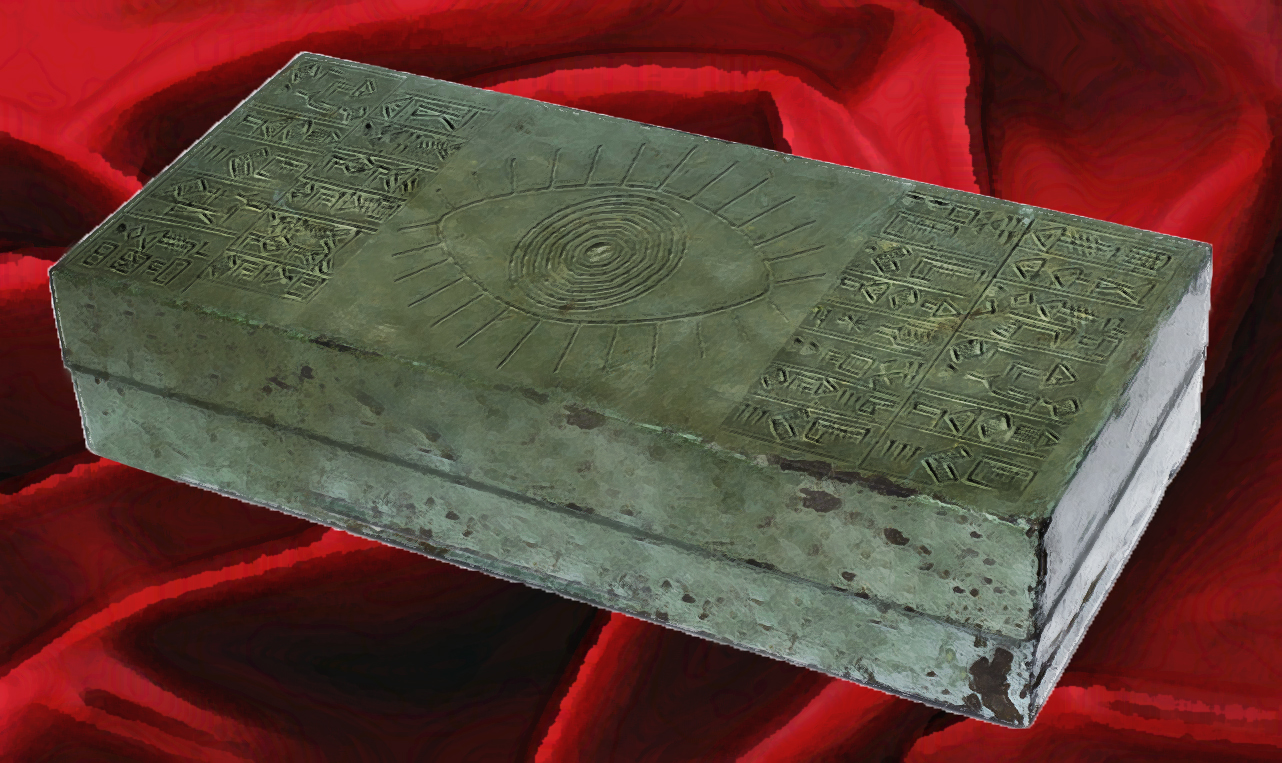
A disconcerting feeling of revulsion overwhelmed me when I touched the strange object, a metallic container the size of a cigar box. Inscribed on it was writing reminiscent of Sumerian cuneiform. The solitary eye engraved on the artifact’s face filled me with despair for reasons unknown to my conscious mind.

The weatherworn package had arrived yesterday from St. Petersburg’s Mineralogical Museum. I had ripped open the package before reading the attached letter, which was adorned in a script I immediately recognized. Since the war had begun, I’d feared I’d lost contact with my dear friend, Leonid.

My head ached and waves of nausea roiled in my gut. It was only after I returned the container to its package that my queasiness abated. I opened Leonid’s letter to learn his reasons for sending me this parcel.

Maximilian,

I wish I were writing you under better circumstances. Tomorrow, I join the Red Army to defend my Motherland against your countrymen. I regret we now find ourselves on opposite sides of this sad struggle. Know that I bear you no ill will. Your politicians are responsible for this fiasco, not you. I still cherish our friendship and scholarly correspondence. It is because of my deep admiration for you that I’ve sent you this package.

I implore you not to open it until you’ve read these words. Some things are best left undisturbed.

I shuddered. What horrors had I unleashed?

The artifact is of extraterrestrial origin. I discovered it in September 1908, during an expedition to Siberia’s Tunguska region. I found it amidst the destruction wrought by a meteorite that had laid waste to wide swaths of Siberian taiga. I passed the object along to my commander, and it ultimately made its way to the Tsar’s court in St. Petersburg.

The impact zone stretched for thousands of versts. There, we discovered queer metallic shards composed of elements unclassifiable on Mendeleev’s periodic table. We hauled samples to St. Petersburg for further examination.

I felt betrayed. I had accompanied Leonid on his “second” expedition to the Tunguska impact site in 1927. His first survey had supposedly been in 1921. Both lies.

The sensitive nature of our find led the Tsar to declare this expedition and one that followed secret. In 1914, one of the Tsar’s ministers ordered the second excursion to Tunguska. Our mission was to wipe the area clean of all extraterrestrial material.

I had always wondered why we hadn’t found any cosmic debris.

The Tungus peasants nearest the site were listless, pale, sickly, and seemingly soulless. Those some distance from the impact reported an eerie green fog that drove men mad. It’s difficult to put much stock into these stories, yet so many witnesses reported the same phenomena that they’re difficult to ignore. Most believe the metallic fragments were the cause. For humanity’s greater good, we collected them and transported them for burial in the bogs beyond St. Petersburg.

After the Revolution, the Soviets engaged in a deception campaign to dissuade other nations from exploring the Tunguska mystery. They sponsored my “initial” survey and the subsequent expedition open to outsiders like you. Forgive me for my dishonesty. I hope you understand my reasons for it given the delicate nature of these disturbing revelations.

I found Leonid’s tale to be both outrageous and intriguing. If his claims were true, I had in my possession an artifact of an advanced interstellar civilization. I read further, keen on divining Leonid’s purpose in placing this scientific wonder into my humble hands.

I sent you this relic because I trust your judgment. It has the potential to topple nations. Ignorance of its power poses a grave threat to humanity. I ask that you pass it on to scientists in America, as that nation is currently uninvolved in this wasteful European conflict. I trust they will safeguard it until the war ends.

To better times,

Leonid

My friend’s trust and my love for the Fatherland resulted in competing loyalties. I held the key to what could end years of bloodshed. Yet it was my friend’s confidence in me that placed it into my possession. I pondered for days about what to do. In the end, duty dictated my actions.

Shooting Stars and Schadenfreude

My head ached and waves of nausea roiled in my gut. It was only after I returned the container to its package that my queasiness abated. I opened Leonid’s letter to learn his reasons for sending me this parcel.


To read the rest of this story, check out the Mad Scientist Journal: Autumn 2013 collection.


Doctor Maximilian von Borcke earned his doctorate in mineralogy at the Humboldt University of Berlin in 1920, where his dissertation focused on the electromagnetic properties of rare earth metals. Shortly thereafter, he completed his habilitation on the electrochemical applications of exoplanetary elements. From 1943 to 1945, he served under Minister of Armaments and War Production Albert Speer synthesizing alloys with extraterrestrial metals to create special munitions for the Wehrmacht’s rail gun program. The Red Army captured him in 1945 and transferred him to Kapustin Yar where he developed advanced materials for the Soviet space program until his death in 1974.


Sean Patrick Hazlett is a technology analyst and Army veteran living in the San Francisco Bay Area, where he considers writing fiction as therapy that pays for itself. His fiction has appeared in Plasma Frequency Magazine, The Colored Lens, and NewMyths.com (forthcoming). For more information, please visit: reflectionsofarationalrepublican.com.


Scarlett O’Hairdye is a burlesque performer, producer and artist. To learn more, visit her site at www.scarlettohairdye.com.

Posted in Fiction | Tagged , , , | Comments Off on Shooting Stars and Schadenfreude

Mad Scientist Produces Burlesque Event

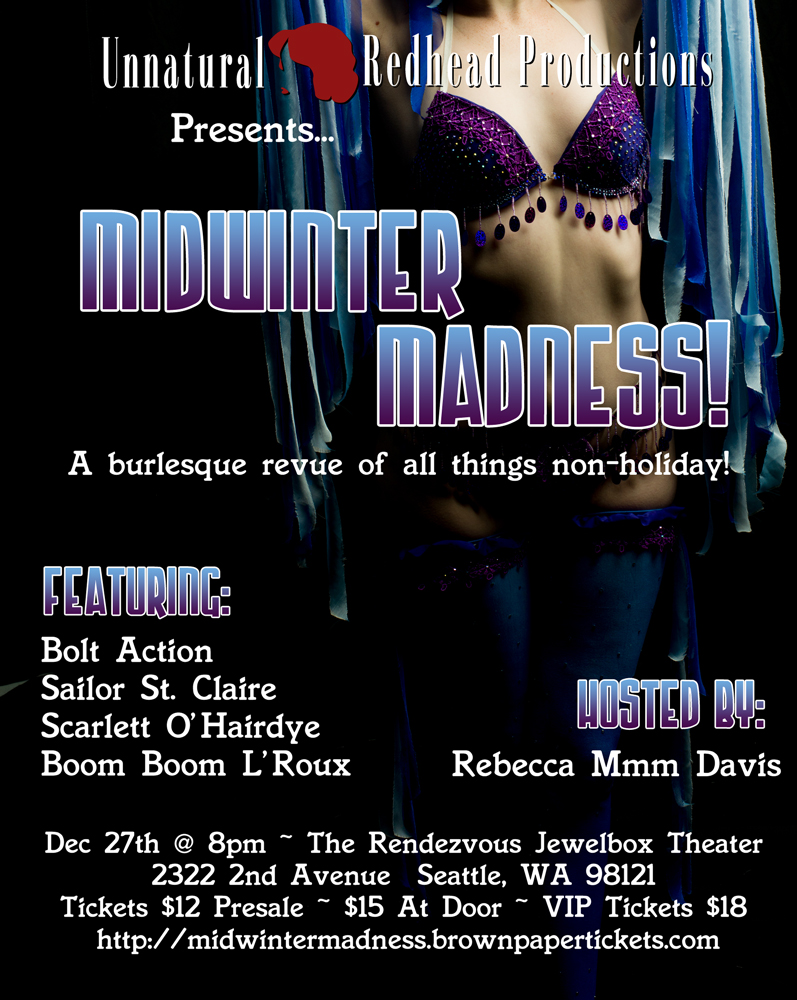
The multi-talented Scarlett O’Hairdye, one of our fantastic illustrators, is putting on a burlesque revue in Seattle to help battle the dark dreary days of a Pacific Northwest winter. Here are the details!


Midwinter Madness Flyer

Unnatural Redhead Productions is proud to present Midwinter Madness! A burlesque revue about all things non-holiday!

Sick of Santa? Weary of wreaths? Tired of tinsel? The antidote is a burlesque revue with nary a carol or fruitcake in sight! The closest this show comes to Christmas is a red sequined dress. The only reminder of winter? A sparkling snowflake. Explore the variety of what Seattle burlesque has to offer in a venue where you can eat, drink and be merry without leaving the theater!

Featuring burlesque performances by:
The Electric Moves of Bolt Action!
The Showgirl Scholar, Sailor St. Claire!
The Superhero of Sparkle, Scarlett O’Hairdye!
The Sound of Freedom, Boom Boom L’Roux!

Hosted by the incomparable Rebecca Mmm Davis!

Sponsored by Wiggle Perfume and Sundries! Wiggle Perfume will be providing scent samples for the VIP bags. VIP bags will also contain homemade cookies and a variety of other goodies.

December 27th
Doors at 7:30pm
Curtain at 8:00pm
The Rendezvous Jewelbox Theater
2322 2nd Avenue Seattle, WA 98121
Tickets $12 Presale ~ $15 At Door ~ VIP Tickets $18
http://midwintermadness.brownpapertickets.com/

Posted in Mad Scientist News | Tagged , | Comments Off on Mad Scientist Produces Burlesque Event

The Dog and the Dinosaur

An essay by Ken Korman, as provided by Adam Rowe
Art by Katie Nyborg


An audio version of this story is available at http://academicemmett.com/1-4-the-dog-and-the-dinosaur/


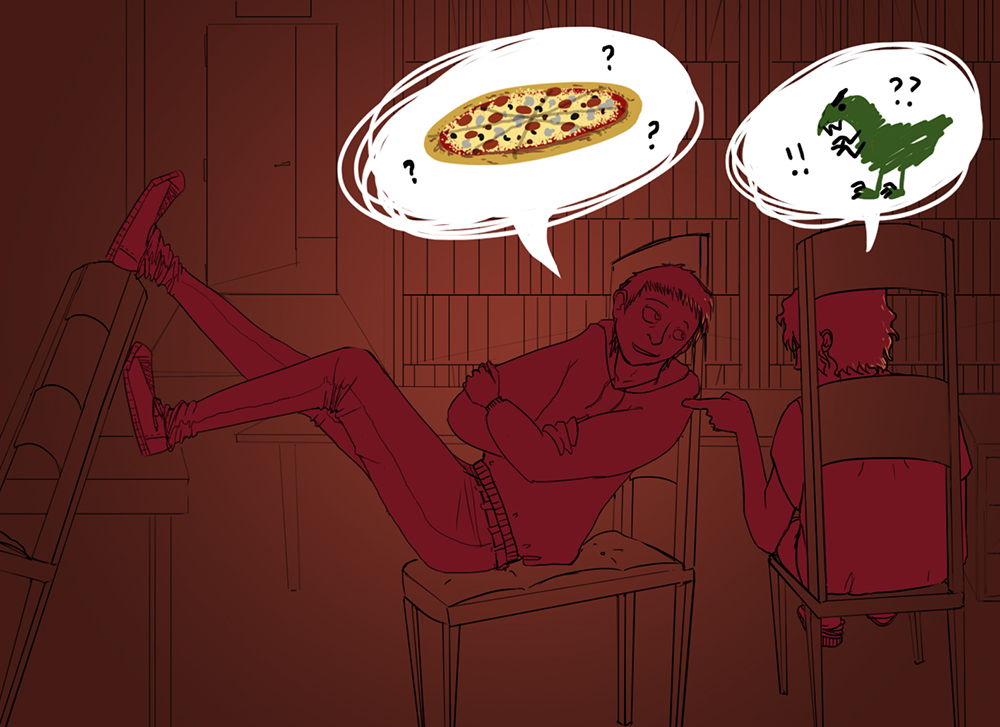
“Do you believe in fortune telling?” Emmett asked me. He was staring thoughtfully up at the ceiling, long legs resting on an equally tall chair back.

“No more than you do,” I told him, “time travel machine aside.”

“Hey, I’ll get that up and running one of these days,” he said with a subdued indignation before returning to his thought: “What if I could predict the future? I’ll bet you a pizza I can tell you who the next person to walk in that door will be.”

I listened for footsteps, but the second floor of the college library was just as quiet as it always was. That wasn’t surprising, as that was the main reason Emmett and I hung out here. The other reason was the free coffee a floor below.

I took the bet. “It’ll be Charlie Becker,” Emmett predicted, “here on an urgent matter. He’ll be frantic.”

No sooner had the word left Emmett’s mouth then sharp footsteps began to sound on the metal staircase. Charlie Becker’s flushed face pushed into view, followed by the rest of him. “Emmett! Are you free?” he said through puffs for air. “I need you right now!”

“I’ll take a large pepperoni,” Emmett said, then, at my eyebrow, “The ceiling light is particularly shiny. I saw his reflection through the window as he walked up to the library.”

“You couldn’t know that he’d talk to you, though.”

“He texted me, too.”

“I’m not paying for that! You said you’d predict it.”

“And I did! I predicted the future based on the available information. I am a scientist, after all.”

Charlie, who had been shuttling his head back and forth as he followed the conversation, gave an exasperated drone, “Guyyys. I said it was important.” Once he had our attention once more, he explained. “I found a dinosaur.”

Our pizza was forgotten. “A … a what? An actual dinosaur?”

The Dog and the Dinosaur

“A … a what? An actual dinosaur?”


To read the rest of this story, check out the Mad Scientist Journal: Autumn 2013 collection.


Ken Korman is best friend to Emmett Barclay, collegiate mad scientist extraordinaire, but is otherwise intelligent. His voice of reason is no match for Emmett’s wild shriek of inanity, but that never stops him from trying.


As a current senior communications and writing major, Adam Rowe was able to base a lot of his tales off of his own college experience, despite the fact that he’s caused considerably fewer chemical explosions. He’s proud to say that he’s proven the existence of just as many missing links as any of his characters. Ken and Emmett’s ongoing adventures are documented as podcasts at AcademicEmmett.com, and Adam can also be found on his blog.


Katie Nyborg’s art, plus information regarding hiring her, can be found at http://katiedoesartthings.tumblr.com/
Posted in Fiction | Tagged , , , , , | Comments Off on The Dog and the Dinosaur

Dying is Easy

An essay by Arthur Weiss, Ph.D., as provided by Franco Raud
Art by Franco Raud


This is what is known.

American Blues guitarist Robert Johnson (1911-1938). Singer of “Hellhound on My Trail,” “Me and the Devil Blues,” and “Cross Road Blues.” Johnson was granted his musical genius through a deal with the devil made at a crossroads outside the minor hamlet of Rosedale, Mississippi (although some musicologists contend that this occurred, conversely, at the crossroads of US Routes 61 and 49 in Clarksdale, Mississippi). The devil appeared to Johnson in the guise of a seven foot tall, jet-black skinned apparition, sometimes purported to have red eyes. In return for his soul, Johnson was given infernal mastery of the guitar and, some will argue, hypno-seductive powers over women. Prior to this incident, Johnson was considered a middling to competent guitarist. Perished after drinking a bottle of poisoned whiskey.

This is also known:

The crossroads at Rosedale had long been the nexus of Satanic goings-on and spontaneous musical ability. The first known Mephistophelean bargain occurred at the site in 1789, before the founding of Rosedale. Since that time, at least thirty-two known musicians have bartered their souls for excessive but short-lived greatness. Guitarists have proven to be the most statistically prominent bargainers, but the devil has also accepted deals with banjo players, fiddlers, pianists, and, in at least one case, an accordionist.

Other musicians of some prominence known to have sold their souls at Rosedale:

Blues guitarist James “Milkcat” Ahers (1911-1954).

Country/Western superstar Freddy Chetson (1947-1976).

Hector Alvarado, guitarist for the speed metal band “Rake’s Progress” (one of several bands known by that name) (1974-1996).

The common formula given for the Rosedale bargain:

The musician waits at the crossroads on the night of a full moon. Musician must have his instrument present. At midnight, the devil appears sitting on a log or stump, or in one account, in the boughs of a cypress tree, formerly unoccupied. Devil appears in the northwest quadrant of the crossroads (northeast quadrant according to historian and ethnographer G. B. Menken (1925-1989)). Devil takes instrument from musician, plays a number of minor chords and phrases (accounts vary), returns instrument to musician. Devil disparages musicians ability, suggests alternate profession, often manual labor. Musician, of own free will, expresses desire to offer soul for musical ability. Devil mocks. Musician persists. Devil makes offer. Verbal contract is sufficient, no documents are signed. Musician experiences three to seven years of musical genius, dies. Known deaths have consisted of poisoning, disease, hanging, choking, consumption, and stabbing to the throat or neck.

Common misconceptions:

Rosedale is not the legendary basis for the song “The Devil Went Down to Georgia” (1979) by The Charlie Daniels Band, which occurred in a different state and involved a different devil. The Rosedale bargain is a straightforward, mutual exchange and is not contingent on the outcome of a contest.

The devil of the Rosedale legend is the amalgam or translation of the Voodoo deity Papa Legba, god of the crossroads. This is not the case. It is the devil.

This is what is known.


Dying is Easy

Figure One


To read the rest of this story, check out the Mad Scientist Journal: Autumn 2013 collection.


Arthur Weiss, Ph.D., (1976 – present) received his doctorate in Comedic Studies from the University of Santa Barbara. His doctoral thesis, “A Day at the Arms Races: The Marx Brothers and the Birth of the Cold War,” will be published in November, 2014 by Mezzinger Press.


Franco Raud (1972 – present) lives in Ploom, Delaware. He has previously had a story, “The Pleasing Shapes,” published in Kasma Magazine and the story “The Pain Engine” published at Drunk Monkeys.

Posted in Fiction | Tagged , , , | Comments Off on Dying is Easy

The Starvation Of Anthony Dargay

An essay by Anthony Dargay PhD, as provided by Ben Revermann
Art by Justine McGreevy


Oct. 28, 2015, Day 8, Anthony Dargay PhD.

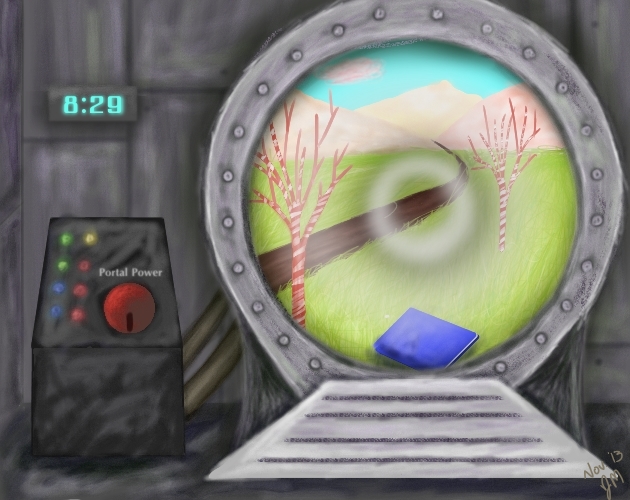
IMPORTANT, DO NOT WALK THROUGH THE PORTAL.

READ THIS BEFORE YOU WALK THROUGH THE PORTAL:

I pray that you see this journal and grab it before walking through. I will leave it right at the foot of the portal so it’s the first thing you see. Khandi, if you’re reading this and I haven’t told you about it then I’m dead. I’ve accepted my fate and know that’s what happened. I’m sorry this didn’t work out but I think once the University finds out what I’ve done, you’ll get the full grant and for a 23 year old, that’s not bad. (Plus maybe they won’t close down our lab.)

You’ll notice above that this is Day 8 for me. To you, if you were on time to work today it will be about 8:00 am on Oct. 20th, 2015. I did the math, and for every minute that passes on your side, 4,320 minutes pass on Candyland side. I also did a number of observations and filled this journal for all seven days prior, but it rained last night and the top pages of the book were ruined and turned to sugar.

The Starvation Of Anthony Dargay

IMPORTANT, DO NOT WALK THROUGH THE PORTAL.


To read the rest of this story, check out the Mad Scientist Journal: Autumn 2013 collection.


Anthony Dargay PHD. Studied and taught at the University of Minnesota, Mankato. His findings helped to further encourage M Theory as well as String Theory. Professor Dargay claimed to have the secret to Inter-dimensional Travel. He has been published in numerous scientific journals. He went missing on October 20th of 2015 along with his assistant Khandi Albright. Attempts by family members to collect his personal belongings from the University of Minnesota have been denied by the US Army with no reason given. A very questionable action.


Ben Revermann lives in southern Minnesota with his wife and children. He is currently working on his Associates degree and will be moving towards his Bachelors degree in English Literature. He has been published a number of times and hopes to one day make his living using the written word.


Justine McGreevy is a slowly recovering perfectionist, writer, and artist. She creates realities to make our own seem slightly less terrifying. Her work can be viewed at http://www.behance.net/Fickle_Muse and you can follow her on Twitter @Fickle_Muse.

Posted in Fiction | Tagged , , , , | 2 Comments