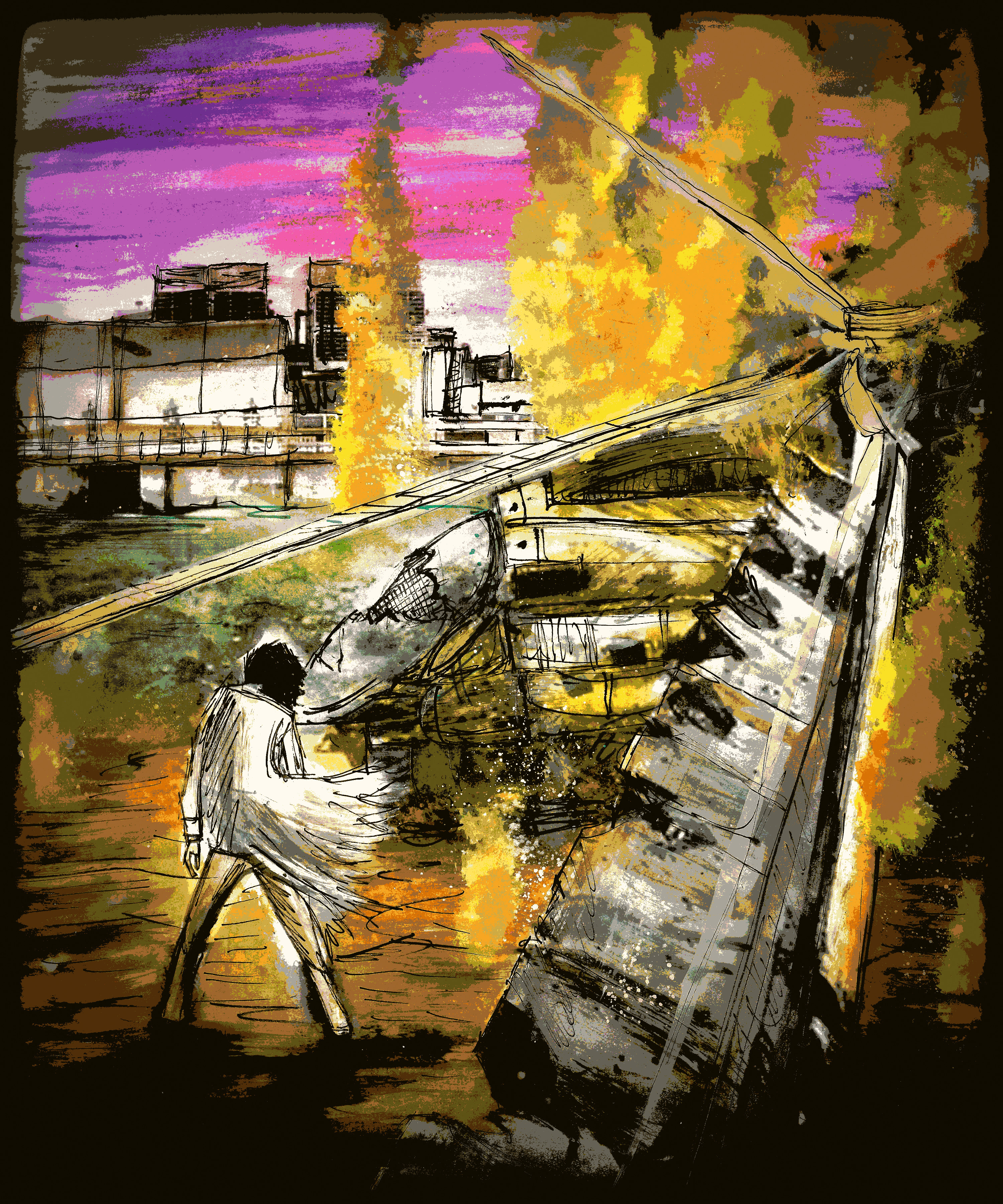
God Lives in My Computer

An essay by Dr. Radical N. Klein, as provided by Peter J. Carter
Art by Leigh Legler


Most people are goddamned pains in the ass. They’re constantly acting with defective intelligence, when not otherwise acting downright criminally apathetic. As if to prove this theorem on a daily basis, when the people in my immediate vicinity aren’t texting, head bent, while walking into the street or reading the newspaper while driving, then they will perhaps get an inkling to mow their lawn at seven o’clock Sunday morning outside my bedroom window.

And no matter what I say or how I say it, they just get angry with me and go on their own blindingly ignorant way. That’s probably why, up until that point, I never had much to do with anyone. I do like other people, but as a concept not as a practice.

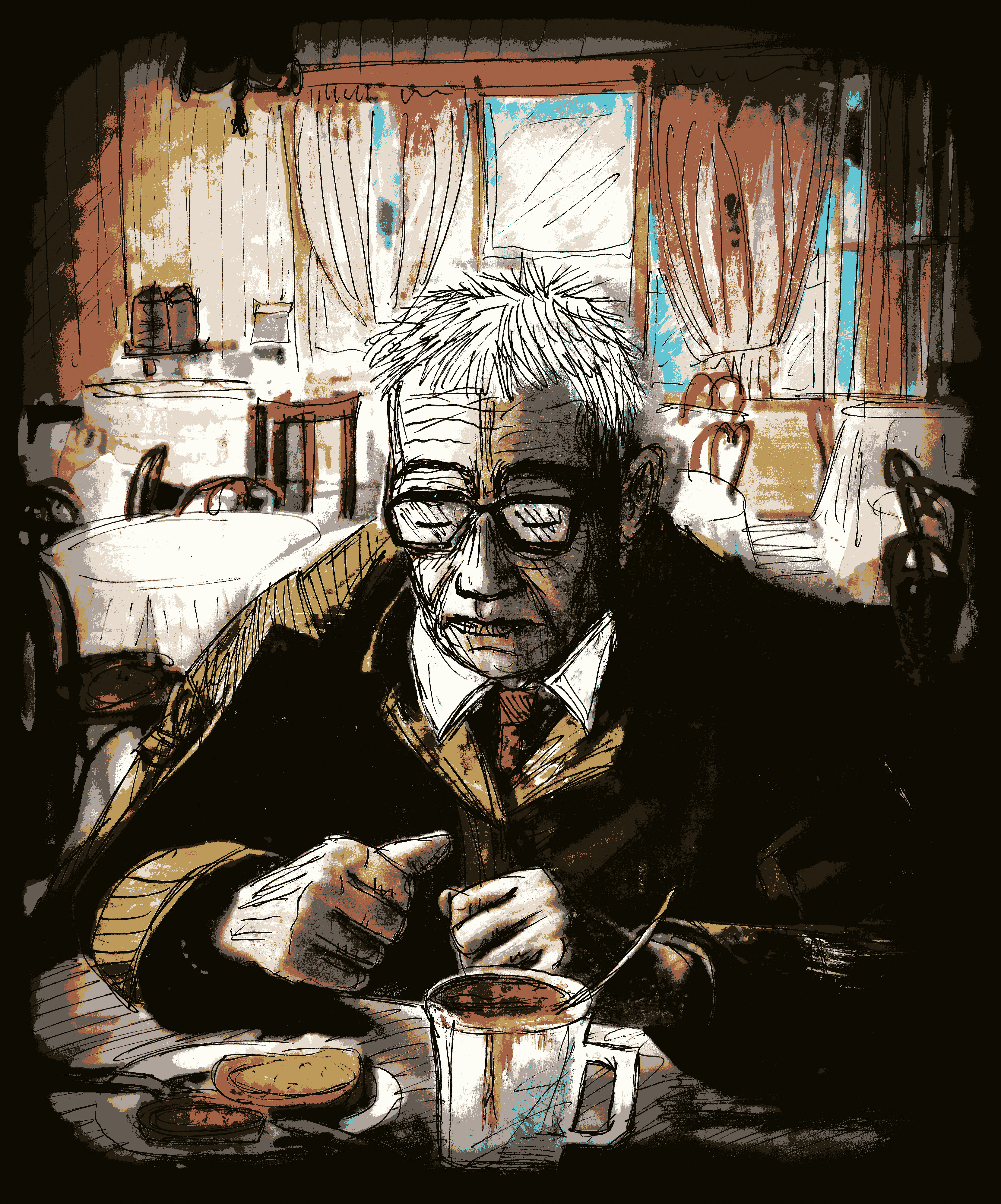
On one particular morning, I sat alone at my usual table at the Good News Diner for breakfast. The restaurant was filled with the regulars that gather there at six o’clock and there’s even a small collection from my place of business. I’d been invited innumerable times to join them, but I preferred to eat alone.

The three people who normally sat at the table were Karen from accounting, who will say, “You know what I mean?” after each spoken sentence even if you try everything to stop her; Jerry from Human Resources, who in addition to having the worst case of cascading dandruff ever known to man, uses the speaker phone constantly and talks only of golf; and Brenda the phone receptionist, who I don’t think has ever listened to a complete sentence from someone else without interrupting while chewing gum with her mouth open.

I have quite enough of that at work without getting it beforehand.

I’d finished my breakfast and was working on my third cup of coffee when a man walked up to my table and looked down at me.

I was deep into an op-ed piece and looked up at him over the top of my paper and said, “Yes?”

He was a diminutive, gray man with just a few hairs left upon his balding pate and those he’d forced into lines to create a horizontal grid work. He wore a blue wind-breaker that seemed fresh off the rack from S-mart and although he wore no glasses, seemed to bring his eyes down into a heavily lidded point just in front of his nose to stare at me.

“I’m Otto Stanislaw, your doctor.” He nodded to the bench opposite to me in my booth.

Although I didn’t recall ever having seen him before, I thought it best to have him sit.

He sat quietly for a few moments, waiting until the words built up and then suddenly releasing them in a torrent like a machine gun, “What do you know about computers?”
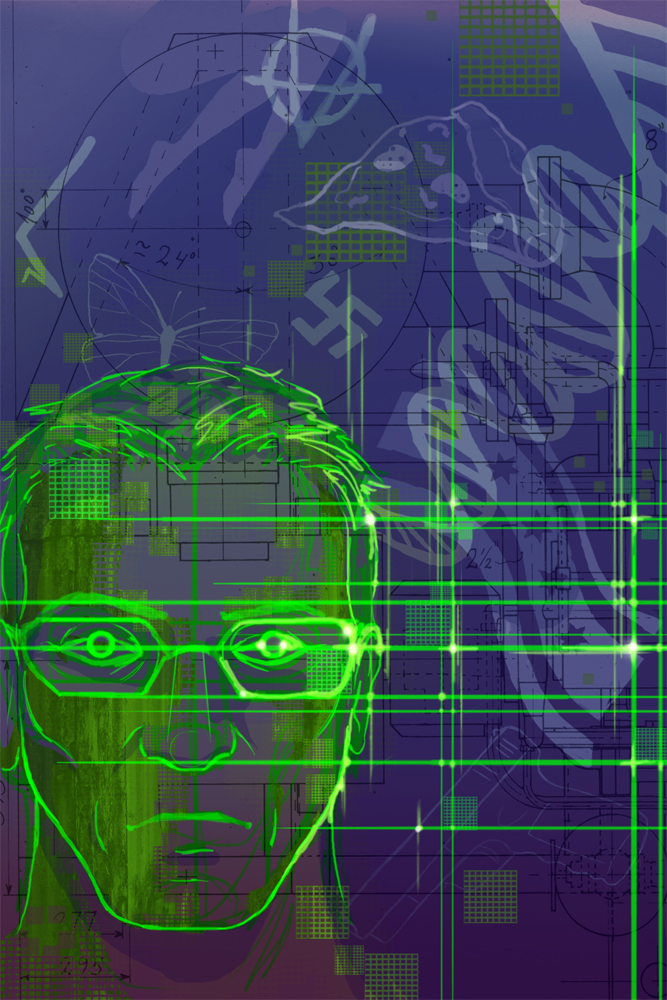
God Lives in My Computer

“I’m afraid you won’t, Mr. Fictive. You don’t really exist.”


To read the rest of this story, check out the Mad Scientist Journal: Autumn 2013 collection.


Dr. Radical N. Klein was born a Mycologist some would say. Fungus grew under his crib in a celebration of his birth to which his mother lamented. His ability to grow any eukaryotic organism allowed his quick rise in the field.

Little did he know, he had been elected Emperor of Fungidom and that’s what gave him this ability. After the Great Mushroom Revolt of 1989, he was overthrown in coop that replaced him with lichen named, “Glort”.

After that any eukaryotic would commit suicide in his presence, which is why he turned to computer science.

His bathroom remains remarkably clean.


Pete Carter lives on Cape Cod where he did most things wrong until he married. After twenty years and two children, he decided he is much happier being right, if only occasionally.

He most often writes short stories and has published with Apocrypha and AbstractionsStatic Movement, Bewildering Stories, Theatre of Decay, Oddville Press, Battered Suitcase, Full of Crow, Ray Gun Revival and Wild Child Press.

While working on a degree in Bio-chemistry, he dropped out of school and became an automotive part’s man; amazed that the two fields were startlingly similar.

He is currently building a time machine with parts found in the trash and currently controls only one clock.


Leigh’s professional title is “illustrator,” but that’s just a nice word for “monster-maker,” in this case. More information about them can be found at http://leighlegler.carbonmade.com/.

Posted in Fiction | Tagged , , , , | Comments Off on God Lives in My Computer

That Man Behind the Curtain: October 2013

A very quick report, as I am hip deep in NaNoWriMo and a bit behind. Because of this yearly quest to compose a novel, we are also a bit behind on our slush. We assure those who have submitted that you have not been forgotten.

The Money Aspect

Amounts in parentheses are losses/expenses.

Hosting: ($17.06)
Stories: ($60.00)
Art: ($182.82)
Advertising: ($5.00)
Paypal Fees: ($7.18)
Donations: $0.00
Ad Revenue: $0.36
Book Sales: $10.73
Total: ($260.97)
QTD: ($260.97)
YTD: ($3,625.92)
All Time: ($6,941.97)

As per usual, I try to list costs for art and stories under the month that the stories run on the site rather than when I pay them. I also cover Paypal expenses when paying authors and artists.

It was what I’ve come to recognize as a fairly typical month. No great shake-ups. No great booms of success.

Submissions

In October we received 5 submissions, of which we accepted 3. This might be our lowest percentage-wise in terms of acceptance, an easily calculated 60% acceptance for the month. Our all-time acceptance rate is 55.59%.

This gives us enough content for the site through the end of January 2013.

Traffic

October represented another drop in traffic. We had a total of 884 visits, another drop from our low September numbers. Our traffic consisted of 570  unique visitors and 2,039 page views. Our highest daily traffic was 65 visits, which was the day we launched the serial.

October’s search engine terms are also lean pickings. I’m going to nominate “essay about bright smile,bright future.” Because I have no idea what that means.

That’s all I’ve got to say for now.

Posted in Administrative, Man Behind the Curtain | Tagged | 1 Comment

In The Absence of Emotion

Editorial: Investigations of Neural Imagining and Surgical Removal of Emotional Cortexes

Edward P. Muinn1, David G. Bolls,1 Felicity I. Killian1,2 and Diana Rohlman3

1Department of Neurology and Neurosurgery, 2Department of Radiology, 3Groom Lake Publishing Services, Groom Lake, Nevada, United States of America

Corresponding author: Felicity I. Killian, killianf@groomlakelab.edu

Felicity I. Killian received her Bachelors of Science degree in 1984 at the University of Pennsylvania, followed by her PhD at Stanford with dual majors in neurology and radiation. After five years in research, she received her medical degree from Brown University. In the past ten years she pioneered the surgical removal of emotional cortexes. This technique has successfully treated severe depression, schizophrenia and intermittent explosive disorder. Most recently it was exploited for a different purpose. The following article is published as presented by the underwriting author, Diana Rohlman (Groom Lake Publishing Services).

#

I began as a naïve, impetuous research doctor, convinced that I would make the world a better place than the one I entered thirty years ago. I was full of the dewy-eyed ambition that I now gleefully mock when I see it in the faces of new interns. Once, I too was hopelessly confident that I could make a difference. I can’t be too bitter; my work greatly advanced the field of mental health treatment, and for that I am profoundly grateful. But humans have an all-encompassing need to pervert that which is good and turn it to a darker purpose for which it was never designed. If you could remove the melancholy from a man, could you not also remove his happiness, his joy, his fear, his capacity to love, to hate, to empathize?

Such drastic and abhorrent thoughts never entered my optimistic mind. I wanted only to help, to create. Such work was the antithesis of all that I strove for. My work was designed to treat serious medical conditions, not to create human shells that would function in a perfect vacuum of emotion.

But once the thought had been presented, once my research was published and publicly available, it was only a matter of time. A person incapable of emotion, incapable of second-guessing orders–certain individuals and governments thrilled to the concept. Caught up in my academic bubble, religiously pursuing answers to scientific endeavors, I allowed myself to participate in the first trial of Neuronal Excision (NE).

Simply speaking, a patient is systematically stripped of all ability to experience emotion.

As a scientist, I cannot allow my emotions to influence my experiments or my results. But I am ethically and morally bound to consider the implications of my work. As a scientist, I am accustomed to writing my results in the dry, clinical rhetoric of my discipline. For the first time, I am leaving the safety of impartial words and didactic writing behind, to convey, not preach, the dangers of this new technique. By compiling the lab notes and surgical notes from that fateful surgery, we have constructed the full story of that day.


In the Absence of Emotions

“She’s so young,” he murmured, looking at the tangled mass of nerves and tissue that comprised the girl’s brain, but seeing instead the ramifications of our work.


To read the rest of this story, check out the Mad Scientist Journal: Autumn 2013 collection.


Diana lives in the Pacific Northwest. She recently received her PhD in Toxicology from Oregon State University. She has been writing fiction since the age of fourteen. When not writing, she’s creating fun new ways to teach science, including using candy to teach the concepts of mass spectrometry.


Dawn Vogel has been published as a short fiction author and an editor of both fiction and non-fiction. Although art is not her strongest suit, she’s happy to contribute occasional art to Mad Scientist Journal. By day, she edits reports for and manages an office of historians and archaeologists. In her alleged spare time, she runs a craft business and tries to find time for writing. She lives in Seattle with her awesome husband (and fellow author), Jeremy Zimmerman, and their herd of cats. For more of Dawn’s work visit http://historythatneverwas.com/

Posted in Fiction | Tagged , , , , | Comments Off on In The Absence of Emotion

Damned Souls and Statistics

An essay by Allison Merton, as provided by Robert Dawson
Art by Scarlett O’Hairdye


“But Pascal expected a reward of infinite value. Do you?”

His eyes, shadowy as a charcoal drawing, fixed me. His face was bleak and gray, his voice was flat and emotionless, and his dark suit looked as if it had been washed slightly too hot. No cloven hooves or scent of brimstone, but, very deep inside, I already suspected who he was.

I stared at my drink, then tried to look away, to find a familiar face in the Faculty Pub. But somehow, that Friday, in a crowded room full of colleagues, I could find nobody to rescue me from this interrogation. Backs were turned, faces invisible behind the dark square wooden pillars that broke up the room. I recognized a few faces, but could not put names to them. I realized how rarely I had come here, in my five years teaching at Greenwald. My eyes were drawn back to his.

“No, I don’t.” Through a gap between the long curtains I could see the warm tangerine light of the October sunset. It should have been a simple matter to excuse myself and walk out of the building. But the reason for walking out was one my modern mind would not put into words; so I stood there, at one end of the bar, my back to the wall, like a deer in a car’s headlights.

“You say that you’re a statistician.” The voice stayed flat. “You teach probability theory.”

Somehow I was on the defensive again. I tried to stick to the facts. “Yes, I have a PhD in statistics.”

He said nothing, but I felt as if, somewhere inside my head, a trap had been sprung. My mind flooded with shame-filled memories of my thesis defense. Partway through, somebody had asked me to explain the derivation of a formula. I started to explain: the transformation, the differentiation under the integral sign. With my mouth dry, I mentioned the convergence criteria that made it work, a detail I’d omitted in the thesis. Then the creeping terror began. Those convergence criteria were met there all right; but I’d used the same technique in another derivation, late in the second chapter. I was sure I had not checked convergence there either. With a dreadful cold certainty, I realized that I could not guarantee more than local conditional convergence for that class of distributions.

The proof did not work. In a moment one of the examiners would bring it up. For half an hour I died there. Finally the ordeal ended. They hadn’t found me out.

It was six months before I dared to look at my thesis. By then I had taken my degree (in absentia, to my parents’ distress), and had been promised a job. On review, I realized that the error was minor, and could be repaired with another page of work. But my joy in my new doctorate had never been whole and never would be.

Damned Souls and Statistics

Like a typical client, he didn’t volunteer an explanation. Good–maybe I’d get away with this.


To read the rest of this story, check out the Mad Scientist Journal: Autumn 2013 collection.


Allison Merton has a PhD in statistics from Midnorthern University. Her thesis, still unpublished, is on transformation techniques in Bayesian statistics. She teaches at the Department of Statistics of Greenwald, where she received tenure last year. She prefers not to do consulting work, and keeps meaning to set up a personal web page.


Robert Dawson has a PhD in mathematics from the University of Cambridge. Parts of his thesis have been published and possibly even read. He teaches at the Department of Mathematics and Computing Science at Saint Mary’s University (the Nova Scotian one), and writes science fiction in between times.  His web page is at http://cs.smu.ca/~dawson/Writing.


Scarlett O’Hairdye is a burlesque performer, producer and artist. To learn more, visit her site at www.scarlettohairdye.com.


This story originally appeared in LabLit in 2011.

Posted in Fiction | Tagged , , , , , | Comments Off on Damned Souls and Statistics

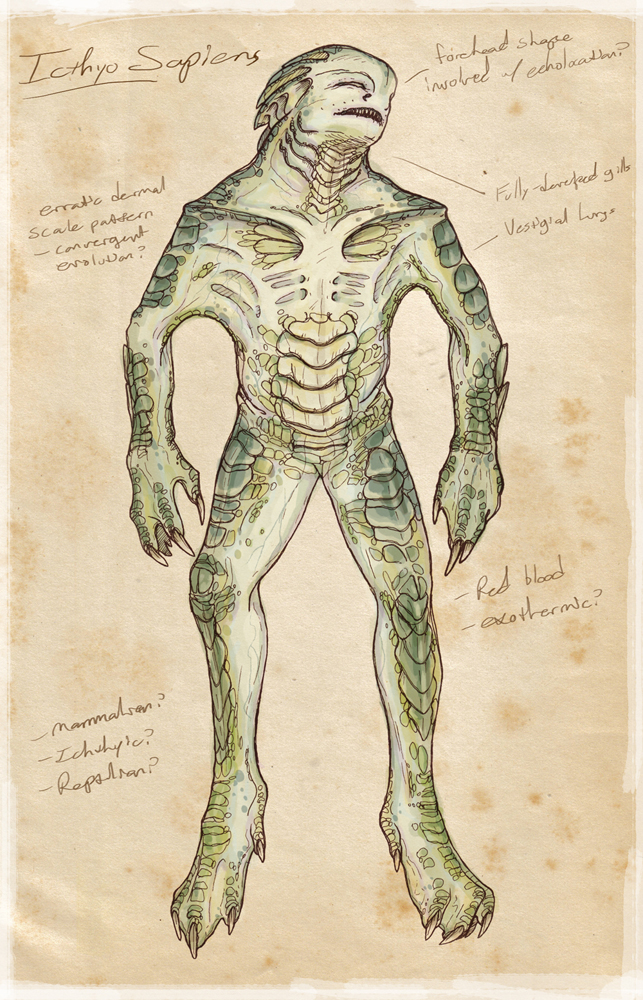
On the Methods of Preserving and Dissecting Icthyo Sapiens

An essay by Dr. Stephen Mackle, as provided by Carrie Cuinn
Art by Leigh Legler


Lab Notes, April 23, 1931. The subject has four limbs, but while its skin appears crocodilian, the limbs are not fixed under the body. Instead they appear to be jointed much as a man’s are, with longer back legs and a wide range of motion in the shorter front legs.

Water is everywhere. It is, always, since the earliest memories of my life. I feel it as a warm pressure on every part of my skin. It is an ever-moving source of air for my lungs and food for my belly. When the currents are strong it becomes thick enough to sit on, to grab a hold of and ride. The water is never still because it is never empty. I can taste the time of day.

Though it has a mouth and front facing eyes, it does not appear to breathe air, and instead has several gills hidden under heavy scales on its neck which are easy to miss. Kudos to Johnson for noticing them, or the thing might have drowned before we got its head and neck into a bucket of water.

I was born there, where the river flows into the deep lake. I have traveled upriver to mate, have seen water muddied by great hippos and in places a river lowered by heat and summer sun. I have crawled along the nearly empty river bed, me, who was born in a place so deep no light can penetrate it! I have seen all manner of fish and monsters and men. Everything has a place in the world, everything fits into each other and makes sense, except the men.

On the Methods of Preserving and Dissecting Icthyo Sapiens

I bring her eggs back with me when I return to my lake. She is perfect in her beauty, with strong limbs and bright eyes and her children will be safe with me.


To read the rest of this story, check out the Mad Scientist Journal: Autumn 2013 collection.


Dr. Stephen Mackle holds a Doctor of Science degree in Aquatic Biology from Cleveland College, and a Doctor of Agronomy degree from the Yerevan Veterinary Zootechnical Institute. He briefly taught at Huron Street Hospital College before leaving to pursue other research opportunities. He considers the study of Icthyo Sapiens and other aquatic cryptids to be his life’s work.


Carrie Cuinn is an author, editor, bibliophile, modernist, and geek. In her spare time she reads, draws, makes things, takes other things apart, and sometimes publishes books. You can find her on Twitter @CarrieCuinn. Links to her published work, as well as her writing blog, can be found at www.carriecuinn.com


Leigh’s professional title is “illustrator,” but that’s just a nice word for “monster-maker,” in this case. More information about them can be found at http://leighlegler.carbonmade.com/.


This story originally appeared in the anthology Monster Gallery.

Posted in Fiction | Tagged , , , , | Comments Off on On the Methods of Preserving and Dissecting Icthyo Sapiens

The Nature of Sin

An essay by Dr. Mark Mathis, as provided by Jeffrey Wooten
Art by Luke Spooner


On the first plane I sat by a young lady that could have passed for the granddaughter I never had. She was excited; it was her first trip to Europe. She asked me what I did for a living and I told her. “Perfume salesman.”

She laughed and didn’t believe me, so I reached into my briefcase and pulled out a small vial–one of seven that I’d carefully hidden–and gently I removed the rubber stopper. “Smell,” I said with a smile.

She spent several seconds trying to catch the scent from the caramel colored liquid in the glass tube but finally gave up. We didn’t talk much after that.

I stayed in London, Paris, Madrid, Istanbul, Tel Aviv, and Bangladesh. I used all my wealth, which was small, and all my credit, which was large, and I traveled the globe. I invited as many people as possible to smell my perfume. None of them could, and for good reason.

The Nature of Sin

The big reveal is here at last.


To read the rest of this story, check out the Mad Scientist Journal: Autumn 2013 collection.


Dr. Mark Mathis MD, MPH, was a researcher at the National Center for Emerging and Zoonotic Infectious Diseases (NCEZID). Dr. Mathis joined the CDC in 1980 shortly after graduating from the University of Maryland. He made numerous contributions during his three decades as a researcher, his main focus involving viral epidemiology.

Dr. Mathis left the CDC in early 2013 citing health issues. In July 2013 Dr. Mathis was reported missing. If you have any information regarding his whereabouts you are urged to contact the FBI.


Jeffrey Wooten lives in the southern United States with his wife and children. His work has appeared both in print and that magical space between computers known as the internet.


Luke Spooner a.k.a. ‘Carrion House’ currently lives and works in the South of England. Having recently graduated from the University of Portsmouth with a first class degree he is now a full time illustrator for just about any project that piques his interest. Despite regular forays into children’s books and fairy tales his true love lies in anything macabre, melancholy or dark in nature and essence. He believes that the job of putting someone else’s words into a visual form, to accompany and support their text, is a massive responsibility as well as being something he truly treasures. You can visit his web site at www.carrionhouse.com.

Posted in Fiction | Tagged , , , , | Comments Off on The Nature of Sin

The Beginning Botanist’s Guide to Lair Defense

An essay by Lady Jelique D’Avern, as provided by John A. McColley
Art by Dawn Vogel


The below information represents years of research into the field of cryptobotany, including active experimentation and cultivation. I present an offering to fellow scientists who find themselves oft disturbed from their own projects by the interloping of dull-witted adventurers. Rebuff those seeking to thwart the summoning of this otherworldly being or completion of that behemoth steam-powered village flattener! Such invaders may be put off by rows or patches of the below plants, all of which are available from my personal growing houses for barter or coin of the realm, by individual negotiation.

This beginner’s list is meant to accommodate even the blackest of thumbs and introduce this meditative and useful pastime to those interested in the fields of cryptobotany. If this opening treatise is successful, lists for experienced and expert botanists will be forthcoming.

#

Devil’s Thumb aka Scorpion Weed
Digitus diabolicus

Aspect: Clustered, dark green leaves alternate around the base of one to four stems. The stem itself is green to brown to varying heights, curled tightly at the end, not unlike fern fiddleheads, though possessing a hidden sting at the terminus. Flowers are rare, but range from yellow to white radially arranged narrow petals. They grow from specialized stalks and form hard, hook-covered seed pods.

Habitat: I first learned of this hardy little darling while searching for manticores to hire as guards for a desert encampment to research my now famous sand animation charms. In the craggy hills at the southern edge of the Jurai Desert, not far from the sandstone pits, D. diabolicus grows in small clusters anywhere it’s not overshadowed by rock formations or other plants.

Efficacy: The uses here are obvious: along a path, amid low grasses, D. diabolicus lays in wait until it senses motion and lashes out, delivering a venomous sting which is particularly damaging to horses, but works quite well to paralyze local muscle groups in any mammals, slowing their gaits to one quarter their normal speed. This leaves them easy picking for any minions or other plants on this list.

Care: Being of desert climes, these plants like as much direct sunlight as possible, but take very little effort. Place them in the proper sandy to rocky soil and keep them from getting too much water, and they will survive for years, producing new plants wherever their victims fall, thus fertilizing themselves and increasing their population. They initially root in the bodies themselves, though, so if one is worried about spreading to unwanted areas, merely have your minions drag the corpses to a more desirable location.

Dangers: Besides the obvious of utilizing minions with thick hides or armor to move, prune, and otherwise tend D. diabolicus, there are no immediate dangers. Their effects are very localized and as stated above, their spread is easily controlled. They do not produce pollen to irritate the eyes or nose, nor do they migrate.

Other Uses: Venom may be collected weekly from any particular plant without putting too much stress on it. The venom may be kept for up to a week before it loses significant efficacy, and therefore can be used on minions’ arrows, spears, or any kind of spiked or bladed weapon.

Deactivation: One often finds it necessary to render a trap or defender inert for a time in order to access a lair, retrieve a treasure, or as stated above, “milk” venom from their garden defenders for other uses. In this case, D. diabolicus will be distracted by water introduced into the soil around it or on its surface. As a desert survival mechanism, it has small vesicles along its roots into which it will draw said water and while it is occupied with this task, one might bypass it. Plants are not by and large very intelligent and can only do one thing at a time.

The Beginning Botanist's Guide to Lair Defense

This beginner’s list is meant to accommodate even the blackest of thumbs and introduce this meditative and useful pastime to those interested in the fields of cryptobotany. If this opening treatise is successful, lists for experienced and expert botanists will be forthcoming.


To read the rest of this story, check out the Mad Scientist Journal: Autumn 2013 collection.


Jelique D’Avern is an avid traveler. Her journeys have led her to discover a dozen plants species and pen four volumes of herbological lore. While at home, she tends her magnificent gardens, gathering magical components from many of the plants for herbalchemy experiments. She also collaborates with her husband, Count Havol D’Avern, in his development of new mechamagical devices in their lovely vintage castle on a rise overlooking the Wens River and the hamlet of Byfor.


John A. McColley lives in a vortex of worlds, characters, machines and language, constantly dragging images and forms out of the storm onto canvas, paper or computer screen to share them with others and give them new life. When not wrestling with words, he cranks dials and makes sparks at his local hackerspaces and searches the wilds of New Hampshire for semi-precious stones with his fiancée. For more info, check out his author page on Facebook: http://www.facebook.com/pages/John-A-McColley/105420682981117 and a blog http://johnamccolley.wordpress.com/


Dawn Vogel has been published as a short fiction author and an editor of both fiction and non-fiction. Although art is not her strongest suit, she’s happy to contribute occasional art to Mad Scientist Journal. By day, she edits reports for and manages an office of historians and archaeologists. In her alleged spare time, she runs a craft business and tries to find time for writing. She lives in Seattle with her awesome husband (and fellow author), Jeremy Zimmerman, and their herd of cats. For more of Dawn’s work visit http://historythatneverwas.com/

Posted in Fiction | Tagged , , , , , | Comments Off on The Beginning Botanist’s Guide to Lair Defense

That Man Behind the Curtain: September 2013

It’s that dark time of the month when we lay bare our digits.

The Money Aspect

Amounts in parentheses are losses/expenses.

Hosting: ($17.06)
Stories: ($325.00)
Art: ($250.00)
Advertising: ($51.02)
Paypal Fees: ($15.20)
Donations: $0.00
Ad Revenue: $0.46
Book Sales: $14.29
Total: ($643.53)
QTD: ($1,229.24)
YTD: ($3,364.95)
All Time: ($6,681.00)

As per usual, I try to list costs for art and stories under the month that the stories run on the site rather than when I pay them. I also cover Paypal expenses when paying authors and artists.

This month was a bit steeper than usual. A bit more art than we’ve been buying. The serial cost a bit more than our usual collection of exclusives. Plus we bought enough exclusives for the next two collections. I bought ad space in the program for a burlesque show, as one does. (Boobs and the Bard: A Shakespeare Burlesque, produced by one of our regular illustrators, Scarlett O’Hairdye.) It was our most expensive month to date. Since previously we’ve been scraping by with getting exclusive content for our collections, it didn’t matter as much to try and put the cost in context like I do with the stories posted to the site. I just didn’t have the notation to record nine months worth of big purchases all done in one month.

On the flip side, it was our highest month for book sales to date. It in no way offset the costs, but it was nice to see Amazon tell me we made double-digits.

As an amusing aside: I was utterly thwarted in my attempt to promote the first part of the serial. I thought, “I’ll go big. Drop $30 to “promote a post” on Facebook. And then the ad stopped running after 50 cents. I couldn’t unpause it or anything. It was just done. All I could do was add more money. So I did. And then it ground to a halt. I wrassled with customer service, first in attempting to even find a way to contact them and then trying to convey my problem.

Their answer was, “Well, there just aren’t enough people to advertise to.” Which is not something I’ve encountered before or since. So despite trying to spend $50 advertising the first part of the serial, I only spent $1.02.

Submissions

In September  we received 6 submissions, of which we accepted 2. This might be our lowest percentage-wise in terms of acceptance, 33.3%. But our all-time acceptance rate is still above 50%. 55.52%, to be precise.

This gives us enough content for the site through mid-January 2013.

Traffic

September dropped sharply in terms of traffic, despite the serial we ran. We had a total of 1,060 visits, two-thirds of August’s numbers. Our traffic consisted of 661  unique visitors and 2,231 page views. Our highest daily traffic was 74 visits, which was the day we launched the serial. As best I can tell, just less of our readership was clicking through: Traffic from Facebook, Twitter, and StumbleUpon all went down, even though we had more content. Was the increase in content too annoying? Or was it just a bad month for The World? I don’t know. I could speculate endlessly.

September’s search engine term for the month is “what were elephants like before evaporation.” Which is a good question. What were they like? Will the world ever truly know?

That’s all I’ve got for this month. Tip your waitstaff.

Posted in Administrative, Man Behind the Curtain | Tagged , | Comments Off on That Man Behind the Curtain: September 2013

Monsters Behind the Scenes

An essay by Melinda Myers, as provided by Kate Elizabeth
Art by Justine McGreevy


We humans are bombarded on a daily basis from telemarketers, door-to-door sales men, infomercials, advertisements … the list goes on. Tempting us to spend more money, change our electricity providers, get rich quick, and lose weight fast. But behind these companies and charities there is a hidden, supernatural, agenda. As consumers, we have the right to know the truth about these products and services. This report details the most common monsters behind the scenes of some of the world’s largest and most profitable business ventures.


Angels:

In today’s society, organised religion is fading fast, with many people feeling unaffiliated with any of the religious denominations. As a result, there has been a steady increase in the number of non-believers, atheist or agnostic, every year. It is no wonder then that counter to this, there has been an increase in the number of door knocking evangelists. Angels are descending from the heavens in unprecedented numbers, going door-to-door spreading the word of God in all of his/her many forms. However, studies have shown that when religions fade, so too does their power (refer to ‘Deposed Gods’). Angels preaching the word of God is clearly a last-ditch effort to maintain their stranglehold over humanity. Without the power of human belief, angels would cease to exist. As a species, we humans should consider such narcissistic behaviour with a certain amount of suspicion.


Demons:

There has been a sharp increase in door-to-door salesmen in recent years, promising a better deal on your gas and electricity bills if you swap providers. Sometimes they will sweeten the deal by getting you to sign up on the spot and go into the draw to win a dream holiday or new sports car. All you have to do is sign on the dotted line. Of those unsuspecting new clients, how many have taken the time to read the fine print–pages of small font that practically require a magnifying glass to read and a law degree to understand? You might just be getting more than you bargained for–as they say, ‘the devil is in the details’–in this case, literally. Gas and electricity companies desperate for your business have partnered up with the devil to improve sales. The company gets free ‘man’ power and increase their cliental, the devil gets your soul and you get to save 10% on your energy costs. Oh, and don’t forget that dream vacation in Hell.


Monsters Behind the Scenes

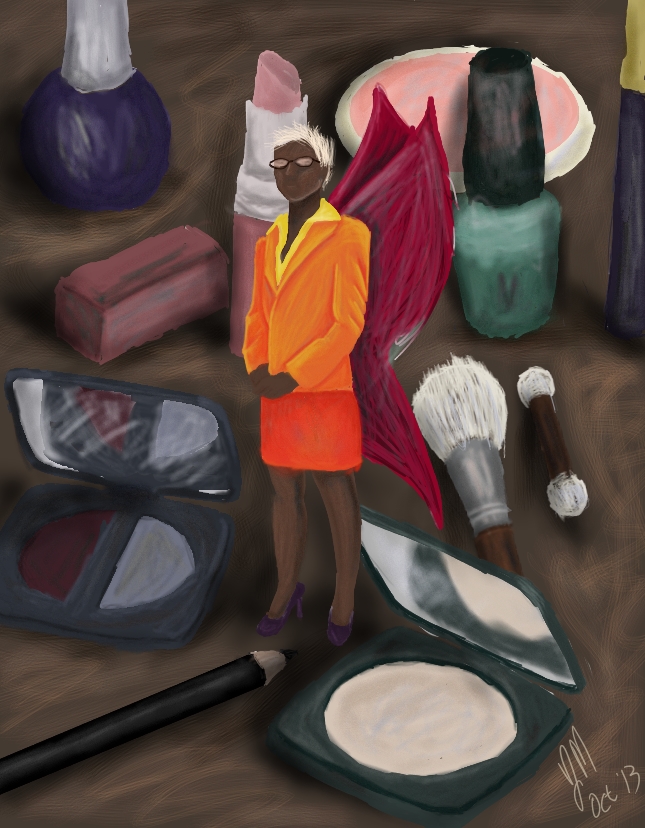
These little winged creatures have a strong affinity with the natural world. So it is no surprise that they would turn to business endeavours that promote natural and/or organic products.


To read the rest of this story, check out the Mad Scientist Journal: Autumn 2013 collection.


Melinda Myers is the co-founder of Human Rights First, a non-profit organisation fighting for human rights in a world increasingly populated by supernatural entities.


Kate Elizabeth lives in Melbourne Australia and enjoys writing stories whenever she has ‘free’ time.


Justine McGreevy is a slowly recovering perfectionist, writer, and artist. She creates realities to make our own seem slightly less terrifying. Her work can be viewed at http://www.behance.net/Fickle_Muse and you can follow her on Twitter @Fickle_Muse.

Posted in Fiction | Tagged , , , , , | Comments Off on Monsters Behind the Scenes

On Dosing the Water Supply with a High Powered Mind Control Mutagen

An essay by Dr. Zora Next, as delivered to the Press by Brandon Miller
Art by Luke Spooner


Dear My Concerned Public:

I want to take this opportunity to clear up the misconceptions about the events of April 20, 2013, at the Carson City water reservoir. My former assistant, Gregory, has been telling his side of the story to every National News Agency, as well as to several nasty authoritarian groups. They are now hunting me down as though I were a rabid dog. As if they could actually catch me. I can’t wait to see the look on Gregory’s face when he finally comes to his senses, and comes crawling back to me.

Anyway, his story is a mostly accurate account of that night’s events. His perspective, however, which is riding across the broadcast waves, is a bit skewed. I just don’t want any of you to get the wrong idea. First, and perhaps most inaccurate, is his general description of me. I believe he has been throwing about the term, “Psychopathic Lunatic.” Nothing could be further from the truth. I am merely a convicted, passionate, ambitious, beautiful, dreamer. Since the mad scientist community has been using such scandalous remarks against me for years, using such terms for my personage strikes a heavy blow to a very sensitive place. Really, it’s all so unfair, but I am very forgiving. I take Gregory’s betrayal to be a loss of heart, a result of the lingering sickness that exists as a terrible plague in our world. The very one hindering human advancement.

Truth be told, I feel sorry for him. This sickness is the cause of so much suffering. I have done my best to help abate the symptoms, but the disease is strong. It is very hard to cure on my lonesome because so many have it. The sickness is the state of mind that leaves people with such fear in their hearts. Fear of change. Fear of the leaping advances in technology. Fear of the coming triumph of Science. The sickness takes many forms, but it is behind both Gregory’s betrayal and the man hunt the C.I.A. is currently undertaking. You know the one–looking for little old me.

On Dosing the Water Supply with a High Powered Mind Control Mutagen

Needless to say, the landing of the helicopter on the waterfront wasn’t as graceful as the take-off from the military base from which we acquired it.


To read the rest of this story, check out the Mad Scientist Journal: Autumn 2013 collection.


Doctor Zora Next does not hold an actual PhD of any sort as any attempt to conform to scholastic standards would be a waste of her time. The reason for this being that she is simply smarter then everyone else and as such the normal rules do not apply to her. She spends her time taking science to places that previously belonged only to the domain of gods and roaming about America avoiding the police.


Brandon Miller is a young American fiction writer who has had a wide variety of jobs and experiences. He finds purpose and joy in his life in two places, the interesting people he has known, and whatever he is writing about at the time. He hopes to have a future somewhere in a creative art form.


Luke Spooner a.k.a. ‘Carrion House’ currently lives and works in the South of England. Having recently graduated from the University of Portsmouth with a first class degree he is now a full time illustrator for just about any project that piques his interest. Despite regular forays into children’s books and fairy tales his true love lies in anything macabre, melancholy or dark in nature and essence. He believes that the job of putting someone else’s words into a visual form, to accompany and support their text, is a massive responsibility as well as being something he truly treasures. You can visit his web site at www.carrionhouse.com.

Posted in Fiction | Tagged , , , , | 1 Comment