July was a relatively quiet month for us. We were closed to submissions and we didn’t advertise as much, so things slumped off a little. Here’s the numbers.
Archives
Categories
-
July was a relatively quiet month for us. We were closed to submissions and we didn’t advertise as much, so things slumped off a little. Here’s the numbers.
Two of Mad Scientist Journal’s artists, Leigh Legler and Dawn Vogel, will have pieces in an art show that opens on Thursday, August 21st, in the Seattle area. The show is called Tiny Tales and Small Stories, and the artists were asked to make a piece of art that was smaller than 6 inches in any direction, and write a story of 200 words or less that went with the piece. Both Leigh and Dawn decided on 3-D pieces–Leigh’s is a sculpture and Dawn’s is a crocheted diorama/playset.
The show is at Stunningly Strange Gallery (407 Main Street, Edmonds, WA, 98020). If you’re in the Seattle area, you can come to the opening, from 5 p.m.-8 p.m. on the 21st. If you can’t make it that night, everything will remain up through September 17th, so you can check the pieces out when you get a chance! Their pieces, along with the other artists’ pieces, will be up for sale at the gallery for those four weeks.
An essay by Desmond Ashmore, as provided by James Hanson
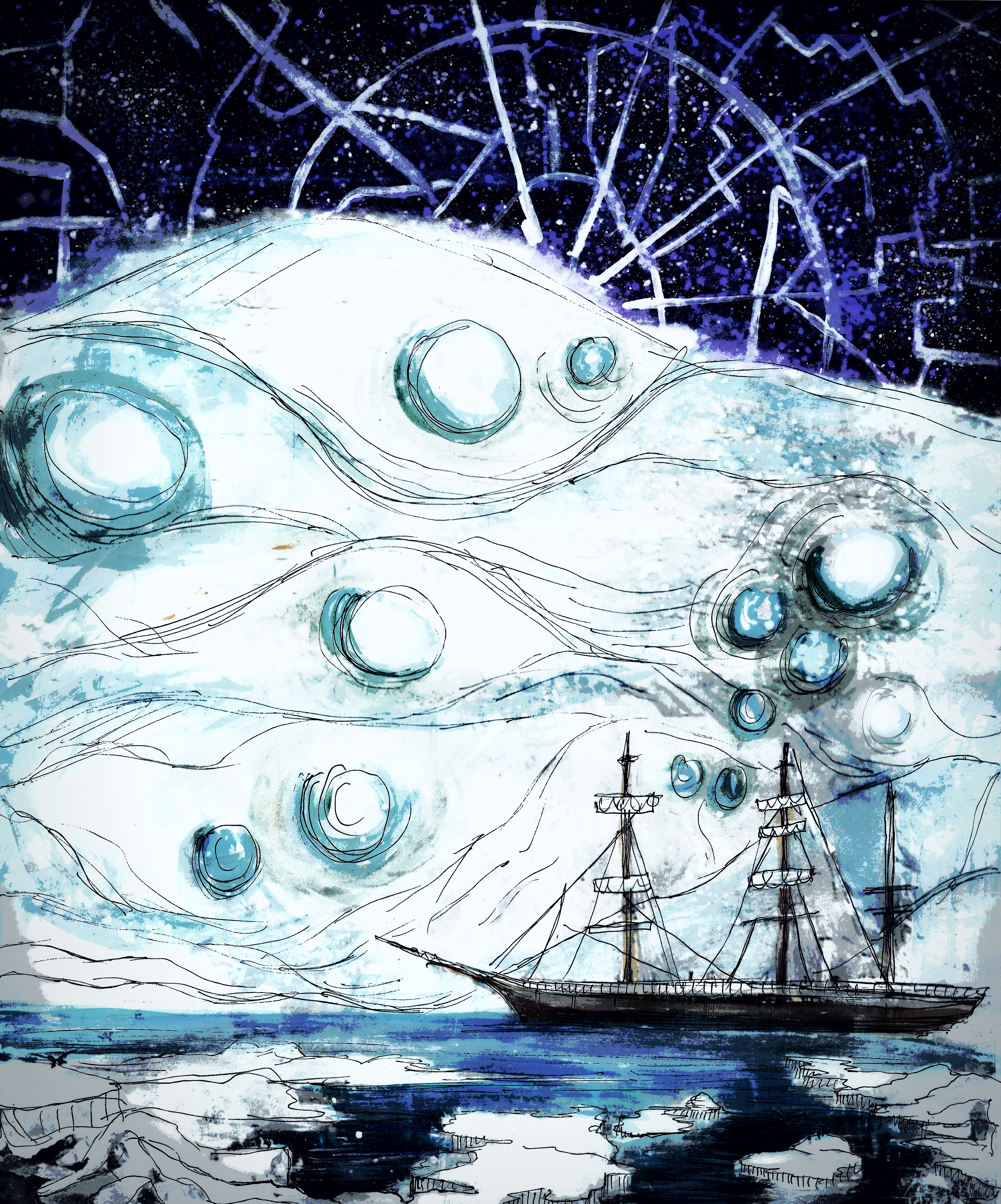
Art by Luke Spooner
May 25th, 1863
I have been vindicated by my machine, which was unfortunately audible for the better part of three days and required constant attendance. My groundskeeper and I alternated in two hour shifts of stoking the machine’s fire and replenishing its oil when necessary. If the torque from the pistons drops too low, some of the more delicate gears can seize up and crack, ruining both the calculation and the machine itself. There is a governor that is intended to halt the operation of the machine before this happens, but it is unwise to trust it, since the better part of the engineering in this machine has gone into its primary function.
After two nights of strong coffee and bleary eyes, the machine’s bell rang once, which I always include at the end of my programmes, and there was a stack of newly punched data cards sitting in the output tray.
I transcribed the data and my mounting suspicion was confirmed. It is so preposterous to even entertain the idea that I have been afraid to record it anywhere, but now I have a calculation, which will of course have to be reconfirmed, which lends credence to this incredible idea that has entered my head uninvited and has been incubating there like a botfly maggot. I am now finally sure enough to commit it to writing. I now believe that
⁂
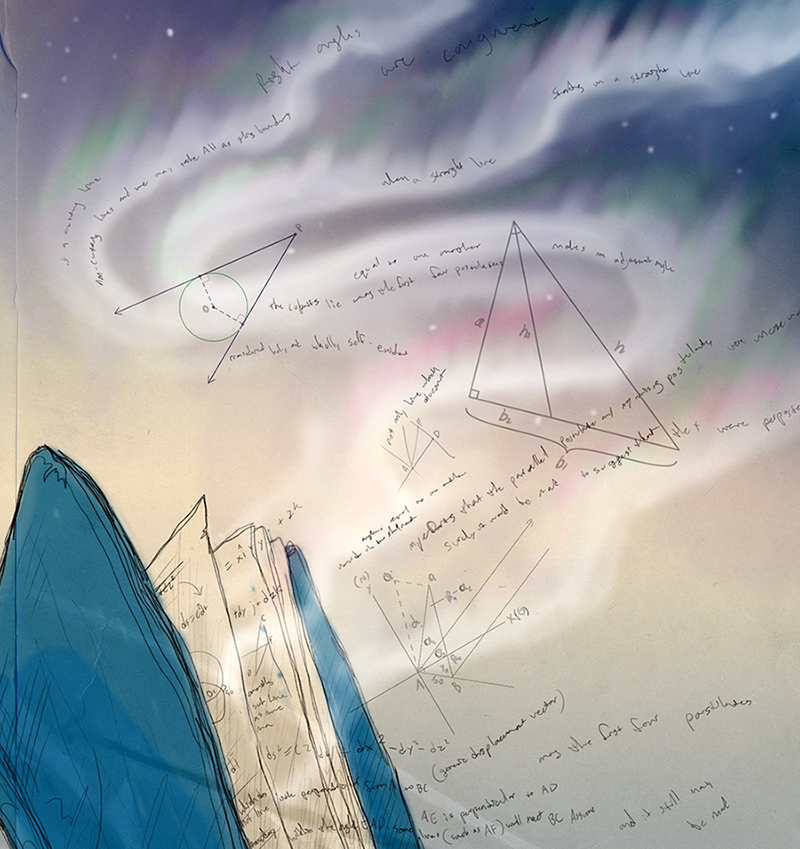
I turned the page. The back of that page was a jumble of figures and calculations. The most prominent constant I found in Baxendell’s notes was his poor grasp of demarcation. Random thoughts and ideas peppered the borders of nearly everything he wrote, and his notebooks’ labels meant very little by the tenth or twentieth page.
The next page was missing. It was torn out as neatly as possible. I had not noticed this before. A survey of the rest of the volume turned up a few more missing pages. There was clear intent in the pattern of omission. I assumed that the only person who could have done it was Baxendell himself. Perhaps he had realised that his idea was flawed and, out of embarrassment, destroyed the incriminating writings. The problem with that was that I saw no evidence of this realisation in his notes.
This piqued my curiosity enough for me to get up and walk back to the ship. We already had all of the supplies we would need, but now I decided I wanted to bring one more thing. I ascended the pilot ladder, grabbed an oil lamp, and, taking a deep breath, descended below deck to the ship’s library, which was remarkably well stocked for a sailing ship, but not for a polar ship. It had been discovered long ago that boredom was as much an enemy as scurvy when wintering in a polar climate. I found the ship’s copy of Euclid’s Elements and hastily returned to the pallid light outside.

And yet beyond the end of the stars, at the perfect centre of the everted heavens, was something I have no words for. It was featureless and yet I knew that it looked back at me through that lens. I had to pull myself out. Why had God created us if we were but microscopic bacteria on the inner edge of–what? An egg? A prison?
To read the rest of this story, check out the Mad Scientist Journal: Summer 2014 collection.
Desmond Ashmore is an astronomer and fellow at the University of Cambridge. He is best known for making spectroscopic observations in India during the eclipse of 1868 which lead to the discovery of the hitherto unknown element Solium, which comprises the atmosphere of the Sun.
James Hanson is a physics graduate student at the University of Wisconsin-Madison. He often finds himself torn between his love of cerebral hard science fiction and his fondness for bad 50s-era special effects. This is his first publication since high school.
Luke Spooner a.k.a. ‘Carrion House’ currently lives and works in the South of England. Having recently graduated from the University of Portsmouth with a first class degree he is now a full time illustrator for just about any project that piques his interest. Despite regular forays into children’s books and fairy tales his true love lies in anything macabre, melancholy or dark in nature and essence. He believes that the job of putting someone else’s words into a visual form, to accompany and support their text, is a massive responsibility as well as being something he truly treasures. You can visit his web site at www.carrionhouse.com.
An essay by Desmond Ashmore, as provided by James Hanson
Art by Leigh Legler
January 26th, 1875, At Sea
The purpose of our expedition as stated in our charter is twofold: to determine the ultimate fate of Baxendell’s expedition of 1869, and to recover as much of their personal effects and scientific equipment as possible, with special emphasis on Oxford’s astrographic lens and the Royal Society’s Synthetical Engine No. 2. Truthfully I have another, personal purpose in this endeavour, which is to vindicate Sir Arthur Baxendell, who has always garnered my deepest admiration, both in his capacity as a physicist and, despite my habitual distaste for the profession, as a mathematician.
The skipper says that we are about a day away from the Great Ice Barrier where we now know they should have landed. At first, when nothing was heard from them, it was assumed that they had overwintered twice on the peninsula where they were originally intended to land. It was feared the HMS Resolute had become trapped in ice, but two relief ships, the HMS Erebus and the HMS Racehorse, failed to find anything.
Eventually, it was supposed that the ship had sunk on the journey from the Florida Colony to Antarctica. But at some point around 1872, the HMS Resolute was spotted ice-locked by the Japanese whaling ship the Kiji Maru, although they did not recognise it and they had neither the ability nor the interest to investigate it. Japan’s trade isolation meant that the news was slow to spread to Europe, and after having been filtered by the Japanese and then the Dutch, all that arrived in the United Kingdom was a rumour that an English ship was abandoned in Antarctica.
Fortunately, an English diplomatic envoy has been in Japan attempting to negotiate the opening of trade and, at the request of the Royal Society, they enquired after more specific details regarding the spotted ship. It came to light that a vital datum has been caught in the filtration: for some unknown reason, instead of landing on the Graham Land Peninsula in the Weddell Sea, the expedition had landed on nearly the opposite side of West Antarctica, on the Great Ice Barrier.
And so, as it had been so long, a search party was formed rather than a third relief party.

In what must have been all of his mathematical notes he had ever written I eventually found the “proof” he mentioned. He was not exaggerating when he said that it was technically challenging, but so are all proofs of absurd falsehoods. I remember that in my school days, similar “proofs” of the equality of one and two would be passed between boys with the hunched secrecy normally reserved for the trading of literary smut and tobacco, for the punishment for propagating mathematical nonsense was nearly as harsh.
To read the rest of this story, check out the Mad Scientist Journal: Summer 2014 collection.
Desmond Ashmore is an astronomer and fellow at the University of Cambridge. He is best known for making spectroscopic observations in India during the eclipse of 1868 which lead to the discovery of the hitherto unknown element Solium, which comprises the atmosphere of the Sun.
James Hanson is a physics graduate student at the University of Wisconsin-Madison. He often finds himself torn between his love of cerebral hard science fiction and his fondness for bad 50s-era special effects. This is his first publication since high school.
Leigh’s professional title is “illustrator,” but that’s just a nice word for “monster-maker,” in this case. More information about them can be found at http://leighlegler.carbonmade.com/.
A proposal by Professor Euphemia Talbert, as provided by Andy Brown
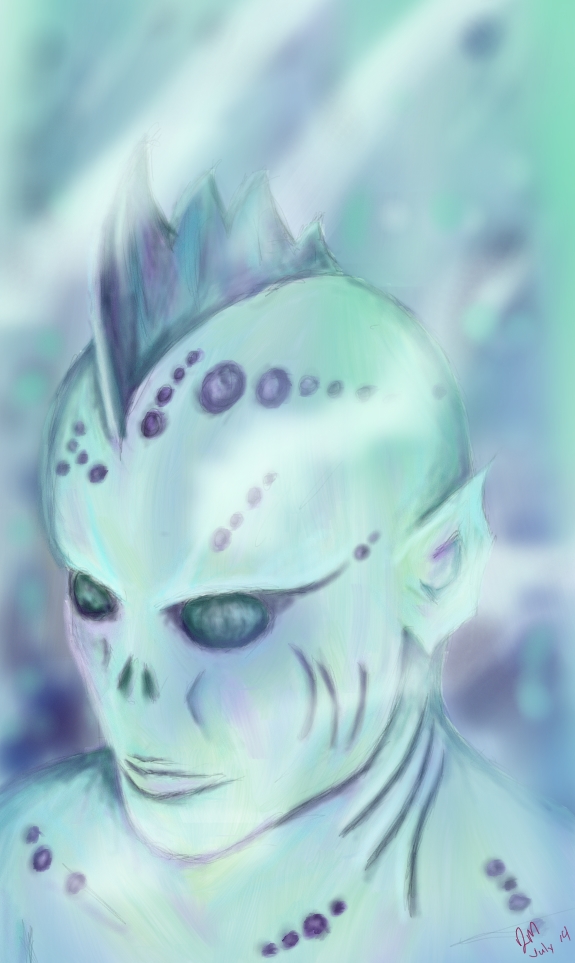
Art by Justine McGreevy
ABSTRACT
For centuries, the tales of supernatural beings and their magical powers have enriched our lives. Now that we have access to these beings after the Pan Species Accord of 1947 (PSA), DNA research has shown that some of the traits of these creatures may be transferable to humans. This project focuses on DNA applications with regard to physical enhancement in sportsmen and women.
ELF
Elf DNA has been somewhat of a holy grail for the supernatural geneticist. Even after the PSA, the elven races were disinclined to provide any specimens for research. I would like to convey my gratitude to Sir Thomas Rhymer, the minister for supernatural and paranormal affairs, for his help in this matter.
POSITIVES
Splicing elf DNA into the genomes of track athletes resulted in a huge increase in both speed and stamina. The elven propensity for running without fatigue was apparent in our test subjects. Double, triple, and quadruple marathons were easily completed. Advantages in sprint events were less marked. (I have always suspected that Jamaican DNA may already have a natural elven DNA component.)
Increased coordination and a certain lightness of body were very clear in jumping events, resulting in the smashing of record after record.
Javelin and archery skills were also enhanced. Speed and accuracy especially showed a marked improvement. (The elven propensity for hand/eye coordination could also be applied to shooting events.)
NEGATIVES
Associated with the obvious physical enhancements of elf DNA are the character traits of the species which have now been proven to be genetic. (“Elven Character, Nature or Nurture?” Prof. Euphemia Talbert. Cambridge. 2014)
In every case, the test subjects began exhibiting arrogance, superciliousness, and aloofness, to the extent that by the end of the trial period, many subjects simply stopped exerting any effort unless they happened to be in the mood at the time. Gifts and praise often succeeded in encouraging the subjects to perform, but it became increasingly difficult to motivate them.
CONCLUSION
The physical enhancements were largely cancelled out by the elven character traits. As noted, positive re-enforcement and the promise of gifts had a short term effect on the subjects. Using reverse psychology did not work, since it invariably resulted in the test subjects striding off in high dudgeon.
Further research may reveal that the elven characteristics may be separated from the positive traits of the DNA. My personal feeling is that elven character traits are inextricably linked with the other elven traits.

An unexpected effect of the experiment is related to the increase of telepathic abilities. All the female test subjects exhibited a tendency to sing whilst in the water, which had a marked effect on the male members of my team. A trance-like state was induced in them, compelling them to walk towards the water and throw themselves in.
To read the rest of this story, check out the Mad Scientist Journal: Summer 2014 collection.
Professor Euphemia Talbert was a child prodigy who left high school at the age of eleven to attend the Royal College of Genetic Interference, where her work increasing the aggression levels of sparrows by adding ogre DNA came to the notice of the military, which was already experimenting with troll and vampire DNA to create a super soldier.
She has been married nine times and still keeps in touch with her ex-husbands. She is currently married to a merman and lives on a houseboat in the Thames.
Andy Brown is a musician and entertainer living near Edinburgh in Scotland.
(He doesn’t currently own a kilt but does play bagpipes a little.)
He is a pleasant enough fellow with a healthy interest in many things and an obsessive interest in many others. (Music, computers, astronomy, reading, writing…)
He plays a wide variety of instruments to a wide variety of standards.
His greatest happiness is his family and the fact that he wakes every morning still breathing.
His greatest sadness is that he might die before warp travel, teleportation, and Klingons are discovered.
Justine McGreevy is a slowly recovering perfectionist, writer, and artist. She creates realities to make our own seem slightly less terrifying. Her work can be viewed at http://www.behance.net/Fickle_Muse and you can follow her on Twitter @Fickle_Muse.
With July behind us, we have now re-opened to submissions. Click here for Submission Guidelines.
An essay by General Penelope Hartman, as provided by Sylvia Spruck Wrigley
Art by Scarlett O’Hairdye
First of all, I want you to forget every single word that they told you at the recruiting office. No, just stop, I don’t need to hear it. It’s all lies.
Stand right up here with me and take a look around. This is the front line. No, that is not a euphemism. War’s not normally neat with straight lines and easy-to-understand strategies but here, we have a line. It’s that trench right there. Don’t get too close to the edge.
The Sporians disintegrate about four of our people a day. Your ship came in with 10 crates of supplies and 500 raw recruits. You do the math. Don’t make friends.
Listen: We don’t need you to wear uniforms or learn to shoot a gun or do anything but be here and drink cod liver oil and die. That’s the reality.
Nah, I’m joking. It’s not actually cod liver oil. It’s worse. It smells like something the dog shat out and tastes like rancid butter. You’ll learn to ignore your gag reflex and force it down, just like the rest of us.
That’s one of the few things we know. We don’t know how to fight them. We don’t even know if they are intelligent. But every time we give up and leave the rock to them, they move in closer. Your job is to stand around like you might want to get infected. Don’t get infected. That’s it.
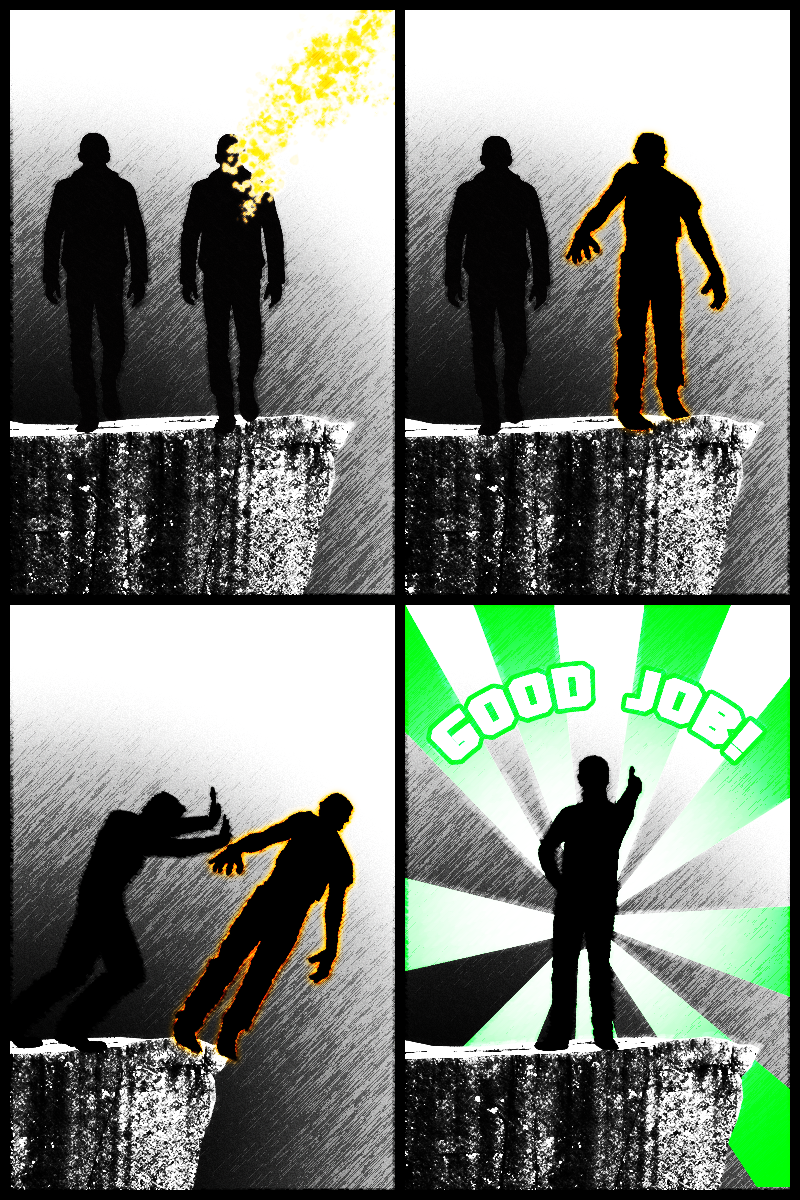
You won’t know if you get infected. You just zombie off looking for high ground and a few hours later, a stalk grows out of your head and explodes. Neon orange spores scatter everywhere, looking for a new home. See, that’s why we like this trench right here. You see one of your mates acting like a zombie, push him in. Fast.

You won’t know if you get infected. You just zombie off looking for high ground and a few hours later, a stalk grows out of your head and explodes. Neon orange spores scatter everywhere, looking for a new home. See, that’s why we like this trench right here. You see one of your mates acting like a zombie, push him in. Fast.
To read the rest of this story, check out the Mad Scientist Journal: Summer 2014 collection.
General Penelope Hartman was commissioned in 2019 as a distinguished graduate of California State University Long Beach ROTC program. General Hartman began her service as a fighter pilot with over 5,000 logged hours in command of the the F-36. She saw active duty in on both Earth and Mars and is currently stationed at asteroid trojan 1998 VF31. General Hartman holds various decorations and awards, all of which are lying at the bottom of the trench.
Sylvia Spruck Wrigley was born in Germany and spent her childhood in Los Angeles. She now splits her time between South Wales and the Costa del Sol, two coastal regions with almost nothing in common. She has been nominated for a 2013 Nebula Award for her short story, “Alive, Alive Oh.” Sylvia’s most recent short stories can be found in Daily Science Fiction, Lightspeed, and Nature’s Futures. You can find out more about her at http://www.intrigue.co.uk/
Scarlett O’Hairdye is a burlesque performer, producer and artist. To learn more, visit her site at www.scarlettohairdye.com.
This story originally appeared in Nature’s Future, April 2013.
An essay by Dr. Simon Rulik, as provided by Christopher David DiCicco
Art by Leigh Legler
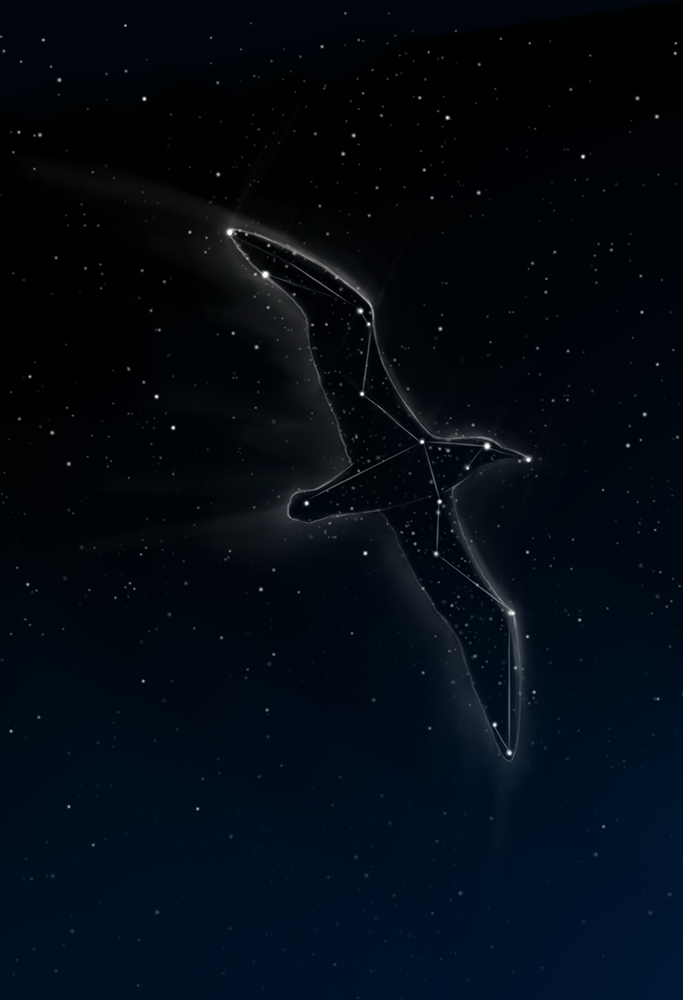
When the shuttle blasted off, launching me outside Earth’s orbit, it wasn’t Sara I thought of or even the kids–it was the PBS animal documentary on migrating albatrosses.
I’d sat the evening before in my family room with the lights dimmed, a pillow propped against my chest for security. Both Jason and Gayle had fallen asleep next to me. Sara leaned over, wrapped her arm around my neck, kissed me, saying, “Don’t worry about it, spaceman. I’ll put them to bed. What’s one more night?”
I got the message, carried Jason to bed, kissed his forehead, thought how I might die in space, that this might be the last time I saw him.
I kissed Jason again, fluttered over to Gayle’s doorway, held Sara there–as light as air. We watched our little darling Gayle breathe in, breathe out, our own respiration matching her falling chest.
Later, I sat back on the sofa, watched television, absorbed the details. The albatross flew across the Atlantic. It used thermo updrafts from islands along the way to gain great height. The warm land baked under the sun produced an advantage to soar from, drifting the bird across, away to where it wanted, needed, to go.
#
In the shuttle, I considered the moon. How I would soon walk on it, ending the first half, the greatest half, of the journey. The dangerous trip was always half-drifting home.

“Roger. We need the size of the meteorite relative to your hand and the distance between it and your helmet. Count the seconds before the meteor appears larger than your fist. If it doesn’t appear significantly larger in five, then it’s not going to hurt you.”
“It’s a bird.”
To read the rest of this story, check out the Mad Scientist Journal: Summer 2014 collection.
Dr. Simon Rulik originally headed Edinburgh’s Aviary Institute, specializing in the study of flight and extended travel patterns there before switching directions and joining London’s esteemed Moon to Stars Exploratory Program where he now examines the effect of space travel on humans. Dr. Simon Rulik theorizes that one day we may learn how to ride the coat-tails of exploding stars from one moon to the next, making our way through this crazy thing we call a galaxy.
Christopher David DiCicco loves his wife and children—not writing minimalist stories. But he does. Work in Superstition Review, Bartleby Snopes, Nib, Litro, WhiskeyPaper, The Cossack and other fine publications. Visit www.cddicicco.com for more published work.
Leigh’s professional title is “illustrator,” but that’s just a nice word for “monster-maker,” in this case. More information about them can be found at http://leighlegler.carbonmade.com/.
The Money Aspect
Amounts in parentheses are losses/expenses.
Hosting: ($17.06)
Stories: ($75.00)
Art: ($211.60)
Advertising: ($65.00)
Payment Processing Fees: ($4.55)
Donations: $61.00
Ad Revenue: $1.26
Book Sales: $21.26
Total: ($289.69)
QTD: ($1,457.90)
YTD: $568.60
All Time: ($6,943.97)
As per usual, I try to list costs for art and stories under the month that the stories run on the site rather than when I pay them. I also cover Paypal expenses when paying authors and artists.
I’ve included payments from Patreon into these figures under “Donations.” Even though it’s technically to support the work I do, the primary expense I deal with is Mad Scientist Journal. I’ve also expanded the Paypal Fees category to “Payment Processing Fees” to cover things like the processing fees from Patreon as well as the fees from other places (like Kickstarter).
Exciting note: We had a sale in India! I got really excited because it was for 60-something. And then I realized it was in Indian rupees and not US dollars. =P
Submissions
In June, we received 13 regular submissions, of which we accepted 6 (46%). We also received 29 exclusive submissions between May and June (8 in May, 21 in June), 8 of which were fictional classified ads. Of these we accepted all of the classifieds and 7 of the regular exclusives, and 1 exclusive that we accepted as a regular submission instead. Our all time acceptance rate is 53.65%.
This gives us enough content for the site through mid April 2015.
Followers
Facebook: 833 (+7)
Twitter: 330 (+59)
Google+: 40 (+3)
Tumblr: 23 (+2)
Mailing List: 18 (+0)
Patreon: 5
Traffic
Despite an increase in followers over the last month, especially on Twitter, our traffic actually dropped. We had a total of 1,238 visits. Our traffic consisted of 849 users and 2,493 page views. Our highest daily traffic was 72.
June’s search engine phrase of the month is “priyanka always keept pink flavour in her pocket.” It’s a useful skill for mad scientists.
That’s all for this month.
An essay by Hester Ninetrees, as provided by Deborah Walker
Art by Leigh Legler
I hadn’t mentioned my approaching birthday to my children. I guess I was in denial. So it must have been a shock when the police turned up at our home. They both tuned out of the data stream immediately.
“Mum, what’s happening?” asked Dinah. Dinah … I wonder if she misses me.
I didn’t know what to say. So I just said it. “I’m fifty today.”
“No!” Dinah collapsed onto the settee.
Pete’s reaction was slower. He’s already showing signs of the brain deterioration that took his father. Pete would not embarrass his children by living too long.
“No … Ma …”
I patted him on the cheek. “It’s okay, Pete. Don’t you worry about it. You go back to your show.”
“Come along ma’am,” said one of the officers. They both looked embarrassed. It was an unpleasant duty for them.
I reached for my handbag. I looked at Dinah and Pete. They’d be okay without me. The house would run smoothly, the food would arrive, the machines would keep the rooms nice and clean. A thought occurred to me, “Will there be data streams under the sea?”
“Of course, ma’am.”
That was a relief. I’d been watching Sunrise Palace for fifty years. I wouldn’t want to miss an episode.
#
We bathe in artificial light in the Aqua Institution. The walls are thick, made of dense, strange metal. Trevor Bimble says the machines mine the metal from asteroids. No Earth-found compound could withstand the enormous pressure down here. The underwater currents knock against the walls of our home. I worried at first that it wasn’t safe, but after a month I got used to it. You get used to everything, eventually.
I’m expected to work down here. Work! Me! It’s all very strange.
We’re allowed four hours a day of data stream, so I can still watch Sunrise Palace, but only in the attenuated version. A punishment, I guess, for growing old or for being mad.
I work in the factory. The people who are like me, the old ones, cluster together. This is a facility for the insane and for the old. I never expected to be here. I never expected to pass my fiftieth birthday. Who does? Maybe only one person in a hundred thousand, certainly nobody in my family had ever done such a careless thing.
Mickey, who’s fifty-five, works beside me. He’s been certified sane, but I’m not so sure. There’s something about the light here, working constantly under fluorescent lighting that might drive a person mad.
Mickey keeps up a monologue while we work, “I shouldn’t be here. Out of sight out of mind. The other people don’t want to see us. We’re a waste of space. We make everyone uncomfortable. So, they send us out here, under the sea. Make us live in these metallic snow globes. Like we don’t deserve to feel the sunshine. Natural light is not a right, it’s a privilege, and it’s slipped out of our fingers. We’re the fluorescent people. We deserve it, but every now and again the machines make a mistake. I’m not mad, you know, Hester.”
“No,” I say patiently. “You’re not mad, Mickey. You’re just old, like me.”
I wonder what my children are doing. Are they working for my release? Are they petitioning the government for an exception? I don’t know what grounds they’d give. I was never exceptional. I just did what everyone else did: had children and enjoyed myself watching Sunrise Palace. I think that Dinah will be trying. Poor Pete wouldn’t be able to manage anything like that.
A stream of data activates my computer screen. I work on input analysis. There’s so much data to be collated. It’s surprising how much actual human input is needed to refine and interpret the data. I’d always assumed that the machines did everything. I didn’t realise that data was refined by the mad and the old here under the sea. Live and learn, eh?

Mickey keeps up a monologue while we work, “I shouldn’t be here. Out of sight out of mind. The other people don’t want to see us. We’re a waste of space. We make everyone uncomfortable. So, they send us out here, under the sea. Make us live in these metallic snow globes. Like we don’t deserve to feel the sunshine. Natural light is not a right, it’s a privilege, and it’s slipped out of our fingers. We’re the fluorescent people. We deserve it, but every now and again the machines make a mistake. I’m not mad, you know, Hester.”
To read the rest of this story, check out the Mad Scientist Journal: Summer 2014 collection.
Hester Ninetrees led an exemplary life, until her unfortunate fiftieth birthday when she was relocated to the thirty-third Aqua Institution. Following her erroneous release, Mrs Ninetrees travelled through all seventeen districts, leaving in her wake a trail of civil disobedience. Her crimes have been judged. Machine Direction alpha-red dictates Hester Ninetrees be subject to capture with extreme prejudice. Machine Direction alpha-red-chi dictates that her body be delivered to the Human Neural Institute for examination. Order will be restored.
Deborah Walker grew up in the most English town in the country, but she soon high-tailed it down to London, where she now lives with her partner, Chris, and her two young children. Find Deborah in the British Museum trawling the past for future inspiration or on her blog: http://deborahwalkersbibliography.blogspot.com/ Her stories have appeared in Nature’s Futures, Cosmos, Daily Science Fiction, and The Year’s Best SF 18.
Leigh’s professional title is “illustrator,” but that’s just a nice word for “monster-maker,” in this case. More information about them can be found at http://leighlegler.carbonmade.com/.
This story originally appeared in M-Brane #15 in 2010.