That Man Behind the Curtain: June 2015

Another month means another report on how things are going!

Drink Nesbitt's

This has nothing to do with the post. I just thought I’d jazz this up with a photo I took recently.

The Money Aspect

Amounts in parentheses are losses/expenses.

Hosting: ($17.06)
Stories: ($70.00)
Art: ($293.57)
Advertising: ($30.00)
Processing Fees: ($8.60)
Printing: ($149.65)
Donations: $40.00
Ad Revenue: $0.70
Kickstarter: $5.00
Book Sales: $74.28
Total: ($448.90)
QTD: ($1716.91)
YTD: ($252.18)
All Time: ($10,713.51)

As per usual, I try to list costs for art and stories under the month that the stories run on the site rather than when I pay them. Sales are for sales when they take place, not when it’s actually paid out to me. I also cover Paypal expenses when paying authors and artists.

This was mostly a typical month. Sales have dropped off a bit. After almost a year, it appears that That Ain’t Right has started to lose momentum. We also had another $5 come in through Backerkit for our Kickstarter.

Submissions

We were closed to submissions up through the end of June. Our overall acceptance rate remains at 48.52%.

Followers

Number of followers in social media as of the end of last month.

Facebook: 971 (+11)
Twitter: 392 (-1)
Google+: 56 (+1)
Tumblr: 95 (+9)
Mailing List: 38 (+0)
Patreon: 9 (+0)

Traffic

Our traffic was down in June. Summer always seems to mark a slump for us. We had a total of 1,180 visits. Our traffic consisted of 844 users and 1,861 page views. Our highest day of traffic was 120.

This month’s search engine term is “method of family management”.  I’m sorry, but you’ve come to the wrong place. Runner up is the ever persistent “ebay 1979’s quilt patterns”. I would like to think I’m really screwing up someone’s search results.

Posted in Man Behind the Curtain | Tagged | Comments Off on That Man Behind the Curtain: June 2015

Review of Ink Calls to Ink by Nathan Crowder

Ink Calls to InkA review by Dawn Vogel

Nathan Crowder’s newest book, Ink Calls to Ink (2015, CHBB Publishing), is a departure from the horror stories and super hero fiction he has written in the past. Fictional Personae, characters from many of the classics of literature, roam the streets of modern-day London. When new “Ficts” arrive on the scene, those who have been around for years find their world changing around them.

Ink Calls to Ink follows the stories of Juliet Capulet, the Steadfast Soldier who calls himself Franklin (from the Hans Christian Andersen story of the Steadfast Tin Soldier), and a Reader named Kate Malloy. When King Arthur arrives through the rift between the fictional world and the real world, he and his associates concoct a plan to bring other Ficts through to London. But Juliet, Franklin, and Kate, along with Judas Iscariot, Medea, and Don Quixote, realize that this plan is dangerous and must be stopped.

What follows is an exciting story of intrigue and adventure. While this book would probably be classed as urban fantasy by most booksellers, it is unlike any other urban fantasy novel I’ve read before. Only the barest hints of a romantic subplot enter the picture, and that not even until more than halfway through the book. It is a refreshing take on a genre that I often bypass.

Posted in Reviews | Tagged , | Comments Off on Review of Ink Calls to Ink by Nathan Crowder

The Trouble With Rabbits

An essay by Rosie Fields, as provided by Sylvia Heike
Art by Leigh Legler


Day 1: Monday 9th April, 2018

My biochemistry professor, Mr Adams, has left me in charge of the lab during the Easter holiday. My job is to care for the six “New Zealand White” rabbits in the backroom, to lock the doors when I leave, and to make sure the undergraduate students working on their extra credit projects don’t turn the lab into a complete mess in his absence.

I fed the rabbits and cleaned their pens, refilled their drinking bottles and hay racks, and made sure that every rabbit was healthy. Bright eyes: check. Clean nose: check. Eating and looking well: check. Lots of droppings: double-check. I’m glad the rabbits are only used for non-invasive educational purposes such as behavioural studies and no actual testing.

An exchange student from Japan named Keiko was the only other person in the lab today. She worked quietly in the corner, peering into a microscope and mixing purple solutions into countless test tubes. When I asked her about her project, she tried to explain, but her English wasn’t very good, so I only picked up the word “amoeba” and left it at that.

If things stay as quiet all week, I’ll be able to finish a whole lot of reading for my dissertation.

The Trouble with Rabbits

The rabbit’s body started growing, swelling like a big, fuzzy balloon, and another head appeared on its side. I thought I must be hallucinating, but then the head parted further, and soon, two identical white rabbits were hopping around in my living room!

#

Day 2: Tuesday 10th April, 2018

Just Keiko and me in the lab again. She came to the backroom waving her lunch box, and we ate our packed lunches together. I talked and she smiled.

Everything went well with the rabbits. Boy, do they make a lot of droppings.

I organised the storage cabinet, but I wasn’t sure what to do with the unlabelled bottles, so I stashed them under the sink. Hopefully Keiko hasn’t been using them. Note: Ask Professor Adams.


To read the rest of this story, check out the Mad Scientist Journal: Summer 2015 collection.


According to Professor Adams, Rosie Fields is currently undergoing a major identity crisis which has caused an urgent need to re-evaluate her place in society. She is expected to return to her postgraduate studies at the University of Poxford next semester in the genealogy department. Her journal was found in a shopping basket at the Buns’R’Us pet store.


Sylvia Heike lives in Finland and loves her pet rabbits even when they nibble on her books. She writes short fiction, poetry, and is working on her novel. Her work has appeared recently in Flash Fiction Magazine and is forthcoming in three anthologies: Indies Unlimited Flash Fiction 2014, Seven Deadly Sins: Pride, and Selfies from the End of the World. Check out her website at www.sylviaheike.com.


Leigh’s professional title is “illustrator,” but that’s just a nice word for “monster-maker,” in this case. More information about them can be found at http://leighlegler.carbonmade.com/.

Posted in Fiction | Tagged , , , | 2 Comments

Escapement, or The Contemporary Coppelius

An essay by Euphemia Thorniwork, as provided by Judith Field
Art by Ariel Alian Wilson


London, November 1888

Two days after Uncle Eric’s funeral, there was another murder in Whitechapel. I am ashamed to admit that I felt relief at the knowledge that he could not have been the Ripper. I had hardly dared consider it, but I had been forced to ask myself why he would never allow me to accompany him when he went to his workshop, in a cellar somewhere in east London.

I sat in the parlour, reading aloud from The London Daily Post to my mother. “… and Her Majesty has urged the police to do all they can to protect these unfortunate women.” I spared her the stomach-turning description of the butchery. At least the poor victims were strangled first.

The doorbell rang. Mother grasped the arms of her wheelchair and pushed herself upright. “No more flowers, I hope, Euphemia!” She dabbed her eyes with a black-edged handkerchief. “Everyone has been most kind, but the house resembles The Royal Botanic Gardens.” I patted her hand and proceeded to answer the door.

I caught movement on the stairs in the corner of my eye. It was my silver tabby, Loki. Mother had named him after a mischief-making character in some opera. He wound himself round my legs, his tail swishing against the skirt of my black dress. I felt my shoulders droop. Never again would Uncle Eric lean over the banister and call me to see his latest construction. He had come to live with us ten years ago, after the carriage accident that killed my father and crippled my mother. He was a watchmaker but his delight was constructing musical automatons–a piano-playing bear, a dancing clown. He had been working on a fluttering, singing bird, the voice created by a tiny bellows, but during his peregrinations to find feathers for it, he caught typhoid and died.

I opened the door. Two men heaved a wooden crate, about six feet long, off a cart and banged it onto the pavement next to a Saratoga trunk. One of them took an envelope out of his trouser pocket. “Miss Thorniwork?” I nodded. He took off his bowler hat and fanned his face with it. “Sign here.” He shoved the envelope, a scrap of crumpled paper, and a pencil stub into my hand. With much sweating and puffing, the men deposited the trunk and the crate in the hall. I gave them the few coins I had in my reticule and shut the door.

Mother wheeled herself into the hall.

I opened the envelope. “This appears to be a letter from Uncle Eric. ‘Dear Pheemie’–”

“Must you ask people to call you that … housemaid’s name?” Mother said.

“Would you prefer Effie?” I said. “‘If you are reading this, I must be dead. Consequently, my gift to you wears a black hatband for form’s sake. In the trunk are my notes; they will show how I constructed the gift and the alloy from which the trunk is made. I am sure you will find a way to unlock it. In the crate is a toy that may amuse you. Once a week be sure to wind, until you feel the spring come to a stop.'” I looked up. “There’s a bit for you, here, Mother. ‘Agnes–remember Coppelia?’ Who is she?”

“Really, you are an uncultured girl. Coppelia is a ballet, about Doctor Coppelius, who created a life-size dancing doll. In his youth, poor Uncle Eric was quite the balletomane, and I think Coppelia sparked his interest in automatons.”

“I find beauty and music in numbers,” I said. That was the end of the letter.

The trunk was made of dark unpolished metal, bound with thick iron bands. The lid closed with a lock, the combination of which comprised four letters.

“Uncle Eric did not give us the code,” Mother said. “How will we open it? There must be hundreds of combinations!”

“There are 456,976,” I said. “If you allow for repetitions of letters.”

“Show off your mathematical skills to me, if you must, but do take care not to do it in front of young gentlemen. They will take you for a bluestocking, and they do not like a wife more intelligent than they. Do you wish to remain a spinster all your life?”

I felt my throat tighten. “I am but nineteen years old, not yet an old maid. And, unless a man crept around the door whilst I was taking delivery, there is none here to observe my mental calculations.”

“Not since your poor Uncle …” Mother sniffed and dabbed at her eyes. I squeezed her arm.

“I regret my insensitivity. I miss him too.” I kissed the top of her head. “Let us leave the trunk for now, I will undo the crate.”

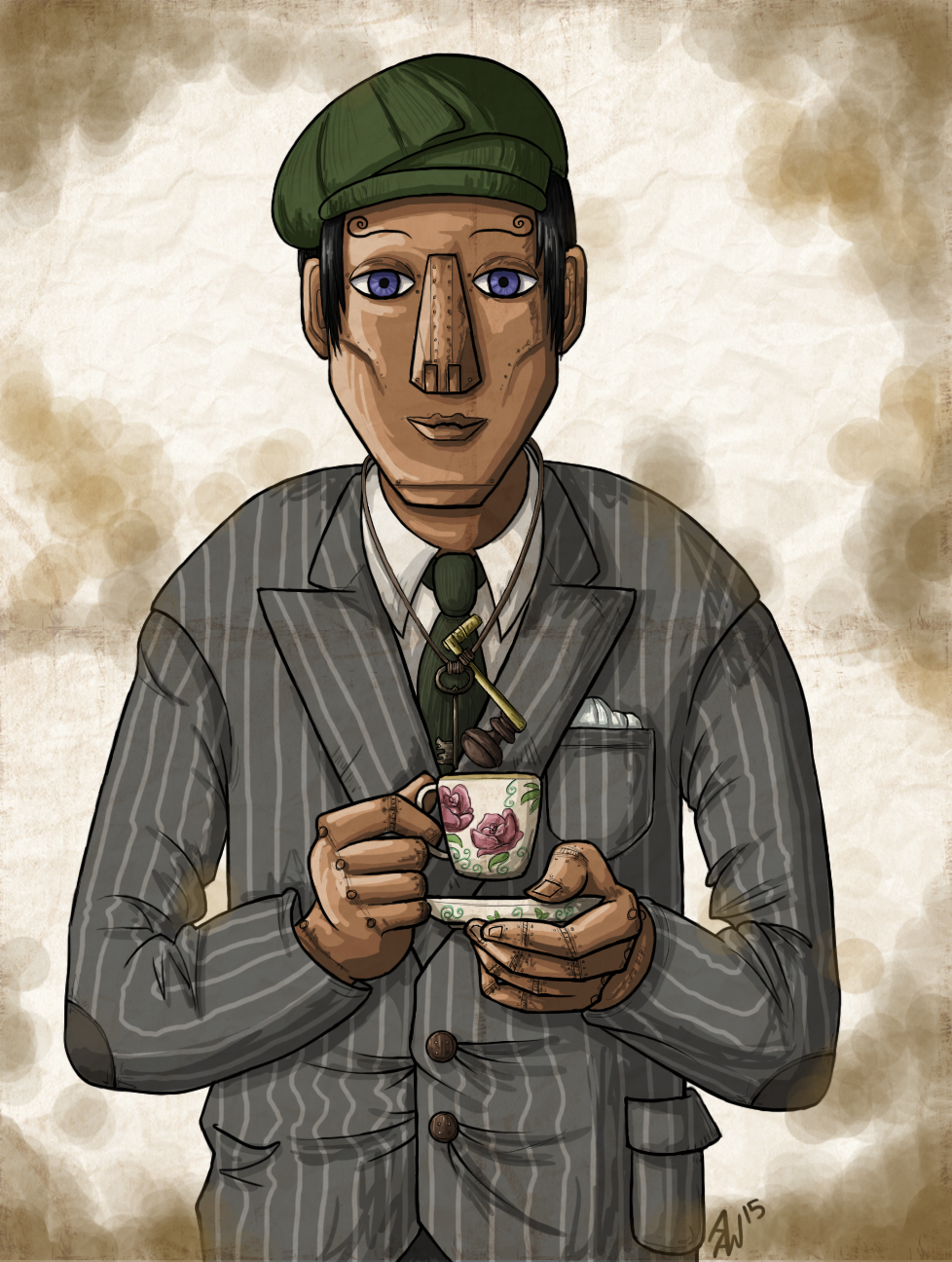
I forced the top upwards with the poker. The nails came away and it opened, revealing an object the shape of a man, apparently constructed of bronze. It was dressed like a country gentleman. Its fingers, interconnected metal cylinders, were riveted to the hands. A cord round its neck carried a front door key and a crank-style grandfather clock winder.

The face felt cold to the touch. It was clean-shaven, with engraved curlicues above the eyes imitating eyebrows. Blue enamelled eyes stared at nothing. On its head was a flat cap, with a black band. I removed it, and the short black wig underneath it came away in my hand. Next to a panel in the top of the head was a button, about one-eighth of an inch wide. I pushed it and the panel popped open, revealing a clock-like mechanism.

I put the crank key onto the winding peg inside and gave it a turn. The box vibrated as mechanisms activated somewhere within the body. Inside the head, a ticking began as a cog turned one tooth at a time, restricted by the rocking anchor-shaped escapement that kept the apparatus running regularly. I closed the door and replaced the wig and the hat. The eyes moved from side to side.
Escapement, or The Contemporary Coppelius

With a whirr of gears and a creak of wood against metal, the automaton sat up and raised its cap. “My name is Arbuthnot, at your service.”

With a whirr of gears and a creak of wood against metal, the automaton sat up and raised its cap. “My name is Arbuthnot, at your service.” Its mouth did not move. The voice was like that of a man, but with a metallic edge and an air of distortion, like one of Mr. Edison’s recordings. It climbed out of the crate and stood up. It was about five feet eight inches, as tall as me. “I am glad to make your acquaintance.”

“And I yours.”

“Now, what about a nice cup of tea?” he said. “You need only show me once. I learn.”


To read the rest of this story, check out the Mad Scientist Journal: Summer 2015 collection.


Euphemia Thorniwork’s account of the events of November 1888 was found in a diary hidden underneath the floorboards in a study at Cambridge University. She was one of the first female students to be admitted to study mathematics and, as later entries in the diary indicate, was largely responsible for Arthur Conan Doyle’s interest in spiritualism. The last entry appears to be a design for a cordless telephone, the shape and size of a child’s tricycle. We will try to piece together the text explaining what happened to it, and her. Watch this space–she may rematerialise into it.


Judith Field lives in London, UK. She is the daughter of writers, and learned how to agonise over fiction submissions at her mother’s (and father’s) knee. She’s a pharmacist working in emergency medicine, a medical writer, editor, and indexer. She started writing in 2009. She mainly writes speculative fiction, a welcome antidote from the world she lives in. Her work has appeared in a variety of publications in the USA, UK, and Australia. When she’s not working or writing, she studies English, knits, sings, and swims, not always at the same time. She blogs at Luna Station Quarterly and www.millil.blogspot.com.


Ariel Alian Wilson is a few things: artist, writer, gamer, and role-player. Having dabbled in a few different art mediums, Ariel has been drawing since she was small, having always held a passion for it. She’s always juggling numerous projects. Currently lives in Seattle with her two cats, Zippy and Persephone. You can find doodles, sketches, and more at her blog www.winndycakesart.tumblr.com.

Posted in Fiction | Tagged , , , , | Comments Off on Escapement, or The Contemporary Coppelius

The Counterweight

An essay by Jean-Michel Borrino, as provided by Damien Krsteski
Art by Dawn Vogel


There is a monster in every text. Or perhaps, one monster spanning all of text. I cannot know. All I am sure of is its existence, because I have seen it, and what is worse, it has seen me.

#

Leading a professorial life is far from boring–despite the claims of those undoubtedly coerced into academia by strict parents–which I was about to discover after three years of teaching semiotics to yawning students.

During a lunch with the colleagues, while I was rearranging the peas on my plate with my plastic fork, Professor Huntov sat down next to me, and in his usual merry manner asked about my lectures.

“I teach Kristeva this semester,” I said. “Intertextuality.”

“Sounds fascinating.”

I chose to ignore that sarcastic tone prevalent in most comp sci academics when philosophy was discussed, and said, deadpan, “It is.”

He seemed to have become conscious of his arrogance so he paused for a moment, pushed his glasses up his nose. He said, “Can I offer a tip? For when you are writing.”

Stuffing green peas in my mouth. “Sure.”

“Use version control.”

“Excuse me?”

“I wrote my book with git. Makes keeping track of your changes a breeze.”

Having no idea what he was talking about, I said, “I will look into it,” and ate the remainder of my food in silence.

The Counterweight

The first message from the monster came one evening, right before bed.


To read the rest of this story, check out the Mad Scientist Journal: Summer 2015 collection.


Jean-Michel Borrino was a Professor of Philosophy whose essay was discovered–several years after his passing–scattered among discarded words from old manuscripts.


Damien Krsteski is an SF author and software developer from Skopje, Macedonia, whose stories have appeared in The Colored Lens, Perihelion SF, Fiction Vortex, Way of the Buffalo podcast, and others. He can be found at http://monochromewish.blogspot.com.


Dawn Vogel has been published as a short fiction author and an editor of both fiction and non-fiction. Although art is not her strongest suit, she’s happy to contribute occasional art to Mad Scientist Journal. By day, she edits reports for and manages an office of historians and archaeologists. In her alleged spare time, she runs a craft business and tries to find time for writing. She lives in Seattle with her awesome husband (and fellow author), Jeremy Zimmerman, and their herd of cats. For more of Dawn’s work visit http://historythatneverwas.com/

Posted in Fiction | Tagged , , , , , | 1 Comment

Mad Scientist Reads Poetry

The New York City Poetry Festival will occur July 25th and 26th on Governors Island. Featured among the authors reading will be MSJ alumnus Lorraine Schein! (Yay!) Click here for their lineup and schedule!

Posted in Mad Scientist News | Tagged , | Comments Off on Mad Scientist Reads Poetry

Submissions Have Reopened!

After a few months of hiatus, we are once again opening our doors to submissions! Not only will we be accepting standard submissions, but we also have a special call for submissions for stories that will be exclusive to our quarterly! Additionally, we are hoping to get questions for our “Ask a Mad Scientist” advice column! So many exclamation points! For information on how to submit to us, check our Submissions page!

Posted in Administrative | Tagged | Comments Off on Submissions Have Reopened!

Now Available: Summer 2015

Mad Scientist Journal: Summer 2015You can read upcoming stories before they appear on the site, as well as exclusive content, in Mad Scientist Journal: Summer 2015! This lovely collection is available at Amazon (Print, Kindle), Barnes & Noble (Print, Nook), Kobo, iBookstore, and Smashwords!

Posted in Administrative | Tagged | Comments Off on Now Available: Summer 2015

Mad Science: Must We Be Evil?

An essay by Dr. Phillip “Pip” Jaminson, as provided by Michael Hudson
Art by Luke Spooner


Do the undoubtedly groundbreaking discoveries sought by the mad scientific community always have to be motivated by a villainous desire to counter all that is morally right and just?

Yes, end of article. Cue the lightning and maniacal laughter.

No, no, no, I’m kidding of course, but there does seem to be an inordinate focus from the general public on the harm that mad science can cause. Yes, mad science is a viable tool for many of us, such as yours truly, to further our own intricate schemes for planetary dominance. There are many among us, however, who possess an unnerving dedication to the pursuit of knowledge at any price, simply for the benefits it may provide. No one stops to think about the good things that fringe science has gifted upon an undeserving and oftentimes unsuspecting world. The messy uncertainty of a routine beheading was revolutionized, pun intended, with the perfection of the guillotine in 18th century France. A potentially disastrous worldwide famine was averted with the mysterious and timely discovery of Soylent Green. The Gatling gun, predecessor of modern automatic weaponry, was created with the noble purpose of reducing the human cost of warfare while demonstrating its inherent futility. To this very day, orbital anti-matter lasers help to reduce the unsightly cluttering of excess matter around large centers of population across the globe. I could go on, but my point is that evil is in the perception of our scientific pursuits rather than the pursuits themselves. Except for Soylent Green, that was pretty messed up when you think about it.

Mad Science: Must We Be Evil?

Science is beholden to no one and mad science is even less beholden than that. We transcend the divisive labels of good and evil while casting aside the question of right or wrong; mad science gives us the answers to problems that the traditional sciences are too afraid to broach.


To read the rest of this story, check out the Mad Scientist Journal: Spring 2015 collection.


Dr. Phillip “Pip” Jamison, The Shame of Glasgow, was born in the chilly northern city of Glasgow, Montana. He is a respected and feared pioneer in the emerging field of orbital disintegration technology. He is the recipient of two honorary degrees from the University of Texas which the university claims were granted under duress. The doctor’s whereabouts are currently unknown, which is exactly the way he wants it.


Michael Hudson is originally from Springfield, Missouri, and moved to San Antonio, Texas, while in the Army. He lives there with his girlfriend and their lazy, poop-machine of a cat, Prince.


Luke Spooner a.k.a. ‘Carrion House’ currently lives and works in the South of England. Having recently graduated from the University of Portsmouth with a first class degree he is now a full time illustrator for just about any project that piques his interest. Despite regular forays into children’s books and fairy tales his true love lies in anything macabre, melancholy or dark in nature and essence. He believes that the job of putting someone else’s words into a visual form, to accompany and support their text, is a massive responsibility as well as being something he truly treasures. You can visit his web site at www.carrionhouse.com.

Posted in Fiction | Tagged , , , , | Comments Off on Mad Science: Must We Be Evil?

Mad Scientist has a Favorite Apocalypse

My Favorite ApocalypseMSJ Alumnus Lorraine Schein has a story in the upcoming anthology My Favorite Apocalypse, from TulipTree Publishing! Plus, it’s available for pre-order from the publisher at half price! Or you can wait until it’s released in July and pay twice as much.

Posted in Mad Scientist News | Tagged , | Comments Off on Mad Scientist has a Favorite Apocalypse