The Trash Construct

An essay by Miguel Hojuelas, as provided by Juan Angel
Art by Scarlett O’Hairdye


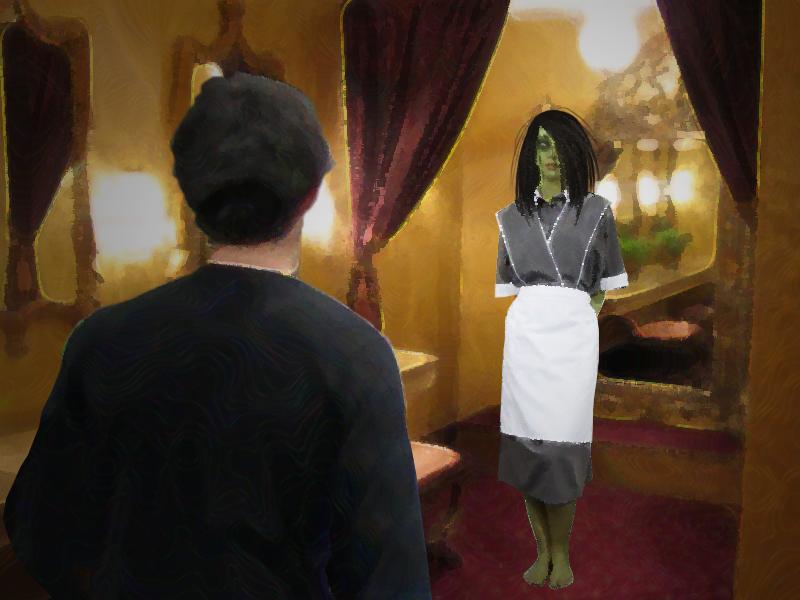
It smelled like wet cardboard the day Mr. Lorenzo took up in flight. The pitter-patter of rain on the aluminum roofs had ceased and, in its place, steam rose from the muddy slopes, the smear of smog vanishing from the sky as the wisps of heat rose towards it. Old Man Lorenzo swooped between our kites, his guttural laugh resonating out over the gleaming roofs and dirt paths below.

Paula’s arm went limp, her kite nylon veering down with it. “I’ll be damned.” She gaped.

Between the blue and green construction papers, their confetti tails fluttering in the air, flew Mr. Lorenzo. That was when I was fourteen years old, and before I got my glasses. I didn’t see the figures dangling below him, but Laura swore it was true. They said his wife and kid wriggled a few feet below him, their hands and feet hog tied as he pedaled his make-shift wooden helicopter into the afternoon sky.

Now, even after all these years, the people around here still talk about him. They curse him for taking his family with him, the promising young boy and the loving mother. But nobody shows promise here, in this shanty-town of decaying wood and aluminum panels. We are born here, on dirty mattresses or kiosk kitchens, and we die here, in more or less the same place as we started. To say that Old Man Lorenzo took promise away from us– that is saying too much. He left us full of hope: hope to get out like he did, hope that the boy would grow up to indeed live a promising life, or perhaps the simple hope that comes with watching something born in this place flap its wings past the sewage and into the setting sun.

The Trash Construct


To read the rest of this story, check out the Mad Scientist Journal: Summer 2013 collection.


Miguel is a commercial airline pilot. He has seen a lot, more than you could possibly imagine, even for a pilot, and is ready to tell you all about it.


Juan Angel lives in London, England. He spends his time writing, reading, and poring over other phantasmagorical things.


Scarlett O’Hairdye is a burlesque performer, producer and artist. To learn more, visit her site at www.scarlettohairdye.com.

Posted in Fiction | Tagged , , , | Comments Off on The Trash Construct

Missing Apocalypse

An essay by Jason Cartwright and Timothy Cartwright, as provided by D. M. Allan
Photograph by Dawn Vogel


Dear Peter,

I read the obituary you wrote for my grandfather and I really appreciate what you said about him. I know he wasn’t everyone’s favourite philosopher but he deserved recognition and you gave him that without overdoing it.

I’ve been trying to organise his papers. Among them, tucked into his journal for 1957, I found a very strange manuscript. There’s no doubt it’s in his handwriting–there are plenty examples of it.

I’m sure you remember that television interview when he upset most of the literary establishment by stating that all fiction, and in particular speculative fiction, was a product of overactive and possibly deranged imaginations. I’ve heard him say similar things often enough that I can’t imagine him writing anything like this. But if it’s not fiction it doesn’t make sense. I’ve included a copy. Please let me know what you think of it.

All the best,

Tim Cartwright.

#

The room was exactly what you would expect if you told an unimaginative set designer to produce a professor’s study. Bookcases covered two of the walls. The third had a fireplace with a portrait of Rupert Johnstone-Jenkins in full academic regalia gazing into the middle distance hanging over it. In front of the window there was a big desk with a swivel chair upholstered in green leather and there were two matching upright chairs facing it.

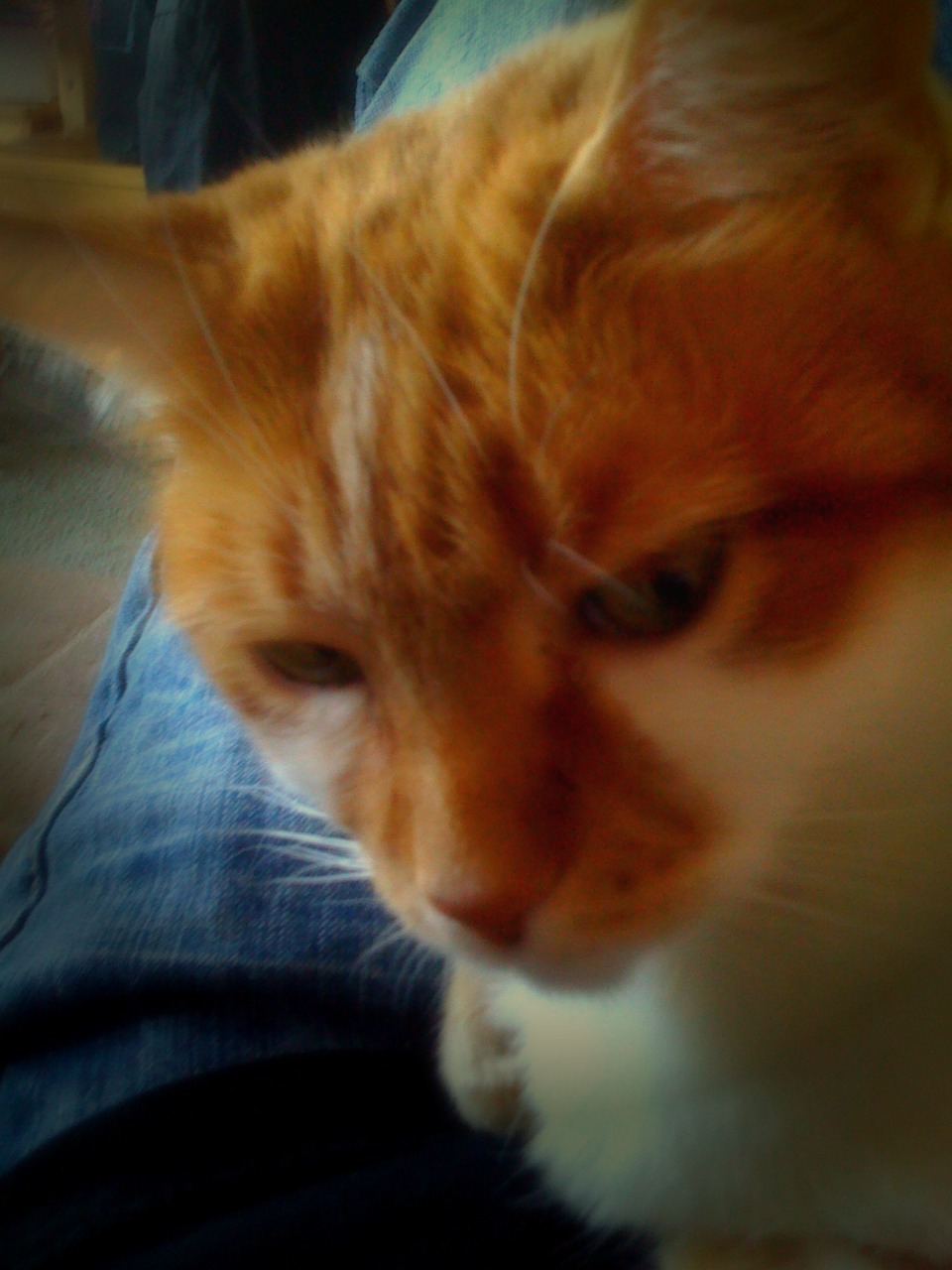
I didn’t have any choice about where to sit. One of the chairs was occupied by a large ginger and white cat who lifted his head, contemplated me for a moment and put his head down again as if it was too heavy to hold up for any length of time.

“Don’t mind Isambard, Mr Cartwright. He has a low opinion of everyone unless they’re about to feed him. Have a seat.” The professor followed me into the room, sat down in the swivel chair and rocked it gently from side to side while looking at me.

The portrait flattered him. He was a tall, gangling man with enormous hands, big ears, and a mass of nondescript brown hair. After studying me for a bit he seemed to come to a decision. He reached into one of the desk drawers and produced two glasses and a bottle of whisky.

“Do you drink whisky, Mr Cartwright? Or doesn’t the stereotype of the hard drinking reporter apply to someone from the student magazine?”

“Thank you, Professor. I wouldn’t describe myself as hard drinking but I do like whisky.”

He poured a hefty dose into each of the glasses, passed one to me and took a mouthful from his own. “Try that,” he said. “I don’t suppose you often get a chance to taste a really good single malt like this. I just hope it doesn’t spoil your enjoyment of lesser varieties.”

I took a sniff and a sip, then I felt my eyebrows go up. It wasn’t just good, it was superb. I mentally thanked my father for teaching me to appreciate whisky. “Ardbeg,” I said confidently, “probably twenty years old.” That may have been the only time I impressed the professor.

“Correct. I am surprised. I didn’t expect you to be a connoisseur. But you didn’t come here to talk whisky. What do you want to know?”

“Well, Professor …”

“Call me JJ. Everybody does.”

The interruption threw me for a moment. He had just put the interview on a more personal basis than I had anticipated. Rupert Johnstone-Jenkins had been appointed to a personal chair in Applied Mechanics, one of the three new professors at Oxford that year. The student magazine always published interviews with new professors. None of us on what might loosely be described as the staff of the magazine were keen on doing the interviewing. We had drawn lots and I was one of the losers. I knew nothing about his subject and I had no idea how to start but, thankfully, he took pity on me.

“I wasn’t at all sure about giving an interview at first,” he said, “but something has happened recently that changed my mind. I’m going to tell you things that aren’t public knowledge. I’m not sure you’ll ever be able to use it but I’ll tell you anyway.”

I sat up straighter. This sounded as if it might be interesting after all.
Missing Apocalypse


To read the rest of this story, check out the Mad Scientist Journal: Summer 2013 collection.


Timothy Cartwright was born in southwest London. He went to Oxford where he obtained a first class degree in politics, philosophy and economics and also played cricket for the University team. Following graduation, he worked first of all as a journalist. Then he joined the editorial staff of a small publishing company and eventually became its chief editor. When this company was swallowed by a larger company he made a successful move into broadcasting. He believes that his most important contribution was collating and editing the work of his grandfather, the poet and Rationalist philosopher Jason Cartwright.


D. M. Allan was born and raised in Edinburgh. He also went to Edinburgh University where he studied medicine. After graduation he chose to specialise in radiology and obtained his postgraduate qualification while working in Oxford. Following his retirement he has pursued other interests, obtaining an MA in archaeology and another in creative writing. He enjoys watching rugby, cricket and American football and he is a keen scuba diver and underwater photographer. At present he lives on a houseboat on the river Thames.


Dawn Vogel has been published as a short fiction author and an editor of both fiction and non-fiction. Although art is not her strongest suit, she’s happy to contribute occasional art to Mad Scientist Journal. By day, she edits reports for historians and archaeologists. In her alleged spare time, she runs a craft business and tries to find time for writing. She lives in Seattle with her awesome husband (and fellow author), Jeremy Zimmerman, and their herd of cats. For more of Dawn’s work visit http://historythatneverwas.com/

Posted in Fiction | Tagged , , , , | 2 Comments

Review of Clockwork Fairy Tales

A review by Dawn Vogel

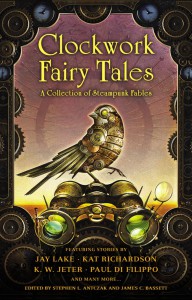
Clockwork Fairy Tales


Clockwork Fairy Tales (2013, Rok Books), edited by Stephen L. Antczak and James C. Bassett, is an anthology of nine steampunk adaptations of classic fairy tales. Growing up with Disney movies, I expected that I’d enjoy retellings of some of my favorites, but I was surprised when the first four stories were based on fairy tales I was not familiar with. It wasn’t until I got to Jay Lake’s “You Will Attend Until Beauty Awakens” (based on Charles Perrault’s “Sleeping Beauty”) that I was familiar with the original story. Despite my ignorance of the original stories, the anthology was still a fun read.

Many of the stories featured interesting twists on the original fairy tales. For example, Steven Harper’s “Fair Vasyl” (based on the Russian fairy tale “Vasilisa the Beautiful”) genderflips the main character to good effect. Other stories replace magic with steampunk technology, or combine the two together.

It’s difficult for me to pick a favorite story in this anthology. I liked Kat Richardson’s “The Hollow Hounds” (based on Hans Christian Andersen’s “The Tinderbox”) and liked it even more when I got to hear her read the first part of the story. This one is definitely worth reading twice, just to catch her clever word use once you know one of the twists in the story. I also liked Gregory Nicoll’s “The Steampiper, the Stovepiper, and Pied Piper of New Hamelin, Texas” (based on the legend of the Pied Piper of Hamlin), which moved the setting to among German settlers of Texas and had a fun Weird West feel to it. And Pip Ballantine’s “The Mechanical Wings” (based on Hans Christian Andersen’s “The Wild Swans”) was beautifully written with loads of evocative detail.

If there was anything I didn’t like about the book, it was mostly that I wasn’t prepared for the length of the stories. The stories are considerably longer than typical short story length, which meant that I wasn’t cruising through more than one story in the hour I had to read before bed. But that’s really a minor problem in the grand scheme of things. The stories are well written and edited, and even the unfamiliar fairy tales held little bits of familiarity in their structure.

Posted in Reviews | Tagged | Comments Off on Review of Clockwork Fairy Tales

That Man Behind the Curtain: June 2013

Here are some numbers behind the glamorous life of running a zine. We’re doing this later in the month to allow all the disparate reporting sources for book sales to come in.

Continue reading

Posted in Administrative, Man Behind the Curtain | Tagged | Comments Off on That Man Behind the Curtain: June 2013

On Dragon Eyes

A Practical Technique for Spectacle Removal in the Royal Dragon (Draco regius)
By Simonius Selvius, scholar-in-residence at the University of Heliopolis South, and Harun ibn Saleh Abd al-Bari, senior researcher at the University of the Nile, as provided by Sarah Frost
Art by Katie Nyborg


Introduction

The eyes of the dragon possess qualities unique in the animal kingdom. The seeing-scale, or spectacle, covering the dragon’s eye can, after being removed and treated, provide the wearer with extraordinary insight. Currently, the scarcity of these scales prevents their widespread use.

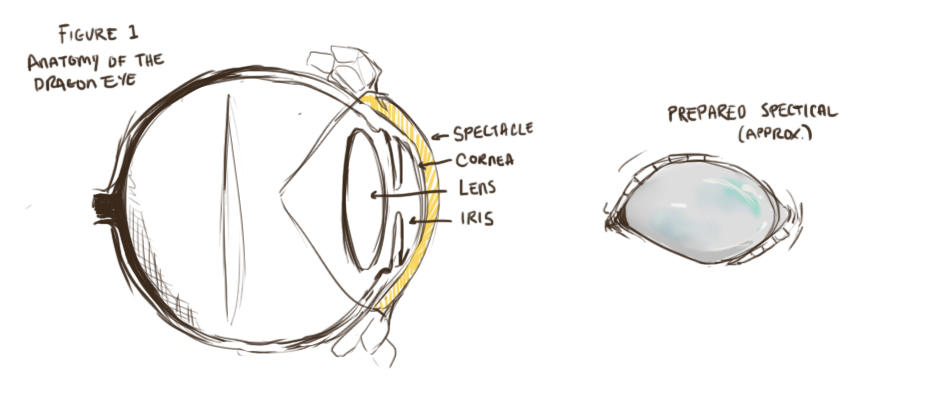
The spectacle forms a protective layer external to the cornea of the dragon’s eye. It consists of a keratinized layer that is shed with each molt. These structures are analogous to the scale-covered epidermis of basilisks and lesser reptiles. The subspectacular space is filled with tears (See Figure 1).

While Common Dragons (Draco parvus) have been domesticated successfully, the spectacles of these animals are too small to be of practical use. In contrast, the Royal Dragon (Draco regius) grows up to 18 hands high (6.6 chi) and possesses proportionally larger spectacles. However, the difficulties involved in maintaining such large and aggressive creatures puts them out of reach of most metafaunal collections, and precludes sacrificing these animals in sufficient numbers to make spectacle production economical.

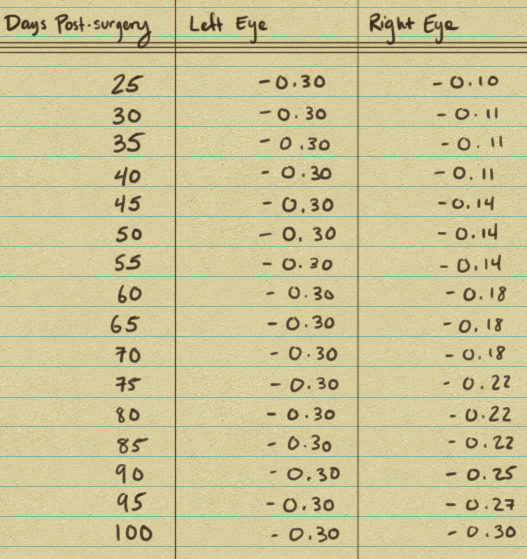
The goal of this study was to demonstrate a novel method for removing the spectacle of a live Royal Dragon without sacrificing the animal, and to assess subsequent wound healing.

On Dragon Eyes, Figure 1

Figure 1

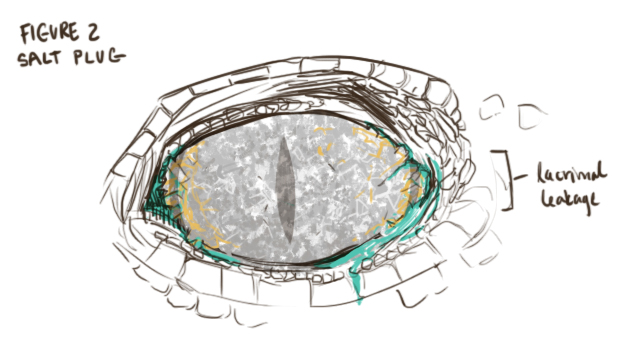
On Dragon Eyes, Figure 2

Figure 2

On Dragon Eyes, Table 1

Table 1


To read the rest of this story, check out the Mad Scientist Journal: Summer 2013 collection.


Simonius Selvius was born in Alexandria. He studied fauna and metafauna at the Confluential College of Mogran under the noted anatomist Leila El-Tahir. His thesis, “Antipyronic Bladders and Inflammable Fluids of the Royal Dragon” earned him laurels from the College of Mogran and his current post in the Metafaunal Department at the University of Heliopolis South.


Harun ibn Saleh Abd al-Bari has conducted numerous investigations into the properties of metafaunal tissue. Of particular note is his monograph on basilisk eyes and the problem of autotransmutation. His other works include “On the Gaze of the Basilisk and the Question of Petrifaction Versus Transmutation” and “Sensory Mediation of Vocalization Behavior in the Sirens of the Archipelago.”


Sarah Frost is a writer from Kansas whose mind has been warped by prolonged exposure to raw scientific research. Her work has appeared in Analog, Andromeda Spaceways Inflight Magazine, and Stupefying Stories, among others.


Katie Nyborg’s art, plus information regarding hiring her, can be found at http://katiedoesartthings.tumblr.com/

Posted in Fiction | Tagged , , , , , , | Comments Off on On Dragon Eyes

Our Devilish Savior

An editorial by Dr. Francis Niemann, as provided by J. Rohr
Photograph by Dawn Vogel


Damnation through salvation. The concept isn’t new. As St. Bernard of Clairvaux observed, “L’enfer est plein de bonnes volontés et désirs.” Or, in a more familiar fashion, the path to hell is paved with good intentions. Consequently, the promise of a better tomorrow may be exactly what undoes the world.

I don’t mean to be pessimistic. However, there are those who’ve espoused the notion my picture appears in the dictionary next to the definition of cynic. I laugh whenever someone mentions as much to me because I know that most people don’t understand the true nature of cynicism. It’s bred from failed romanticism: the constant ability to perceive how the world could be soured by the recognition of what humanity chooses instead. Naturally, people with a contrary perspective immediately call up a litany of meaningless examples. For instance, only the ignorant believe Pasteur’s hunt for disease occurred without any flagrant self aggrandizement; and additionally, it was Koch, not Pasteur, who humbly proved that specific, individual germs kill people. The fact of the matter is that while there are those who do well for humanity, they rarely act altruistically, and they pale in comparison to the majority.

In 1997, I developed an edible compound which contained a range of nutritional benefits. The intention was to devise a low-cost, nutrient-rich supplement. It did not sell very well until my business partner decided to deep fry the compound in bar form. Like overheated miso, deep frying killed off roughly 70 percent of the bar’s beneficial elements. Thus, a supposedly healthy alternative to cheese sticks made it into the market. Invariably, people tend to choose what they want over what they need, and they will utilize an extensive array of twisted reasoning to make it seem as if want is need.

Still, I made a lot of money off that endeavor. Yet, feeling a bit disgusted over exactly how I made it, I decided to put that money to good use. Thus, the International Center for Advancement was born. In the beginning, we boasted to be on the verge of radical technological advances, but then, after only three years, the doors closed. The closure stirred little outside interest, though a small group of scientists persistently wished to know what happened. For the last decade, I’ve been trying to avoid answering that question. But on the eve of Professor Pavel Sobakevich’s impending announcement, I feel the need to speak.

Our Devilish Savior


To read the rest of this story, check out the Mad Scientist Journal: Summer 2013 collection.


Dr. Francis Niemann is best known as the inventor of Altee Snacks, the fun fried way to stay healthy. He graduated from Stanford, though the university does not like to acknowledge any association with him. Once highly respected, his work to prevent technological advancements has made him a pariah in the scientific community. Dr. Niemann is currently touring the globe to promote his theory of balanced dependence.


J. Rohr has a taste for history and midnight barbeques. Internationally published, his work has appeared in places such as Jupiter, Annalemma, and 69 Flavors of Paranoia. Having recently finished a novella entitled Home Sweet Homicide: a tale of reasonable madness, he is operating the blog www.honestyisnotcontagious.com to deal with some of the more corrosive aspects of everyday life.


Dawn Vogel has been published as a short fiction author and an editor of both fiction and non-fiction. Although art is not her strongest suit, she’s happy to contribute occasional art to Mad Scientist Journal. By day, she edits reports for historians and archaeologists. In her alleged spare time, she runs a craft business and tries to find time for writing. She lives in Seattle with her awesome husband (and fellow author), Jeremy Zimmerman, and their herd of cats. For more of Dawn’s work visit http://historythatneverwas.com/

Posted in Fiction | Tagged , , , , , | Comments Off on Our Devilish Savior

Spring 2013 LIIIIIIIIVES!

Hello all! I pushed this back a day since we had a story appearing on the site, but now I’m free and clear to share with all of you: Mad Scientist Journal: Spring 2013 is now available through both Smashwords and Amazon. We’ve got a stellar line-up of featured authors this quarter: K.C. Ball, David D. Levine, Cat Rambo, and Trent Walters all have stories to share with you here.

As it percolates through Smashwords, it will also soon be available in the iBookstore, Kobo Books, Barnes & Noble, and other places! And, also, a gorgeous cover by Scarlett O’Hairdye!


Mad Scientist Journal: Spring 2013

Posted in Administrative | Tagged , , , , , , , , , , , , , , , , , , , , , , , , , | Comments Off on Spring 2013 LIIIIIIIIVES!

Keep Your Pants On

An essay by Dr. Keith Piantsov, Ph.D., as provided by Heather Frederick
Art by Luke Spooner/Carrion House


I’d been raised not to stare. But surely her dog wouldn’t mind–for science?

For a week, each morning she’d walked him past my table outside the library and made eyes at me. She had cropped hair and wore a sweater and jeans. I happened to like my girls a little more girl-like.

Her dog, however, was eye-catching.

Maybe not everyone would notice, but I was a biological anthropologist and a trained observer. And the fact that she could walk him around campus suggested scientific implications. My career was stalled–damn grants–and I was desperate for inspiration.

Keep Your Pants On


To read the rest of this story, check out the Mad Scientist Journal: Summer 2013 collection.


Dr. Keith Piantsov, Ph.D., is an Associate Professor of Biological Anthropology at a large university in Durham, North Carolina. He is best known academically for his extensive research on prosthetic limbs in tropical climates. He enjoys jazz music, wine tastings, and blues dancing.

He was last seen in the company of Dr. Emily Raynor, M.D. Ph.D., Professor of Medicine, Professor of Molecular Biology and Genetics, Director of the Center for Inter-Genomics, and her dog. Dr. Raynor was recently awarded a joint National Institutes of Health-World Health Organization grant to further state of the art transplant medicine in developing countries.


Heather J. Frederick is a medical doctor by training and a writer by choice. She writes short speculative fiction and, thus far, has completed one children’s action adventure novel in the little known “fluffy spy kitty” category. She lives in Durham, NC with her husband, two children, and four cats, none of whom are secret agents (that she knows of).


Luke Spooner a.k.a. ‘Carrion House’ currently lives and works in the South of England. Having recently graduated from the University of Portsmouth with a first class degree he is now a full time illustrator for just about any project that piques his interest. Despite regular forays into children’s books and fairy tales his true love lies in anything macabre, melancholy or dark in nature and essence. He believes that the job of putting someone else’s words into a visual form, to accompany and support their text, is a massive responsibility as well as being something he truly treasures. You can visit his web site at www.carrionhouse.com

Posted in Fiction | Tagged , , , | 1 Comment

A Case Study of the Side Effects of Nauseamin and their Possible Treatment

An essay by Dr. John Carver, as provided by Diana Parparita
Art by Scarlett O’Hairdye


Aidan was one of the first cases. Looking back, I should have noticed it sooner: the weight loss, the heavy makeup, her temper getting shorter and shorter like a burning fuse … But I thought it was just the wedding: a bit of a diet, trying on makeup for the big day, nerves … And I was out of the loop, not keeping track of “the plague” as they called it then. No one linked it to Harbringdon Pharmaceutical meds yet. You could still see their commercial for NauseaminTM in between news of the plague. The wonder drug that could cure nausea in five minutes, whether it was from food poisoning, morning sickness, or just your boss’s outrageous demands making you want to throw up. It really did work, just as quickly as the commercial said, and that’s what made it so popular. Even my father was impressed. For months I had to listen to him telling me how Harbringdon had come up with such a perfect drug while our own pharmaceutical company was “practically struggling” in his words, and why couldn’t I come up with something just as good, or at least finish writing my Ph.D. thesis.

Of course, that all changed when people found out about the side effects: weight loss, increase in physical strength and irritability, loss of physical and emotional sensitivity, regression of cognitive and intellectual functions, a markedly greenish pigmentation of the skin, and, ultimately, death. Death, or, rather, apparent death, followed by awakening in a state that the sensationalists called “zombification” and the journalists who strived to stay politically correct called “unlife.” But back then, no one knew it was Nauseamin that caused it, so reporters just called it “the plague.”

Looking back, I think I should have followed news of the plague more closely, asked permission to examine the afflicted, and tried to find a cure, if only to make my father proud. But all I could think of was Aidan and our wedding and the news on TV was always just background noise to me … until Aidan died.

A Case Study of the Side Effects of Nauseamin and their Possible Treatment


To read the rest of this story, check out the Mad Scientist Journal: Spring 2013 collection.


Dr. John Carver is the son of George Carver, CEO of Carver & Digger Pharm. He studied pharmacology at the prestigious Oxbridge University, but interrupted his studies during the outbreak of “the plague” caused by Nauseamin side effects. The scientific community was amazed earlier this year by his Ph.D. thesis on the side effects of Nauseamin, which has earned him considerable fame and government funding for further research. He is currently working with Dr. Peter Ashfield on testing and refining a “cure” for Nauseamin adverse effects at a secret Carver & Digger facility.


Diana Parparita lives in Bucharest, Romania, blogs rather infrequently at http://dianaparparita.blogspot.com and posts just-for-fun scribblings at http://dparparita.deviantart.com. Her work has appeared in Mad Scientist Journal: Autumn 2012 as well as a few other places.


Scarlett O’Hairdye is a burlesque performer, producer and artist. To learn more, visit her site at www.scarlettohairdye.com.

Posted in Fiction | Tagged , , , , , | Comments Off on A Case Study of the Side Effects of Nauseamin and their Possible Treatment

Hazelwitch vs. Hazelwitch

An essay by Judge Salvadore Ironfist, as provided by K.G. Jewell
Photograph by Dawn Vogel


(This story is also available in audio format at Toasted Cake.)


BE IT REMEMBERED on January 21, 2012, the Court held a hearing in the above-styled cause, and the parties appeared with counsel.

Background

Marlene Hazelwitch and Doreen Sneed were married on February 14, 2007. Marlene Hazelwitch’s kitten, Snuggles, was, with assistance, the ring bearer in the ceremony. Ms. Sneed changed her name to Hazelwitch upon execution of said marriage. The Hazelwitches cohabitated in matrimony for four years, sharing jointly in property and income throughout that time.

During this time period Doreen Hazelwitch, with Marlene’s encouragement, began studying the occult arts. After extensive investment of time, soul, and bodily fluids, Doreen joined a coven focusing on Discordian, or “prank” magic. Although the record is disputed, it appears that Doreen began utilizing Snuggles as a familiar shortly after her coven initiation. Doreen currently practices as a certified Hexwitch. Throughout the time period at issue, Marlene continued her traditional tarot practice.

On July 14, 2011, the Hazelwitches jointly initiated divorce proceedings, citing irreconcilable differences in demonic obligations. The parties have mutually agreed upon all matters relating to their separation except the disposition of Snuggles, and have beseeched the court to resolve that matter.

Hazelwitch vs. Hazelwitch


To read the rest of this story, check out the Mad Scientist Journal: Spring 2013 collection.


Judge Salvadore Ironfist has presided over the 12th District Arcane Court for the last four decades. In that time, he has heard testimony on over a hundred disputes involving garden gnomes. He no longer eats carrots.


K.G. Jewell lives and writes in Austin, Texas. He has never lost a cage match. His website, which is rarely updated, is lit.kgjewell.com.


Dawn Vogel has been published as a short fiction author and an editor of both fiction and non-fiction. Although art is not her strongest suit, she’s happy to contribute occasional art to Mad Scientist Journal. By day, she edits reports for historians and archaeologists. In her alleged spare time, she runs a craft business and tries to find time for writing. She lives in Seattle with her awesome husband (and fellow author), Jeremy Zimmerman, and their herd of cats. For more of Dawn’s work visit http://historythatneverwas.com/


Posted in Fiction | Tagged , , , , , | Comments Off on Hazelwitch vs. Hazelwitch