My Neighbour, Mr. Telford

An essay by Martin Telford and Geoff Stevens, as provided by Mark Carpenter
Photograph by Dawn Vogel


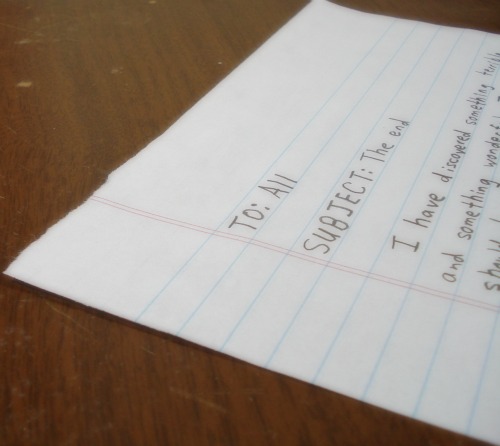
To: All

Subject: The end

I have discovered something terrible, and something wonderful. This discovery should have been one that would shock the scientific establishment and usher in a golden age of progress and development. But it won’t be. The discovery came too late, and because of it … well, in simple terms, the end is nigh and it’s my fault. As I write, the universe is beginning to collapse–and I destroyed it.

This is the story of how it came about. I am sharing this because I believe that even in our last moments, the population of the world has a right to know something as important as this.

I was doing experiments on particles to try and discover how the universe formed. I won’t go into details here, except that I was sending protons back in time by tiny increments, using my new Antimatter Trans-Temporal Displacement Bowl, enveloped in Tesco Own-Brand High Density Magnitude Multiplying Silver Shiny Foil. My logic was that by sending a number of protons to the same point in space time, there would be some sort of reaction and that might show me the secrets of the universe or something.

It wasn’t going very well. No matter how much Time Fuel I added, the protons weren’t budging. They just sat at the bottom of the Displacement Bowl and slowly got wetter. My experiment was a complete failure, so I tipped the contents of the Bowl into the Waste Disposal Cylinder and sat on the floor, slowly sinking into a deep meditation on the incomprehensible multiplicity of the universe.

A knock on the door woke me from my reverie. Surely it must be the courier from the Institute, I mentally ejaculated. I ran to open the door and sure enough, on the other side of it, dressed in the customary pink hat of the Institute of Science and the Universe, stood the courier. The courier said something I didn’t understand (I must say I disagree with the Institute’s secret policy on using illegal immigrants as couriers) and handed me the package. I nodded, thinking that was the most polite way to avoid saying I didn’t understand, but the courier appeared to take that as an invitation and gleefully pushed past me into my apartment. Not wanting to make trouble, I let it happen.

In the brighter lights of my home, I could see much more clearly that the courier was in fact a woman. In fact, it was a woman that I recognized–it was Margaret von Flubert, who lives across the hall.
My Neighbor Mr. Telford

As I write, the universe is beginning to collapse–and I destroyed it.

“Margaret!” I exclaimed, “I didn’t realize you were an Institute member too!”

I detected from Margaret’s countenance that she was unsure what to say next. My speech had been designed to trap her–and she had fallen in to it. It was with a heavy heart that I noted that Margaret must be a spy.

“A what?” she said, in English this time.

“Never mind. Come through to the lab.”

I couldn’t reveal that I knew she was a spy; that would spoil everything. I had to be clever about this. As she entered the lab, I realized with a start that I had left the Antimatter Trans-Temporal Displacement Bowl on the table. I carefully dodged around her so that I was between her and it–if I could stay standing here, she’d never see it.

Thankfully, I soon discovered that I had little to worry about. If Margaret was a spy, she was a severely ill-informed one. She looked at the protons and fuel I had left out, and said to me, with a serious countenance: “I wouldn’t have expected a man like you to like that sort of drink!” Alas, the poor girl doesn’t know the truth! Her bosses at the Team of Evil would behead her for this if they only knew! I feigned agreement, and told her that everyone has their guilty pleasures.

“Go on then,” she said, “pour me a glass.”

I was shocked. “Are you sure? It’s not good for you, you know!” The pitiful ignoramus! She can’t drink Time Fuel!

“You know, at my age I’ve sort of stopped caring.”

Fair enough, I thought, but if your intestines end up in ancient Carthage, it’s your own fault. I poured a glass of the orange fluid. She picked it up and gazed at it queerly.

“I’ve always thought something that color just shouldn’t be drank, but I guess it’s okay.” Before I could do anything, she had downed it. I stared at her, trying to hide my terror. She opened her mouth. “Actually,” she said slowly, “that’s not bad. But I don’t see why they can’t spell ‘brew’ right. Or ‘iron,’ for that matter.” I looked at the bottle. IRN-BRU. Funny, I could have sworn it was Time Fuel. I guess that explains why the protons wouldn’t go. Turns out old Margaret is cleverer than I gave her credit for.

After half an hour or so, she told me she had to leave. “I made something for you,” she said, leaving a package on the kitchen counter.

“Alright,” I said as she left. If I had known the significance of that package then I wouldn’t have been so nonchalant. I poured myself a glass of Irn-Bru.

I didn’t open the package until past midnight. I don’t sleep much. Inside the brown paper wrapping was a metal tin, and within that was a simple banoffee pie. I took the pie–oh, how stupid I was–and put on the counter, then took a knife and cut a thin wedge out of it. This was my first great mistake.

I took a bite from the wedge. This was my second great mistake, but also the start of my great discovery. There was something in the taste of the pie, something almost … cosmic. The realization came suddenly to me, as if the idea had been implanted into my brain by an outside force. The taste was so unique, so distinctive–it could be nothing else. That banoffee pie: it was the universe. The entire universe.

Some background: the universe exists within itself. I have known this for some time; it is quite simple to deduce. Firstly, the universe is a thing. All “things” exist somewhere. Secondly, the universe is everywhere. That means that the universe must exist somewhere within the universe. Clearly, Margaret found it–or was given it–and gave it to me, recognizing me as the expert on the subject. And what did I do? I took a bite out of it. Truly, I am terrible. But it gets worse.

While I was confident that the banoffee pie was in fact the entire universe, I knew that the scientific community wouldn’t accept my explanation of “it definitely tasted like the universe” if I were to try and prove it to them, and of course I could never invite them to eat it or else we’d damage the universe more than I already had. No, I would need to run some tests.

After taking the Universe through to the lab, I inserted what I thought was a scanning implement into the top of the top of the banoffee pie, being careful not cause any more damage than was absolutely necessary. Upon turning the device on, however, I discovered that it was not, in fact, a scanning implement, but was instead some sort of high-speed mixing device. This was my third great mistake, and the greatest of the lot. A set of blades on prongs started rotating at incredible speed, and before I knew what was happening there was more Universe on the ceiling than there was on its designated plate.

I have destroyed the universe. Of course, with something this huge, there is bound to be some delay between the destruction of its physical “thing” and the actual destruction of the greater version of itself as observed by humans. When you look into the night sky, you are looking into the past: the light of even the nearest star takes years to reach earth, and the light from distant quasars takes billions of years to reach us. It makes sense that this sort of destruction would work in the same way.

But destruction moves faster than light. I don’t know how long we have left. It could be minutes. It could be years. If we’re lucky, it could be a century. I doubt it. No matter how long it takes, though, the fact of the matter is that we’re going all going to die in the relatively near future.

I’m really sorry, everyone. It’s my fault really. I mean, I know that Margaret could have been a bit more specific with regard to what she was leaving at my place, but she wasn’t the one that accidentally blended it. The full responsibility for that can go to no one but myself, and from the bottom of my heart I sincerely apologize.

What follows is an account from Geoff Stevens, a neighbor of Martin Telford. As will become apparent, this note was written before the first stars began to disappear. Geoff Stevens has since publically retracted some of his statements.

Mr. Telford is generally a decent enough neighbor. He’s very quiet and doesn’t go out much, but he never causes any trouble and the few times we have spoken he’s seemed incredibly nervous, but never unpleasant–and oddly enough, he’s always appeared to understand me completely. Every so often, though, I would get a strange note put through my letterbox. I think everyone else on the floor gets them too. Mostly they’re just odd, like bizarre requests for non-existent equipment. He kept bugging Mrs. Rogers from number twenty-two let him borrow her “antimatter trans-temporal displacement bowl”–only with politely written notes passed through the door, mind you. She gave him her colander in the end, and apparently that was satisfactory. If I said that its appearance in this note didn’t amuse me I’d be lying.

We all quite like him here. He’s like a weird little mascot for our floor of the building. It gives the place a bit of character, you know? A little character goes a long way in a concrete cube like this. Poor old Mrs. Fallows, whose husband died last year, is particularly taken with him. She bakes him a cake every Tuesday and Thursday. He accepts them graciously, naturally, but he’s never returned the attention. She keeps trying though, bless her heart. It seems like he doesn’t even know her name. He thinks she’s called Margaret. She’s not called Margaret, she’s called Penelope. But I can’t dislike him for that.

Physically, he’s a short, slender man. He looks about fifty, but his mannerisms make me feel like he’s older than that. When we talk, he’s always impeccably polite and calm. His voice is soft and a little posh. Once, I tried to look him up online. I found very little–a mention on the Lancaster University website, on an old cached version of the page. His name–Martin Telford–was at the top of the alumni in large letters for approximately a week, seven years ago. It says he studied physics, which is believable enough. Perhaps he was someone important once but for some reason he’s being erased from existence. Perhaps it was a glitch and a coincidence. I don’t think I’ll ever know for sure.

This message is unique because it is the only one formatted as an email (even though it was clearly written out by hand with a blunt pencil), and it’s also by far the longest and most interesting. He’s an interesting man, to say the least. I’ve contemplated telling someone about him, but he doesn’t seem dangerous and he appears to be content enough here. Considering how the note ends, I was worried he’d gone and had a breakdown or something, but I spoke to him this morning and he was as calm and amiable as ever. He still thinks we’re going to die imminently, but I guess he doesn’t think there’s any point in panicking about it. I told him that was the right way of thinking and let him be. And how embarrassing would it be if it turned out to be an elaborate joke at everyone else’s expense?

-   Geoff Stevens


Martin Telford is a retired physicist who lives alone in a small flat in the London suburbs. As a researcher, his most important work was on the development of [REDACTED] for [REDACTED], which [REDACTED] but fortunately [REDACTED].


Geoff Stevens is a stay at home dad who gained international fame for revealing the identity of Martin Telford, the man who we believe destroyed the universe.


Mark Carpenter is the pen-name of a student and writer from the far north of England.


Dawn Vogel has been published as a short fiction author and an editor of both fiction and non-fiction. Although art is not her strongest suit, she’s happy to contribute occasional art to Mad Scientist Journal. By day, she edits reports for historians and archaeologists. In her alleged spare time, she runs a craft business and tries to find time for writing. She lives in Seattle with her awesome husband (and fellow author), Jeremy Zimmerman, and their herd of cats. For more of Dawn’s work visit http://historythatneverwas.com/

Posted in Fiction | Tagged as: , , , , , , | Leave a comment

Leave a Reply

Your email address will not be published. Required fields are marked *

You may use these HTML tags and attributes: <a href="" title=""> <abbr title=""> <acronym title=""> <b> <blockquote cite=""> <cite> <code> <del datetime=""> <em> <i> <q cite=""> <strike> <strong>