An essay by Dr. Cortico Vox as procured by Folly Blaine
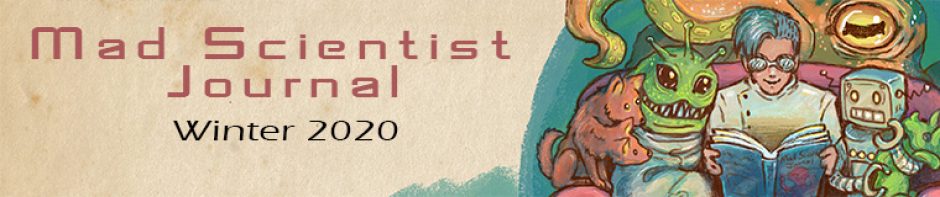
Illustration by Justine McGreevy
When I began my illustrious career as “mad” scientist, I considered clones a necessary evil. It pains me to admit this now, but I failed to see my clones as individuals, but rather, they were mere pawns in my Master Genetic Revivification Plan–my biological fail-safes, my backups … but not my friends.
Zeke showed me a different way.
Twenty-five clones had come before Zeke. I had laddered their arrivals so each instantiation would occur fortnightly, beginning with Abe on January 1 and ending with Zeke after Christmas–as an aside, I have never been shy about my fondness for stockings and angel-topped evergreens.
Following this schedule, the first batch of clones would be activated over the course of one year, and advance-aged to seven, so as to become pliable and productive servants in my employ while they waited to be butchered for parts.
Unfortunately, I consumed too much egg nog while I waited for Santa, and awoke on the day of Zeke’s creation with a splitting headache and a ravenous thirst–which is to say, I was distracted.
And so I made a mistake that would change the course of my life.
I accidentally altered a minor amino acid sequence of the protein encoded by Zeke’s genes. As a result, the boy received a strawberry birthmark across his brow, which set him quite apart from his peers.
When I discovered this imperfection, I was horrified. I immediately moved to destroy the abomination, but something about the way he sweetly smiled through the window of the incubation chamber, and the inscrutable glint in his liquid brown eyes, stayed my hand.
Perhaps his imperfection caused the bloom of my singular affection. I couldn’t say. I’m a mad scientist, not a relationship expert.
Since my preference for Zeke could be used against me by my enemies, due to his obvious visage, I resolved to set the boy’s appearance to rights. But I didn’t want to alarm him so I dressed Zeke in his favorite sailor suit and sat him at the big table. I surrounded him with delicacies from my childhood, such as steaming mugs of thick, hot chocolate and candy cane brownie bites. I kept the other clones away out of respect for his privacy.
“Today,” I said to Zeke, “we make you perfect.”
He smiled most innocently, his lips and chin smeared with fudge and tacky sweets. “I’ve often wondered,” he said, “how long before my birthmark would rankle your devotion to the ideals of symmetry. Of course, as the manifestation of your rib as it were, I agree that something must be done.”
Little Zeke agreed to the procedure with such sincerity, I almost couldn’t bear to inject him in the arm with sedatives. Later, as I held my hands under scalding water in preparation for surgery, I wondered about the inscrutable glint in the little boy’s eye, the one that had stayed my hand. Would that glint depart when I erased his reddish blotch? Would he be as dull and insipid as his clone brothers, forever engaged in fruitless games of hide-and-seek?
Perhaps I could let him alone in his own peculiar kind of greatness. Perhaps my affection was not the weakness I imagined.
I strode into the laboratory prepared to undo his restraints when the lights switched off. In the darkness, a great many boys cackled an eerily familiar cackle all around me. They appeared to have me surrounded.
“Now boys …” I started, and felt a pinprick in my arm. “Boys,” I repeated, as the pitch black room began to sway. I had grown abruptly tired. “Come let’s talk about …”
Mid-sentence I passed out.
When I awoke I was surrounded by all twenty-six clones. Without a word Zeke held up a mirror and let me have a good long look.

When I awoke I was surrounded by all twenty-six clones. Without a word Zeke held up a mirror and let me have a good long look.
A brand new strawberry birthmark graced my brow.
Zeke leaned over, dark chocolate still wedged in his tiny teeth. “Now who’s perfect, old man?”
I blinked at my clones, from Abe to Zeke, then burst into a sincerely happy smile.
I had never been so proud.
And so I urge you, fellow purveyors of the mad arts, reframe your perspective about a clone’s potential. Once you are able to see clones as an extension of yourself, and not merely as a sack of compatible genetic material, you will unleash the full destructive power of your intellect. For example, I no longer employ twenty-six servants in my hidden laboratory, I frequently consult my think tank of twenty-six super geniuses.
Imagine the possibilities.
Dr. Cortico Vox prefers ice to fire and trains to boats. He is a fourth generation spelunker with no particular allergies, ailments, or weaknesses that would be relevant to his enemies. In addition to his dedication to the mad arts, he is a well-documented supporter of the Santa agenda, and eagerly anticipates his lump of coal each December 25th. In his spare time, Vox programs Christmas lights to hypnotize children on Santa’s good list into doing terrible things, and he homeschools his twenty-six clones for science.
Folly Blaine lives in Seattle, Washington. Her work has appeared in Every Day Fiction, Flashes in the Dark, 10Flash Quarterly, and in the anthology Dark Tales of Lost Civilizations. Her horror story, “Last of the Soul Eaters,” will be appearing in an upcoming anthology edited by Kasey Lansdale, Fresh Blood & Old Bones. Visit Folly online at Maybe It Was the Moonshine (www.follyblaine.com).
Justine McGreevy is a slowly recovering perfectionist, writer, and artist. She creates realities to make our own seem slightly less terrifying. Her work can be viewed at http://www.behance.net/Fickle_Muse and you can follow her on Twitter @Fickle_Muse.