Robot Ethics and the Turkish Turtledove

An essay by Mando Viday, as provided by Django Mathijsen


Dylah wasn’t the prettiest girl I’ve ever known. Still she is the only one I often recalled with melancholy and even regret. Because although we’d been close, we’d never become “an item.” I’ve often wondered if she should have been the one. So it was no surprise that I recognized her straight away this afternoon, in spite of the fact that I hadn’t seen her since March 2029, almost six years ago. In hindsight, it was also no surprise what subsequently happened. I couldn’t see it coming though. Not for one second. Not even if I’d stopped to think about it.

#

As usual I’d escaped my office and its choking air-conditioning for an hour around lunchtime. Outside a soothing warmth enveloped me, nurturing like a child’s blanket. A big, white blob splashed apart exactly on the tip of my shoe. A “message of love” from a turtledove that flew up and brushed past my head, chased up by two screaming crows.

“Missed me!” I yelled up to the bird as I burst out laughing. The sunlight stabbed my eyes. I bent over to wipe my shoe. A playful breeze caressed my cheeks. The silver birches at the fountain, which were planted in geometric patterns, were waving back and forth. Loudly rustling in its foliage, the dove found refuge.

That’s when I realized that even on these corporate premises, cordoned off from the outside world with razor-wire, high-voltage fencing, and aramid-concrete walls, nature couldn’t be locked out. Mother Nature was defiantly radiating as if she was celebrating the beginning of summer tomorrow. Even the thirty-foot-high, horizontally whirling windmill that shone on top of the twelve-story office bunker like a crumpled up helicopter rotor, was merrily dancing to her rhythm.

Maybe it’s not fair to call the office building, which was shaped in “biometrically dynamic curves,” a bunker. Sure, you’d be hard pressed to find any heavy stones or stern angles on it. The building had completely been wrapped in flowing curvatures with inflatable plastic façades in primary colors. Those façades opened like rose petals when the solar rays hit them and closed again as it got dark.

But under that “essence of nature and humanity encapsulating” illusion I could still feel the bunker that swallows up people and forces them to degenerate into efficient, creative office slaves.

Don’t get me wrong. I’m not complaining. Like most people in the civilized world of today, I had entered into this daily incarceration of my own free will and happily endured it. That was just the price I had to pay to be allowed to do groundbreaking research, to work with the best tools and cooperate with the smartest people. People who were now all huddled together in the office canteen, which was craftily disguised as a tropical oasis. With air-conditioning of course.

#

With the scent of freshly cut grass in my nose and the languor of the day in my legs I strolled along the test track. All over the place, unmanned cars, laden with sensors and electronics, were autonomously making their way through complicated circuits.
“On a day like this I’m really jealous of your job, Helger,” I said to the tall, skinny security guard at the side-entrance of the site, while I offered him my right shoulder.

“Then let’s trade places,” Helger suggested with a smile, while he read my subcutaneous identity chip with his scanner. “Just put your paycheck right here in my hand.”

“Done,” I said laughing. “Hand over that uniform then.”

“It’s definitely no punishment to stand here today,” Helger crinkled his eyes. “I’ve already enjoyed a lot of spectacle this morning. Over there, where those people are working with that tow truck, two robot cars smashed into each other head-on. And do you see that little wooden shack there?”

I could only see a sloppy pile of wooden planks that looked like a bomb had gone off in them. “Damn! What’s happened to that?”

“Blown up by the Robot Emancipation Front,” he answered with a serious look in his steely blue eyes.

I felt an instant wave of fear running down my spine. “Really?” I asked.

“Gotcha!” With a triumphant grin he pointed at me. “No, man. One of the robot cars just went totally ape and tore through it full throttle.”

“I should have known!” I cried out. “We don’t need the help of those activist nutcases to mess things up.”

“You’re wasting your time,” he said, shaking his head. “You’ll never get those robot drivers to perform perfectly.”

“We don’t have to,” I explained. “Human drivers make mistakes as well. On average, our robots already cause far less accidents.”

“And still you’re not allowed to sell them to the public.” He waved his index finger at me like a schoolteacher.

“That’s not a technical but a legal problem.” I shrugged my shoulders. “I bet the sun was still low when that little shack was destroyed?”

“Yes, it was.” Helger looked at me with a baffled look in his eyes.

“If the stereovision sensors are blinded, the radar and lidar systems have to compensate for it. But since the newest generation radar systems came out, we’ve been having a lot of trouble getting them to cooperate with the lidar system. It’s some compatibility issue that still has to be sorted out.”

“Is that what you’re going to brainstorm about this afternoon in the zoo?”

“No, I work on the normative and moralistic algorithms,” I declared as if that went without saying. “I’ve told you that hundreds of times before, haven’t I?”

“Yeah, maybe. But every time you say ‘normative’ I always stop listening,” he said with a smile.

“Then unfortunately you’re not suitable to do my job,” I said with an earnest face. “So please, give me back my paycheck, will you?”

#

As always I crossed the road near the remnants of the old bus stop. Fortunately the traffic in these back roads nowadays obeys the 35 mph speed limit very well, since the speed restrictions on the superhighways were lifted. I did have to jump aside again for a recumbent bicycle that came flying in low on the wrong side of the road.

Via a shallow spot in the ditch next to the road, I walked over to the thin spot in the yew tree hedge. Before ducking down to lift up the branches to slip through, I spied around. Only Helger could see me.

#

With a feeling of freedom (and the satisfaction of doing something “illegal”) I strolled along the cages: that’s the ideal way to clear your head and shake off all stress. I’ve got some of my best ideas there.

Okay, I admit: I still wasn’t completely free there. In the back of my mind I’m always thinking of artificial intelligence. But that’s okay. I love my profession. Strange interactions in the monkey cage or cooperative behavior in the rat colony have often inspired me.

At the parrot cage a wave of recognition suddenly went through me. Those sloppy black curls. That long, sleek neck. That hooked, always slightly opinionated looking nose. That proud, laidback posture.

“Dylah?” My superfluous question was out before I realized it. My heart skipped a beat.

She turned around and looked at me with a frown. “Mando!” she exclaimed. Her strangely transparent, gray eyes shone as she took stock of me. “You haven’t changed a bit.”

“Neither have you,” I said absent-minded. “Except for those crow’s feet.”

“Well, that’s nice!” she said with an insulted pout, putting her hands in her sides.

“But they look good on you,” I quickly assured her.

#

“Suddenly you were gone,” I said while I stirred my mug of banana yogurt on the rough, wooden table. “No explanations, no messages, nothing. Your mother could only tell me that you’d flown to your grandma in Ankara.”

“I just couldn’t take those artificial intelligence courses anymore,” she said and blew into her mug of cinnamon coconut milk to cool it down. She really hadn’t changed a bit: hot cinnamon coconut milk in a seventy degree heat!

“But we always used to play with your rabbits and my little mindstorm robots,” I said surprised. “We used to build labyrinths for them. We programmed robot dancing shows. You were just as clever with the robots as I was. Do you remember that contest we won?”

“At university everything was different.” She sighed as she was looking around helplessly on the terrace of the zoo restaurant. “I just had to get out. So I went to my gran for a year. I traveled a lot afterwards through Iran, Afghanistan, and India. And finally I wound up in China where I’ve spent the last three years.”

“Are you back to stay now?”

“So you did finish university?” she evaded my question. She nonchalantly rested her arm on the log that separated the restaurant terrace from the winding path where the zoo visitors were lounging about, gaping at the animals in their cages.

“Yes. I’m working on my dissertation now, back here at RCI,” I answered. “Robotic Car Innovations.”

“How exciting,” she said with a naughty look in her eyes. That was the exact same look she always used to have as a child when she was about to involve me in one of her adventures. “I saw you guys on the news last week.”

“That was probably when the Robot Emancipation Front was demonstrating at the main entrance.”

“Are you guys doing anything shifty that needs to be demonstrated against?”

“Are you kidding?” I waved it aside. “Of course not. Those activist nutcases are just always looking for something to object to. Now that finally there are stem cell grown test organs, so nearly all medical animal tests have been abolished, they’ve bombarded robot programmers to be the new bad guys.”

Robotic Ethics and the Turkish Turtledove

"Twaddler really knew how to sell it," she said and started to scribble on my chest with the lipstick. "Emotions and feelings are essential for the successful functioning of people. And so it follows we have to build them into robots as well."

“So what exactly were they demonstrating against?”

“They don’t want us to make ‘sapients’,” I reluctantly explained. “Programs with life goals that take initiatives and philosophize about their actions. Surely you remember them from Professor Trottler’s classes?”

“Twaddler,” she confirmed and nearly choked on her cinnamon coconut milk.

“The one and only!” I laughed. “In those programs we emulate feelings and consciousness, ethical norms, and moral values. And even belief structures. Do you remember my little robot dinosaur? You know, the one we used to play with when we were little?”

“Pleo,” she said with a smile, while she wiped away her cinnamon coconut moustache with the back of her hand. “Who you threw into the canal because you wanted to know if he could swim.”

“Because you refused to believe he could swim, missy!” I cried out.

“How long we pestered your dad, until he finally drove us out to the river where we searched all night for him.”

“I thought we’d agreed never to talk about that? The loss of Pleo was very traumatic for me.” I exaggerated that of course. But not a lot. “Pleo was already a sapient, although a very primitive one. A robot driver is far more complicated. He constantly has to make difficult moral decisions. If for example his sensor modules calculate a one percent chance that the vague blob he sees straight ahead is a cyclist, should he brake or not? And what if he’s driving along with children in the backseat just in front of a sixty ton truck and suddenly a pedestrian falls onto the road in front of him? That’s when his morality systems turn the scales. And those systems are what I work on.”

“How long have you been married?” She pointed towards my ring.

“Almost two years.” I opened the pendant of my necklace.

“Pretty girl,” she said as she looked at Astrid’s hologram. “I see you still have a thing for blondes. Are you guys happy together?”

“Sure.” I felt uncomfortable. When we were kids, she could always tell when I wasn’t speaking the whole truth. Those gray eyes always seemed to look right through me.

“Children?”

“Easy, easy …” I made a “calm down” gesture. “And have you got anyone special in your life?”

She shook her head and rubbed her index finger over her mug, staring dreamily into her cinnamon coconut milk. “Have you ever wondered why we’ve never become an item?”

I was shocked. That was the only thing we never used to talk about.

“Relational asynchronicity,” I answered without having to think about it.

“Excuse me?” She opened her eyes wide.

“Every time you were free, I had a girlfriend. Whenever that was over, I looked you up. And every single time I had to listen to you rave on for hours about some brand-new boyfriend you’d just run into …”

“… and as soon as my relationship had ended, you were taken again,” she finished my sentence and nodded. “Have you any idea how much agro I’ve had with boyfriends who didn’t want me to see you?”

I burst out laughing. “My girlfriends always thought I was cheating on them with you. They somehow couldn’t believe that you were just my best friend.”

“Or they couldn’t accept it,” Dylah added.

“Ah, well. People only believe the stories they make up in their own heads.”

“Can you remember how we climbed into the robot room at school on a Sunday to copy that new mindstorm-upgrade?”

“For which I subsequently got a week’s worth of detention?” I laughed as I slammed my fist onto the table. “Girl, you used to have an extraordinary talent for getting me into trouble!”

“Innocent little boy,” she sneered with a defiant look in her eyes.

I bent over the table and whispered: “Do you know how I get in here?”

“Season ticket?”

I grinned. “Come on.”

#

“So while I’m coughing up my hard earned, Mister Mando sneaks in for free every day,” she correctly assessed the situation. She stood with her hands in her sides, looking at the gap in the hedge we’d just slipped through. As I watched her standing there like that, it felt like we were eleven again. She was still wearing a frayed old sloppy joe and faded black work trousers with four pockets per leg.

“How did you find out about this?” she asked.

“Look over there, behind the trees.” I stood behind her and let her look along my pointing finger. Her sweater waved softly against my belly. I felt her warm shoulder against my chest. She turned her head and looked me in the eye.

“What am I supposed to see there, except that high wall?” she asked.

I could smell the cinnamon on her breath. I felt sixteen again.

“Helger, our security guard,” I stammered. “He told me about this, shortly after I’d started working there three years ago.”

“Can I see your office?” she asked as she grabbed my hand. Without waiting for an answer, she pulled me towards the shallow place in the ditch. “I’m really curious where I would have wound up if I had finished university.”

“But you’re not allowed in there. Highly confidential!”

“Yeah, that’s what they all say,” she said as she looked me up and down. “Those important business types with their ambitions and wives and shirts with woven in telephones, health monitors, and appointment calendars.”

#

“That’s the first time you’ve ever brought back a souvenir for me,” Helger said, winking at me. “Liberated from the monkey cage?”

“Another charmer,” Dylah sneered and drew an insulted face.

“No, I dug her up in the snake pit,” I teased. “Dylah’s a good friend. I’d like to show her where I work.”

Helger sighed deeply and folded his arms with a stern look on his face. “You do know that you should clear that with the PR department?”

“Just for a few minutes, Helger.”

#

“It’s like a whirligig!” she cried out as we went up with the spiral lift. She spread her arms and stared through the floor. “Wee! Can’t you make it go faster?”

The transparent polycarbonate elevator boxes hung from large, green screws which were attached to the outside of the walls of the ‘bunker’ like ivy. Like maple seeds the boxes wound themselves up and down around the screws.

“What’s this for?” She slammed into the button that said ‘blind’ and the elevator box suddenly became opaque green.

“That’s for people with acrophobia,” I answered.

She hit the button once more and the box was translucent again. “That’s much more fun. I can see the whole zoo from here!”

#

“This is where I run my simulations,” I said while I sat down behind my three-dimensional screen. Suddenly Dylah grabbed my wrists and pushed me and my desk chair back until the back of the chair bumped into the window seat.

Legs apart she stood in front of me. With a promising grin she pushed my arms down. She caressed my forearms and wrists.

Suddenly she let go. That’s when I felt the cold hard steel of the magnet cuffs she’d used to tie my wrists to the armrests.

“I didn’t know you liked those games,” I said with an uncontrollable giggle while she started to unbutton my shirt. “Did you learn this in China? What if someone was to come in now?”

Painfully slow she produced a fiery red object from a trouser pocket.

“Since when have you been using lipstick?” I asked.

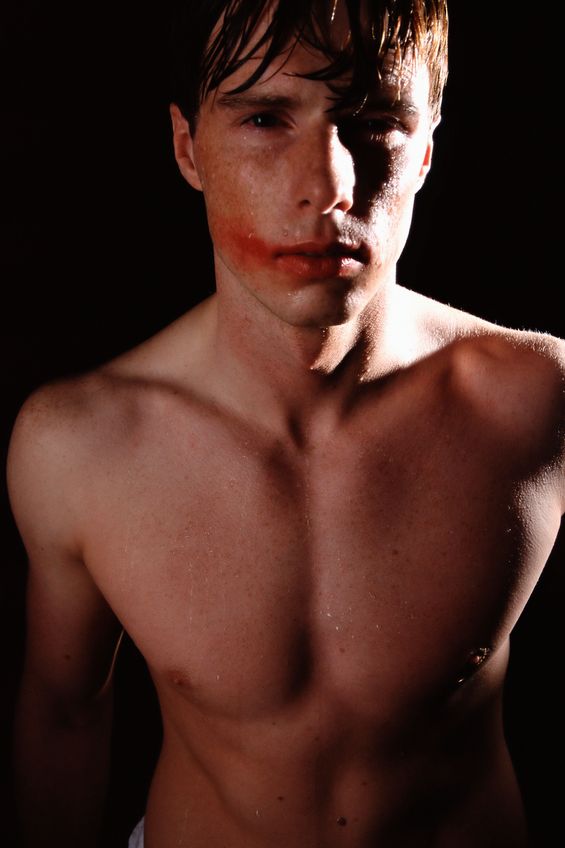
“Twaddler really knew how to sell it,” she said and started to scribble on my chest with the lipstick. “Emotions and feelings are essential for the successful functioning of people. And so it follows we have to build them into robots as well.”

“Come on. Untie me, please.” The lipstick tickled my chest. “I’m going to get into so much trouble if they find us here like this.” Reading upside down I could just manage to piece together what she was writing on my chest. In cheerful, bright red letters, like you see on the banner at a child’s birthday party, the text said “I breed slaves.”

“It had me lying awake in my bed for nights on end,” she proceeded. With a wild hand gesture she brushed a lock of hair out of her face. “Purposely creating something that suffers pain and unhappiness.”

“But those are just imitations,” I objected. “Little voltages in semiconductors. Fake feelings.”

“I know that you didn’t get it,” she said and looked at me with a sad look in her eyes. “Not even you, my best friend, my buddy. Have you any idea how hard that was for me? Your feelings in your neurons are just little voltages as well. Are they fakes as well? When we lost Pleo, we were just as sad as when one of my rabbits died. Didn’t you feel Pleo’s pain, love and happiness?”

“You’re on about robots like they are human.”

“So you work on ethics algorithms. Then you must remember Professor Hallman’s ethics class. About Hillary Putnam, who already spoke of civil rights for computers and robots more than half a century ago. As soon as you give them feelings, they’re no longer dead objects. Then you have to treat them like living beings that have a right for happiness. Still you develop robot drivers who feel pain in a collision and grief if they get into a traffic jam …”

“Feelings …” I interrupted her, “imitated feelings make robots more efficient. Pain, grief, punishment and reward are wonderful incentives.”

“Yeah, the masters of human slaves sure thought so,” she judged. “You guys handle robot rights so opportunistically! RCI, insurance brokers and car companies are lobbying like crazy to get robot drivers legally recognized as persons. But only so far that those robots can be made liable if they cause an accident. Robots only get the burdens that go with being a person but none of the benefits.”

“Otherwise we could be made liable,” I explained while she started to put lipstick on her lips. “And corporate liability leads to astronomic insurance claims. That would surely bankrupt us. Car owners cannot be made liable either for accidents caused by their electronic drivers, because then they wouldn’t buy any robot drivers in the first place. So the robots themselves have to be persons that can be made liable.”

“And because robot drivers cause less accidents, less people are hurt and killed,” she added. “We don’t have to drive ourselves anymore. RCI, the car companies and the insurance companies get stinking rich … Everybody wins!” She made a big, triumphant gesture.

“Exactly!”

“Except for the robot drivers who have to suffer the pain and sorrow for it. In a heavy accident, their personalities even get deleted and replaced.”

“Only if it’s been proven that the development of their moralistic systems has gone wrong.”

“Don’t you realize that this means the death penalty for robots?” She slowly bent over me.

“Are you completely out of your mind?” I cried out while I felt her lips press a big, red kiss next to the ‘b’ on my chest.

“I thought that was one of the things you always liked about me,” she said while she produced a memory diamante from another trouser pocket. “Didn’t we always have a lot of fun together?”

“We didn’t meet by chance today,” I concluded as I watched her insert the memory diamante into my three-dimensional screen. Suddenly I was terrified.

“Your company isn’t connected to the omninet. So we had to introduce the virus locally,” she explained. “In ten minutes it will start to delete RCI’s memory banks. Exciting, isn’t it?”

“Did you stop to think what the consequences for me would be?”

“I’m sorry, dear Mando, but punishment and reward are wonderful incentives.” She walked over to the door. “Think about that until we meet again.”

Before she opened the door, she took a little mediatelescope out of yet another trouser pocket.

“Smile!” she yelled as she took the picture. “And say ‘hi’ to your wife from me.”

#

After she’d closed the door, I burst out laughing. As soon as they’d find me, I was probably going to lose my job. And not only that. My dissertation, my marriage … everything that had always been so important for me. But the amazing thing is that, to my surprise, I suddenly realized it just didn’t interest me anymore. For the first time in my life, I felt the sensation of real freedom. Right here in my office. Cuffed to the chair.

I pushed my feet off against the hemp carpet to turn my desk chair around so I could look out the window. While I watched a turtledove take off from a silver birch and fly away, my last cares and thoughts flew away as well. Except for one. That one little thing she’d said: “until we meet again.” That thought made me tingle all over. Did this mean that I’m going to get together with that crazy activist nutcase after all?


Mando Viday always was into robotics and always wanted to be the best. He already competed in Mindstorms competitions at the age of six and in Robot Wars as a student. Historians disagree whether Mando’s jail time and the sex-scandal following the incident at RCI ended his scientific career, or that it allowed him to find his true vocation. The only thing we know for certain is that he went on to join Helger Scheckman’s detective agency “Roborec”, becoming the first and foremost private detective, specialized in robotics technology.


Dutchman Django Mathijsen (www.djangomathijsen.nl) is the only author who’s won the Unleash Award, the most prestigious Dutch SF-story award, three times.

As a son of professional musicians, he was a jazz-organist while graduating as an engineer at the Eindhoven University of Technology. He was technical consultant on the award winning British TV-programs Robot Wars and TechnoGames. And as a science journalist he’s written over three hundred articles for English and Dutch magazines.

Now, he concentrates on writing music and fiction. His first novel, a science fiction techno-thriller published in Dutch in March 2010, was based on Mando’s story.


Image credit: imagesource / 123RF Stock Photo

Posted in Fiction | Tagged as: , , | Leave a comment

Leave a Reply

Your email address will not be published. Required fields are marked *

You may use these HTML tags and attributes: <a href="" title=""> <abbr title=""> <acronym title=""> <b> <blockquote cite=""> <cite> <code> <del datetime=""> <em> <i> <q cite=""> <strike> <strong>