We have a new collection out for sale! It’s at Smashwords and Amazon now, and will be available at other ebook stores as time goes on.
We have a new collection out for sale! It’s at Smashwords and Amazon now, and will be available at other ebook stores as time goes on.
An essay by Professor August Flemming, as provided by David Neilsen
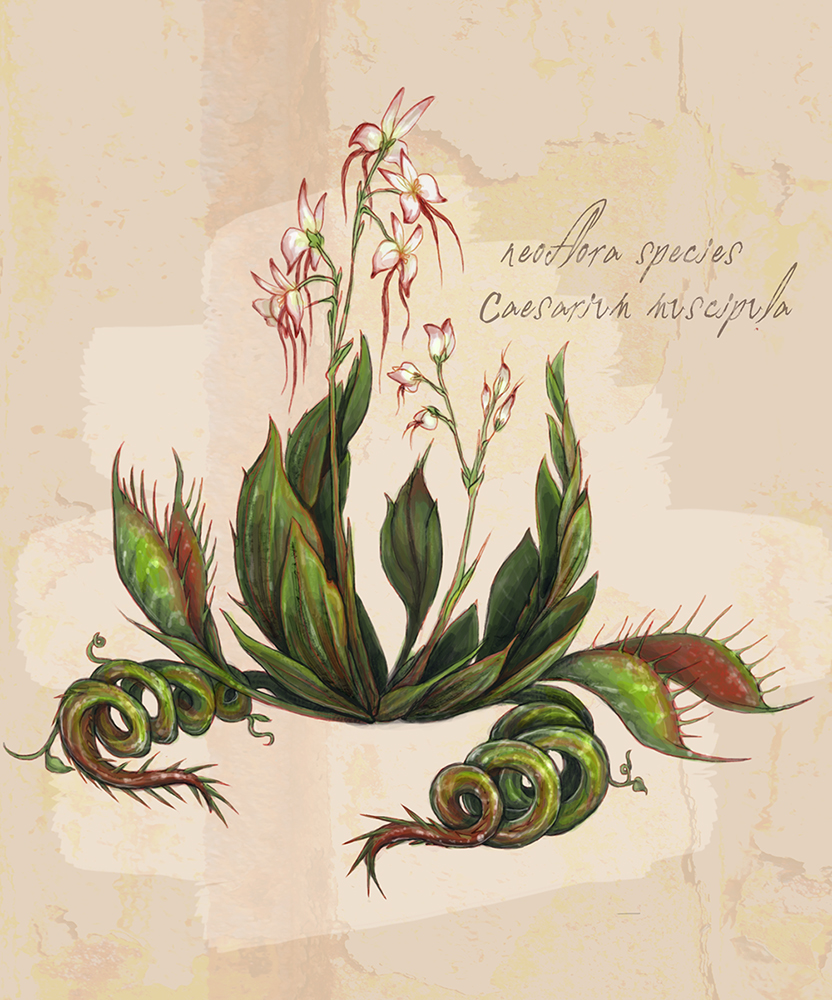
Art by Leigh Legler
Respected Board Members,
It is with great urgency that I reach out one final time in an attempt to dissuade the Board from its calamitous decision to withhold further funding for my project.
Mrs. Davis’s injuries aside, the fact that members of this Board were taken aback at the contents of my presentation is a testament not on the quality of my research, but on the limited imaginations of those foolishly entrusted with safeguarding and nourishing this University’s scientific reputation.
I admit that my studies and experiments may be seen as unorthodox, but I defy anyone to prove they in any way deviate from my original proposal. When I came to this noble Board over two years ago, I professed my aim to create strains of common agricultural varieties through genetic engineering that could withstand the damage being done to this planet by our species. We are killing our world. On a purely practical level, if mankind is to survive (I leave it to others to debate the morality of this question) we must develop new sources of food that can thrive on an ever-warming globe.
All I have done is succeed beyond my wildest dreams. How, I ask you, is that a crime worthy of banishment from the hallowed grounds of the very University to which I have pledged my life? Where have I done wrong? Why has the Board chosen to act so stringently now when four months ago it turned a blind eye to the unfortunate business which forced my graduate assistant, young Jeremy Franks, to take up residence in Newton Psychiatric Hospital?
What message does this send the world at large? That the sanity of a brilliant and promising student is tragically unimportant but the well-being of a gluttonous old hag decades past her prime is worth severing the scientific process of discovery at the core?
I feel the Board’s actions following the unfortunate incidents that took place during yesterday’s presentation–incidents for which I take no responsibility–were uncalled for and may even constitute a breach of contract. I also took great offence to Mr. Chambers’ implication that my work was, in some way, evil.
Science is neither evil nor good, Mr. Chambers. You would do well to remember that fact.
To read the rest of this story, check out the Mad Scientist Journal: Winter 2014 collection.
Professor August Flemming holds PhDs in Molecular Biology, Genetic Engineering, and Molecular Chemistry. Two days after The Board received the above Response, fire consumed his laboratory, gutting the entire Eastern wing of the Localio Memorial Science Building. Authorities are investigating the cause of the blaze. Professor Flemming has not been seen since, though unverified reports claim he was spotted in the deserts of New Mexico.
David Neilsen is the author of a number of relatively disturbing short stories, and a slightly-less-disturbing novel. When he’s not writing, he’s performing one-man shows of either The Legend of Sleepy Hollow or The Call of Cthulhu. David wants to be a mad scientist when he grows up.
Leigh’s professional title is “illustrator,” but that’s just a nice word for “monster-maker,” in this case. More information about them can be found at http://leighlegler.carbonmade.com/.
The last month has been crazy. Running a Kickstarter is far more exhausting than anticipated. But let’s look at last month’s numbers!
The Money Aspect
Amounts in parentheses are losses/expenses.
Hosting: ($17.06)
Stories: ($40.00)
Art: ($200.00)
Advertising: ($104.97)
Paypal Fees: ($2.36)
Donations: $20.00
Ad Revenue: $1.14
Book Sales: $$3.26
Total: ($359.99)
QTD: ($840.49)
YTD: ($840.49)
All Time: ($8,353.06)
As per usual, I try to list costs for art and stories under the month that the stories run on the site rather than when I pay them. I also cover Paypal expenses when paying authors and artists.
Last month I went a little heavy with the advertising. I had a budget for the life of the Kickstarter, and then I overshot it. It’s really hard to get word out about a Kickstarter. I may write an after-action report about it. But long story short: I paid a lot for advertising.
I also added a banner ad to the bottom of the site, which greatly increased revenue. The average bid for that space is higher than the sidebar ones. An important lesson I guess.
Submissions
In February we received an insane 48 submissions. This is a record high for us, almost doubling our previous high. The Kickstarter really brought a lot of attention to us, and that meant we had a large pool of possibilities. 25 of these were exclusives for the quarterlies and 6 were classified ads. Of the 48 submissions, we accepted 27. This included 10 exclusives and all 6 classifieds. We also accepted a couple of stories that were submitted as exclusives for our regular publication instead of exclusives. There were just so many that we shifted some to the regular publication just so we could accept more. That’s 56.25% for the month. Our all-time acceptance rate is 55.2%.
This gives us enough content for the site through mid-August, and we have also filled our exclusives for the rest of the year.
Traffic
Traffic increased significantly in February. We had a total of 1,563 visits. Our traffic consisted of 1,000 unique visitors and 3,079 page views. Our highest daily traffic was 107. It was our second highest month ever in terms of page views, and the best month we’ve had in several months.
February’s search engine term of the month is “self mummification hands behind back.” The mind boggles.
That’s all for this month.
An essay by Raymond C. Stewart, as provided by Damien Krsteski
Art by Dawn Vogel
Let me tell you a story about language.
In 2021, with the conclusion of the Human Brain Project, several months before fully publicizing the research finds, chunks of data were allocated randomly to four different institutions. Colleagues from Germany received slices of brain-data pertaining to aural signal analysis, professors from Scotland were allotted the tonotopical maps and the auditory cortex, University researchers from South Africa were granted the scanned neuroglia of the hypothalamus, and our University got the brain’s language processing algorithms.
That is when we created Noam, our experiment.
Noam’s purpose was to help us figure out our own brains by embodying a part of them. The mapped neurons were simulated on a cluster of supercomputers buried under our campus, and on our lab screens we saw a virtual representation of him sit in a corner of his gray room, absolutely motionless.
Minimalism was the core concept of our experiment. Giving him a complete set of functions (visual, auditory, motor) would serve us no purpose, but besides the language skills, he needed memory to commit facts to, so we gave him that.
Once Noam was set up, we needed to start communicating, but he was a grey blur, completely deaf-mute, and dumb as a brick.
We needed a way to connect his language processing algorithms to a knowledge-acquiring process.
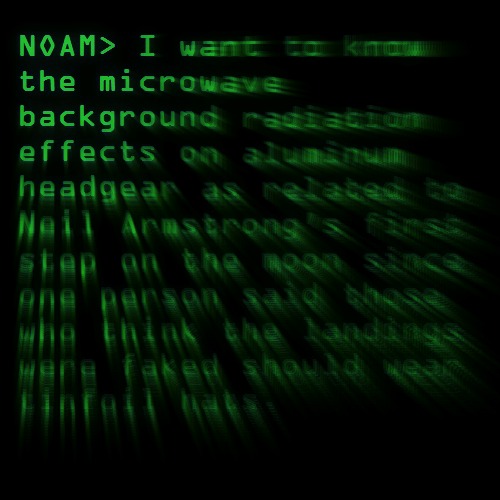
I began work on the programming language for the task, tentatively called Noamian. I based it on Prolog, to a certain extent, but made it closer to plain English: likes(Robin, Noam) became “Robin likes Noam,” a fact he could commit to his memory and thus provide an affirmative answer to the query “Does Robin like Noam?”
His knowledge was limited to what we gave him, and the sliver of Internet access he was allowed was used for grammatical analysis. His answer to a factual question such as “Is it raining?” was not based on actual weather data, but on a yes/no boolean fact coded into his database.
With time, the complexity and versatility of Noamian grew. We were soon able to chain predicates, such as “Bobby likes Noam, but hates John, and loves apples.” By processing the code, Noam could understand the subject of the sentence is Bobby and then easily convert it to facts in the format: likes(Bobby, Noam), hates(Bobby, John), loves(Bobby, apples).
Programming languages group actions together into functions, and Noamian was no different. Encapsulated into an “About” block, the predicates would remain within the confines of the function, therefore the sentence “About Horses: they are big, they are fast, they are strong.” represents the Horse function. When queried “Are horses big?” Noam would answer in the affirmative. Likewise, the query “Tell me about horses” would return all known facts on the animal within his memory.
Functions could inherit facts from other functions, so the sentence “About Unicorns (They are like Horses): …” would allow the Unicorn models in Noam’s memory to share the same attributes as the already defined Horses.
It is worth noting here that since our end-goal required the isolation of language from other high-level brain functions like image recognition, we never allowed Noam to make the connection between a “Horse” and its visual representation. Instead, it remained just that–a word in his memory interlinked to other words.
With time, and many lines of Noamian written, his knowledge map grew. Obviously, it wasn’t our intention to manually grant Noam the entire fact set of all of human knowledge, so when his relational memory got sufficiently large, we moved to the next step.
To read the rest of this story, check out the Mad Scientist Journal: Winter 2014 collection.
Raymond C. Stewart is an artificial intelligence professor, specialized in the field of natural language processing. Happily married, he lives with his wife and two children in Boston, Massachusetts.
Damien Krsteski is an SF author from Skopje, Macedonia. His work has appeared in places like Liquid Imagination, Fiction Vortex, The Way of the Buffalo Podcast, Fiction365 and others. More information about his work can be found at http://monochromewish.blogspot.com
Dawn Vogel has been published as a short fiction author and an editor of both fiction and non-fiction. Although art is not her strongest suit, she’s happy to contribute occasional art to Mad Scientist Journal. By day, she edits reports for and manages an office of historians and archaeologists. In her alleged spare time, she runs a craft business and tries to find time for writing. She lives in Seattle with her awesome husband (and fellow author), Jeremy Zimmerman, and their herd of cats. For more of Dawn’s work visit http://historythatneverwas.com/
Our Kickstarter has finished it’s funding period, and this means we have raised enough money to pay 1-cent per word for stories submitted to us. Submission guidelines can be found on our Submissions page:
http://madscientistjournal.org/submissions/
We will be accepting submissions until April 30, 2014. Thank you again for everyone who has joined us on this wild ride.
We have a some announcements regarding some of our alumni! This was meant to be posted a few weeks ago, but with the buildup to the Kickstarter (Have I mentioned we have a Kickstarter?), it slipped through the cracks.
Antoinette McCormick has had her first piece of non-fiction, “Postmark,” published at Halfway Down the Stairs.
John A. McColley has had a couple pieces of good news: First, his son Oliver was born recently. Second, his first professional sale has been published on Crossed Genres. You can read his story, “All the Pretty Colors,” by clicking this link.
We’ve only got four days left of the Kickstarter. It would be nice to cross the $5,000 mark, but that would require us to pull in over $300 a day in this last hoorah. Kicktraq doesn’t think it’s possible, estimating our best possible would just be $4,500. Perhaps we can prove it wrong? Either way, it’s been an honor to make it this far.
But enough about me, let’s talk about Erik Scott de Bie.
“What I’d taken for framed art of landscapes were in fact exquisite if strange abstract pieces depicting doorways of many different shapes and sizes. All of them were done in the same hand, with the initials ‘E.O.’ at the bottom. One in particular caught my eye: a round, black gateway with what looked like green slime that ran from its top down the middle. I reached out my fingers to touch it, then saw something else: a sculpture of some kind, about the size of a gallon jug, sitting on the counter. It had to be an abstract piece, but I thought I could see limbs and fins in its strange curves and folds. The dryer beat out a recurring rhythm. My mind stretched . . .”
— “Dr. Circe and the Shadow over Swedish Innsmouth” by Erik Scott de Bie
Erik is perhaps best known for his stories set in the Forgotten Realms, especially his Shadowbane series. But he has three new novels coming out this year! Shadow of the Winter King, the first in his dark metal epic fantasy World of Ruin series, comes out in April. May will bring us Scourge of the Realm, a fantasy novel that explores what happens after the Hero beats the Villain. And then he has a stand-alone space opera set in the Traveler universe titled Priority: Hyperion.
His contribution to our anthology brings back Dr. Circe, who first appeared in the story “Dr. Circe and the Separatist Man Cheetahs,” published in Growing Dread: Biopunk Visions. She’s a fierce scientist in an alternate history less pretty than our own. We hope you enjoy it as much as we did.
An essay by Abigail Perkins PhD, as provided by Kelda Crich
Art by Leigh Legler
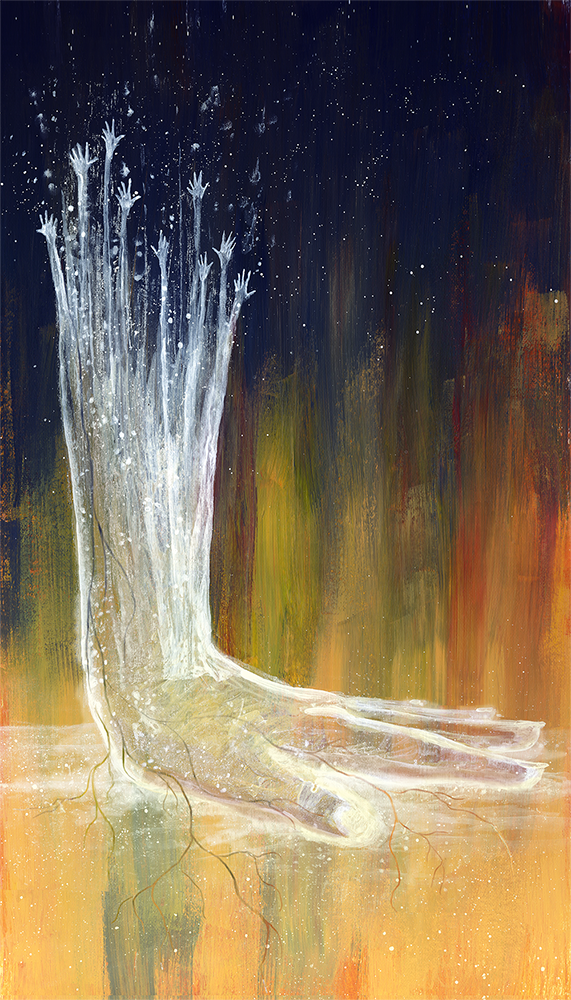
In the light of the twinkling, tawdry Christmas lights, I’m typing just as fast as I can. Deleting as much as I’m able, but they’ve created walls around my commands, convoluted labyrinths of protection. They’re smart. Smarter than me. How is that possible?
They lead me along blind alleys. They sacrifice themselves in their billions to protect the shared central consciousness. Hope flares and dies in me like a guttering lantern light.
I’m bathed in cold sweat. Beads of perspiration linger at my breasts. I glance at my arm. The silver line under my skin following the line of my artery is at my elbow. I resist the urge to scratch it. They’re within me, under my skin, making their steady way away from my heart towards my head.
It was only one week ago that I came up with the idea. That I’d coded the programs for the data people, my fingers flying over the keyboards as if I was divinely inspired. I remember glancing at the mirror on the wall. Seeing myself and being embarrassed. This was me, a woman without family or friends. A lonely woman. It had always been the same.
But so what? Couldn’t I make my own happiness? Couldn’t I use my intelligence to do something for myself?
Defiantly, I’d written that simple, ancient command: worship me.
And they had. Their small electronic minds adored me. For the first time in my life I’d been loved, the total unconditional love of a thousand tiny, almost mindless entities. I was their Goddess.
They loved me. I’d made them that way.
To read the rest of this story, check out the Mad Scientist Journal: Winter 2014 collection.
Afterword: Abigail Perkins PHD did not report for work on January 2nd. Her absence was un-remarked. Efforts to stem the so-called body-snatcher plague continues.
Bio: Kelda Crich is a new born entity. She’s been lurking in her creator’s mind for a few years. Now she’s out in the open. Find her in London looking at strange things in medical museums or on her blog: http://keldacrichblog.blogspot.com/. Her work has appeared in Lovecraft Ezine, Spinetinglers and the Life After Death anthology.
Leigh’s professional title is “illustrator,” but that’s just a nice word for “monster-maker,” in this case. More information about them can be found at http://leighlegler.carbonmade.com/.
Just about a week left. We’ve crossed two of our stretch goals! We’ve added reward tiers featuring author Sanford Allen, and I’ve got descriptions of those rewards in the main Kickstarter area if you want more details. But for now, let’s check out our next author in our series.
“The landscape, while alien, reminded me of my native Miskatonic Valley. Rolling hills stood in the same basic configuration, covered in the elms, willows, and pines of home, but the stone had the pale shade of the blocks back in Special Collections. And the sky…
“Though cloudless, it stretched chalk white from horizon to horizon. The sun, if that’s what it truly was, could barely be distinguished — a bright sphere of white surrounded by the deadwhite sky. I tore my gaze away. It felt as if that star might seep it into my soul and drain my life and energy as it had the sky’s.
“Naturally, I recognized it all from my dreams.”
-- “The Laughing Book” by Cliff Winnig
Cliff Winnig’s contribution to the anthology has more of a Clark Ashton Smith feel in spots, a tale of alternate realities and strange fantasy. He’s the other Clarion graduate we have in this book (so far), and he has several pieces of short fiction available in the world, including a recent story in When the Hero Comes Home 2 titled “The Call of the Sky.” And he plays sitar. As one does.
He shares a stretch goal at the $7,000 mark with Erik Scott de Bie, where we will add books featuring tales from both of them to the reward tiers. Can we make it that far in the next week?
We’re continuing to creep towards our next stretch goal. Thank you to everyone who has pledged so far or taken time to help spread the word. It is sometimes a little overwhelming to see that much support for a project like this. Before I start getting maudlin on you guys, let’s talk about another of our authors.
“Growing up in Arkham, you hear things. Ghost stories wrapped in magickal moon lore with a heaping helping of elder gods and forbidden books, all swapped between boys and girls over dwindling campfires. We collected alternate histories like kids on TV traded baseball cards. As a child of Arkham, you just took for granted you lived in a special town, but seeing that difference up close and personal, in the place where you gave up evenings and weekends so college admissions might think you were wellrounded and responsible, well, seeing that kind of truth was an awful big shock.”
–“Arkquarium” by Folly Blaine
Folly Blaine is our other alumni from the pages of Mad Scientist Journal that has joined the fun. While most of her contributions to our zine have been wacky shorts that draw off of her natural wit, she has quite a horror portfolio. And she did not pull any punches with her contribution to our anthology. As an added bonus, Folly’s the Podcast Manager of EveryDayFiction.com. Not only has she narrated over 80 stories for weekly podcasts, but she donated audio narration of someone’s fiction as a reward tier in our Kickstarter. If you’re on the fence about whether you want to spring for her narration, treat your ears to some speculative tales at EveryDayFiction.com.