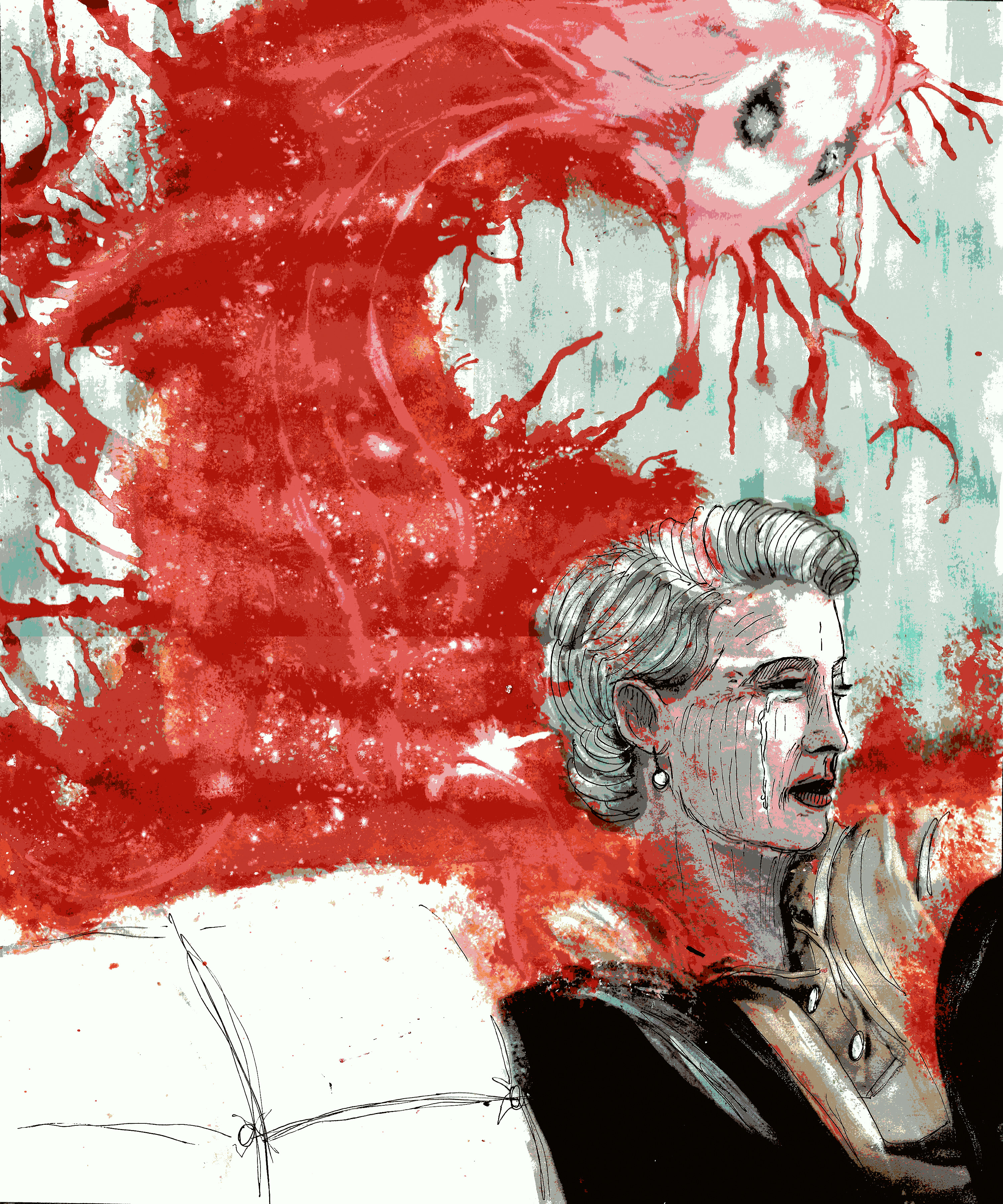
Sweet Sand Fleas

An essay by C. R. Anderson, as provided by Steve Zisson
Art by Leigh Legler


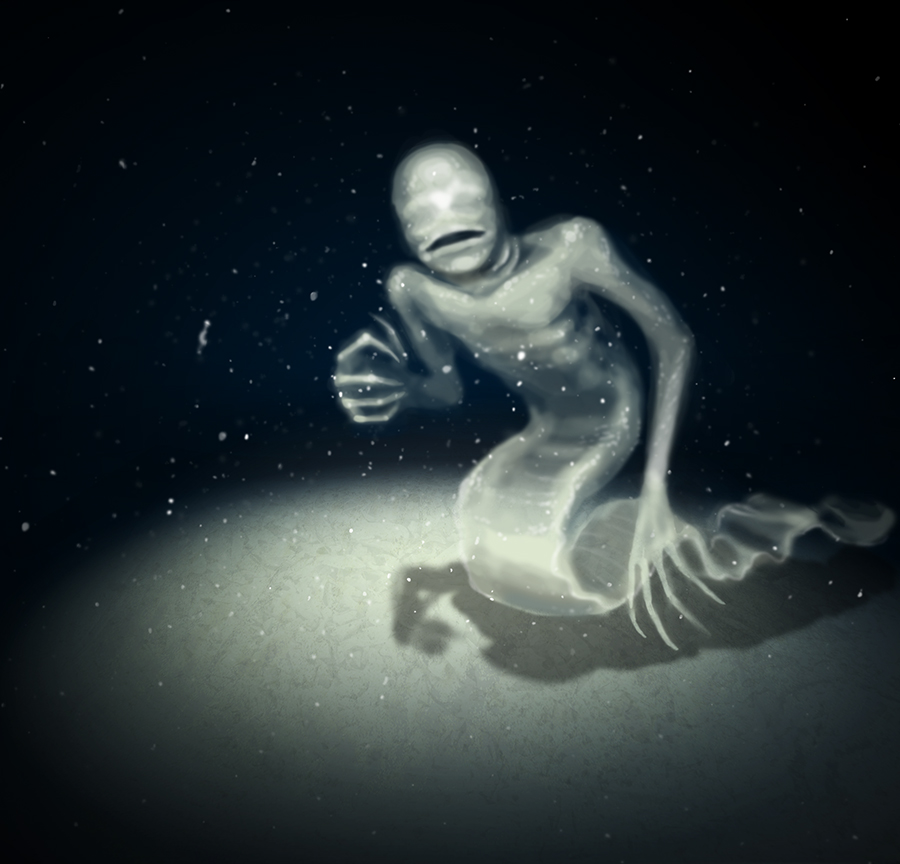
“Get your hands off me,” that’s what I hear him say. So clearly now. “Please don’t pick me up. I don’t want to go back in the cold, suffocating water again. We’ve been there too long. Way too long. We weren’t made for it.”

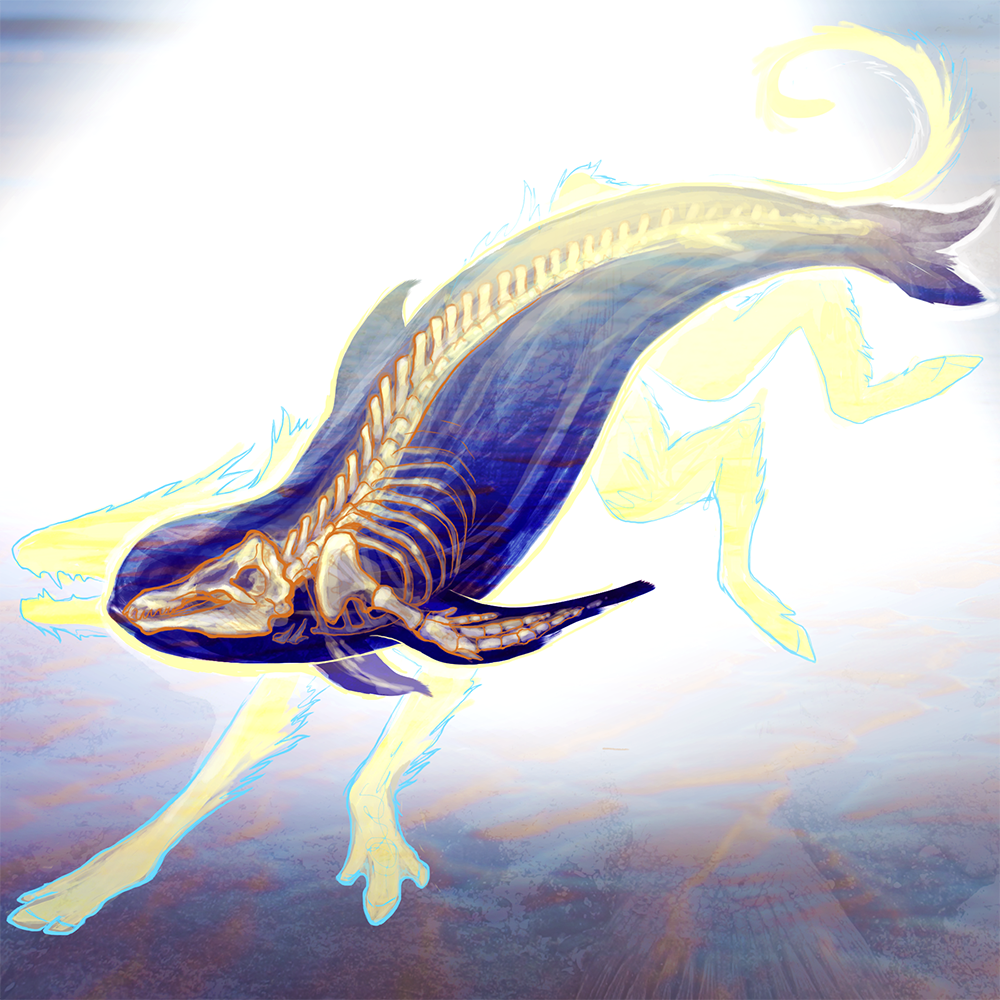
He’s a big male, the leader of the pod. Maybe a dozen feet long and a couple of tons. His blackness now shrouded by light colored, drying sand sticking to him. His sounds come out all shrill and plaintive.

The rescuers can’t hear him. They hear only whistles and pulsed sounds. They are too busy anyway, there are so many whales to save. They ignore his sounds, they can only guess what he means. But I know what he is saying.

I know what they’re saying, these stranded pilot whales. I’m a cross-species linguist and I come to these strandings to understand them. Strandings of 100 or more are becoming quite common. Some blame a new disease, toxic pollution, a parasite, a change in magnetism. Maybe it is the noise pollution from boats and sonar. They’re wrong.

Cape Cod Bay is a favorite spot for strandings of dolphins, sea turtles, and the most prolific stranders of all, pilot whales, the largest of the dolphins. Luckily, I live in Brewster on the bay side of the Cape. And I am tapped into the strander network so I often am among the first to arrive to capture the last words of so many expiring whales who want to live. They don’t seem to mind me. They know that I sympathize, that I understand. They don’t like the rescuers at all. They call them anti-evolutionists. The pilot whales’ words, not mine.

I wear my translation headset, a prototype I’ve developed. They look like ordinary headphones to the casual observer.

An out-of-breath rescuer runs up to me and shouts, “Help us. Help us lift the big whale back into the water.”

I shake my head, point to my headset, and then throw up my arms. The bearded rescuer becomes enraged, his face goes red and he jabs a finger in my face. “How can you be so heartless? You’re listening to your music there while all the whales die. Help save them!”

I turn and walk away when I think he’s going to hit me.

I can hear him shouting at me through the squeals and whines of the big male struggling in my headset.

“We are as smart as you think we are. Give us some credit. We know what we want. Please don’t put us back in the ocean! We were on the land, the sweet land, long before you were.”

A dozen rescuers squat and grab the big male and begin to lift. “All of your hands, abrasive, so dry and cracked, let go. Your foreign bacteria and viruses from your dirty fingers will infect me, kill me like the others who stranded in earlier days when you returned them infected to the sea. The weight of my body crushes from gravity, but it feels like home. The land is home.”
Sweet Sand Fleas


To read the rest of this story, check out the Mad Scientist Journal: Spring 2014 collection.


C. R. Anderson was first a PhD toxicologist who once taught at New University, where she then pursued a second PhD as a cross-species linguist. She lives on the bay side of Cape Cod, Massachusetts where she only haunts the beaches during off season.


Steve Zisson began his writing career as a journalist and now writes speculative fiction from a town north of Boston. He finds most journalism these days to be highly speculative. His day job now is running a medical education publishing company. He likes to write in approximately 1,500-word bursts and has another similar length story forthcoming in Daily Science Fiction.


Leigh’s professional title is “illustrator,” but that’s just a nice word for “monster-maker,” in this case. More information about them can be found at http://leighlegler.carbonmade.com/.

Posted in Fiction | Tagged , , , , | Comments Off on Sweet Sand Fleas

An interview with Norman E. Farious

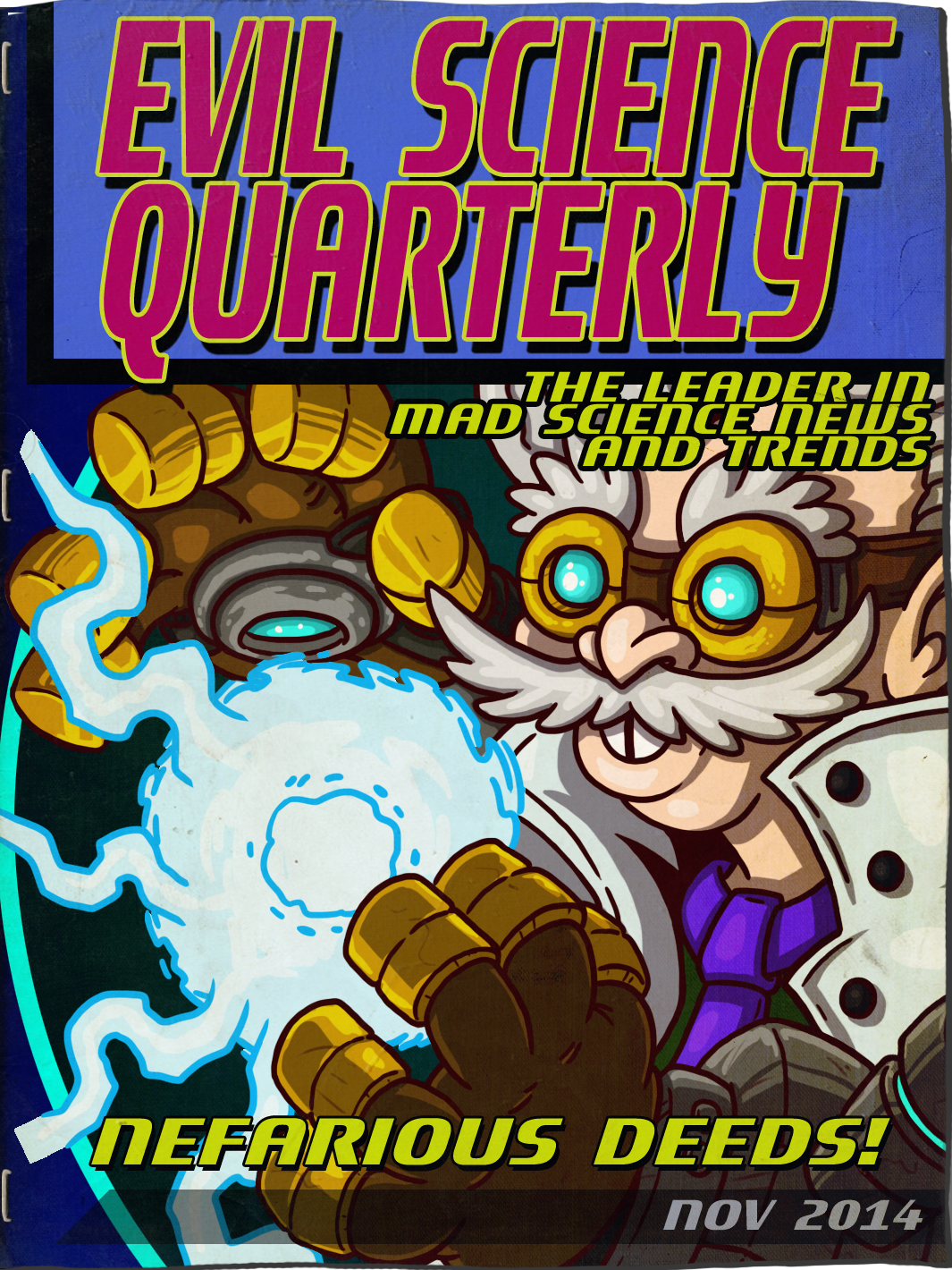
An interview with Norman E. Farious from Evil Science Quarterly: The Leader in Mad Science News and Trends, as provided by Arinn Dembo


Doctor Norman FariousESQ: Thank you for joining us! Yours is an illustrious name in Mad Science. And an illustrious set of initials! You are the son of Nigel Elmore Farious, are you not?

N.E.F.: Doctor Nigel Farious, yes. And the grandson of Nestor Edgar Farious. The nephew of Nancy Egan Farious, as well.

ESQ: And you are Norman Erasmus Farious yourself, according to your recent Manifesto. How does it feel to be the latest Doctor N. E. Farious?

N.E.F.: It can be a burden at times, I must admit. As a boy I wanted to be a dentist, for example, but my parents forbade it–I was their only child, and there simply was no room in the family castle for a Farious D.D.S.

Eventually I became reconciled to the burden of greatness, of course. Our family name has a long and vivid history, and now that I’ve assumed the mantle, I shall be the best Doctor N. E. Farious I can.

ESQ: You’re certainly off to a roaring start. Ginormasaurus is … an impressive contribution. May we ask how long the Great Machine took to build?

N.E.F.: A lifetime, really. I was working on the first prototypes and schematics when I was seven. The vision of a mechanical, city-destroying dinosaur has always delighted me.

ESQ: Can you tell us anything about the construction and design of the robot? Without revealing any trade secrets, of course.

Evil Science Second IssueN.E.F.: Well, anyone with a rudimentary knowledge of mechanical engineering will see the most obvious things. Every piece of the robot’s internal structure is made of cast titanium, for example. Light, durable, resistant to corrosion, and less stiff than steel …

ESQ: I imagine that’s useful in the legs and tail sections?

N.E.F.: Indubitably.

ESQ: Is there any truth to the rumor that you’ve built an atomic forge on the Moon?

N.E.F.: No, that’s nonsense. Not every vacuum forge capable of reaching temperatures of 1650 degrees Celsius is on the bloody Moon.

ESQ: On a related topic … rumor has it that the Great Machine is fueled by a Purpletonium Reactor. Is this correct?

N.E.F.: I see no reason to deny it. Purpletonium is wonderful stuff.

ESQ: Is there any truth to the rumor that you actually gave Purpletonium its … unusual name?

N.E.F.: Yes and no. I was indirectly responsible for that unfortunate sobriquet. In fact, it was my young ward Nicky who had the honour. She found the first meteoric fragment when we were searching the Siberian crater, and thereby earned the right to name the stuff.

Unfortunate, but nothing to be done. A gentleman does not renege upon a friendly wager with an eight-year-old orphan. Nor upon a Pinky Swear.

Kaiju-a-Gogo poster GINORMASAURUSESQ: Out of curiosity, what had you originally intended the name of the mystery element to be?

N.E.F.: You have to ask? “Nefarium,” of course.

ESQ: Speaking of Nefarious deeds … have you given any thought to your next target, Doctor?

N.E.F.: I have.

ESQ: Can you tell us whether we’re in the line of fire?

N.E.F.: Of course you are. This is about world domination! You cannot make an omelet the size of a planet without cracking a few heads.

ESQ: Can you promise to spare our home offices?

N.E.F.: I could, if I was so inclined.

ESQ: Would you pinky swear?

N.E.F.: Never again!


Arinn Dembo is a multi-genre author and the Lead Writer of Kerberos Productions, a computer game development studio in Vancouver, BC. Her prize-winning short stories and poetry have appeared in The Magazine of Fantasy and Science Fiction, Weird Tales, Lamp Light Magazine, H.P. Lovecraft’s Magazine of Horror, and several anthologies. Although she is best known for the games and novels set in the Sword of the Stars universe that she created for Kerberos Productions, her guest post today is for a new game, Kaiju-a-Gogo.

To learn more about ruling the world with super-science and giant remote-controlled monsters, see the Kickstarter campaign for the game at http://www.kickstarter.com/projects/kerberosproductions/kaiju-a-gogo.

Kaiju-a-Gogo Logo

Posted in Fiction | Tagged , , | Comments Off on An interview with Norman E. Farious

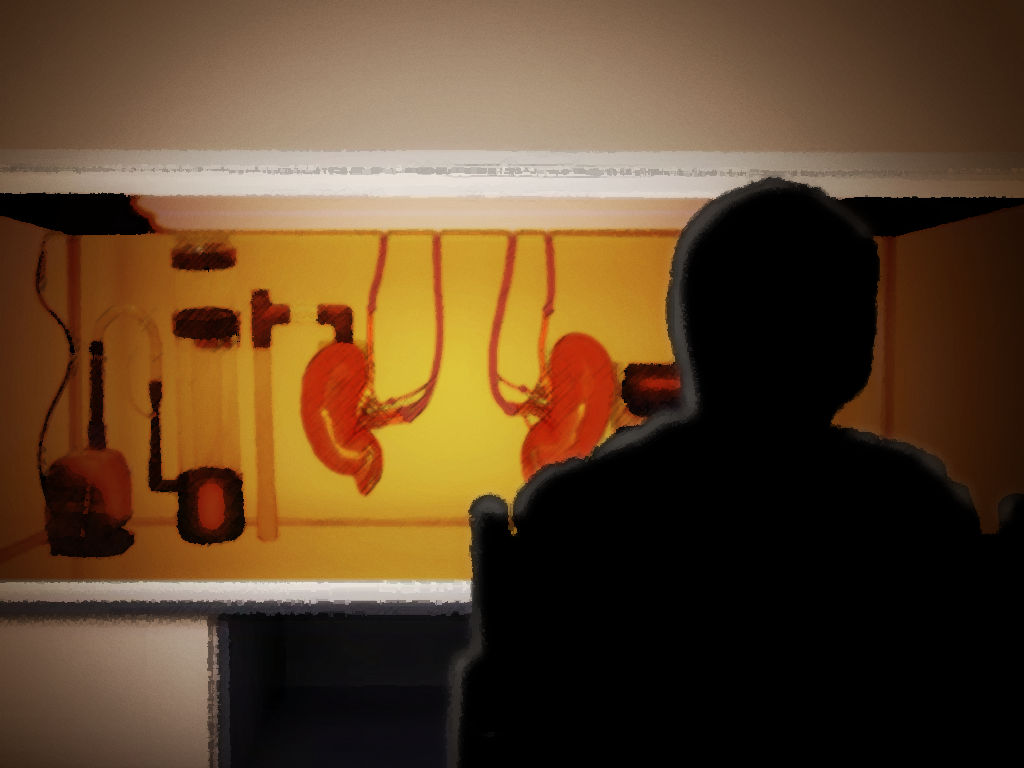
One scientist’s struggle against federal cloning regulations: A case study

Dr. Jasmine A. Connell1,2 and Dr. Diana Rohlman3

1Department of Nephrology, Groom Lake Laboratories; 2Center for Ethical Cloning, Groom Lake Medical Center; 3Groom Lake Publishing Services, Groom Lake, Nevada, United States of America

Corresponding author: Jasmine A. Connell, connellj@groomlakelab.edu

Art by Scarlett O’Hairdye


Jasmine A. Connell received her Bachelors of Science degree in 1975 at Oregon State University. She received her medical degree from the University of Pennsylvania, followed by a PhD at University of Massachusetts in comparative anatomy. She continued at the University of Massachusetts with a three-year post-doctoral position in the laboratory of Dr. D. Parson, who pioneered early organ cloning techniques using human cells. Dr. Connell created the first successful human kidney using intestinal cells from a human donor. The following case study is published as presented by the underwriting author, Diana Rohlman (Groom Lake Publishing Services).

#

I arrived at the Center for Ethical Cloning filled with excitement and trepidation. I didn’t know what to expect. Despite my medical degree, I had spent minimal time with patients. The last ten years had been spent in a lab, logging hours at microscopes and flow cytometers and any number of highly technical instruments to create a medical miracle. I suppose it should not have been a surprise that I entered a medical facility, rather than the drab laboratory I would have expected, but it was.

A large printer next to the closest nurse’s desk spewed forth color pictures: A thin brunette, her skin sallow, lay asleep on a hospital bed, hooked up to a dialysis machine. Her picture was captioned in stark, uncaring terms: 32-year-old female, Caucasian, Kidney. A small boy, scars bisecting his chest numerous times, his lips tinged blue; 8-year-old male, Hispanic, Heart. A portly man, jaundiced, broken veins in his nose attesting to a love of the drink, sat limply; 53-year-old male, Caucasian, Liver, poor candidate.

I stepped up to the information desk tentatively. I could smell the disinfectant. Suddenly I began to wonder if I was ready for this job.

Before I could turn around, give in to my nerves, and discreetly sneak out the front door, a nurse in an impeccable white medical jacket saw me and strode over.

“Welcome to Dr. Jorgen’s office,” she said briskly, “Please fill out those forms.” With an air of practiced efficiency she took a slim stack of printouts, slid them onto a clipboard, and affixed a pen. She handed the entire package over, looking up only when I declined the offering. This time, she saw the small nameplate affixed to my blazer. The nice guard had given it to me when I entered the facility. He had even wished me good luck with the new job. Her eyes widened.

“Oh, I’m sorry …” She cleared her throat, dropped the clipboard behind the desk. “You’re Dr. Connell … I–”

I smiled, trying to ignore the butterflies in my stomach. “I always wanted to make an impression,” I joked.

The nurse–her nameplate identified her as Kathy–laughed gratefully.

“Then I am glad I could help fulfill your wishes! You don’t have to fill out any forms, but would you like a quick tour before you meet Dr. Jorgen?”

I had been looking around curiously. At first glance, the medical facility seemed like any other sterile facility, complete with white walls, blue and beige accents, and an easy to clean, nondescript floor. The ceilings were too high though, the doors too wide. Everything seemed just slightly off-kilter, as though a medical facility had been superimposed onto an existing structure.

Kathy must have been used to the disorienting sensation, because she laughed again, this time in sympathy, and launched into a quick explanation.

“The Center used to be an old factory, to tell the truth. However, Dr. Jorgen completely refitted it with new, state-of-the art equipment, the highest technology, and a security system that the Department of Defense envies.”

I raised my eyebrows. “That’s quite impressive.”

Kathy nodded, and I could tell she thought quite highly of the work Dr. Jorgen had done.

“Then let’s start with a tour.” She stepped out from behind the desk, setting down a stack of papers.

One scientist's struggle against federal cloning regulations: A case study


To read the rest of this story, check out the Mad Scientist Journal: Spring 2014 collection.


Diana lives in the Pacific Northwest, invariably spending the rainy days inside, writing, with a glass of wine nearby, and her dog offering helpful critiques. Her website is http://sites.google.com/site/rohlmandiana or check her out on Amazon (amazon.com/author/dianarohlman).


Scarlett O’Hairdye is a burlesque performer, producer and artist. To learn more, visit her site at www.scarlettohairdye.com.

Posted in Fiction | Tagged , , , , | Comments Off on One scientist’s struggle against federal cloning regulations: A case study

List of Stories for Anthology!

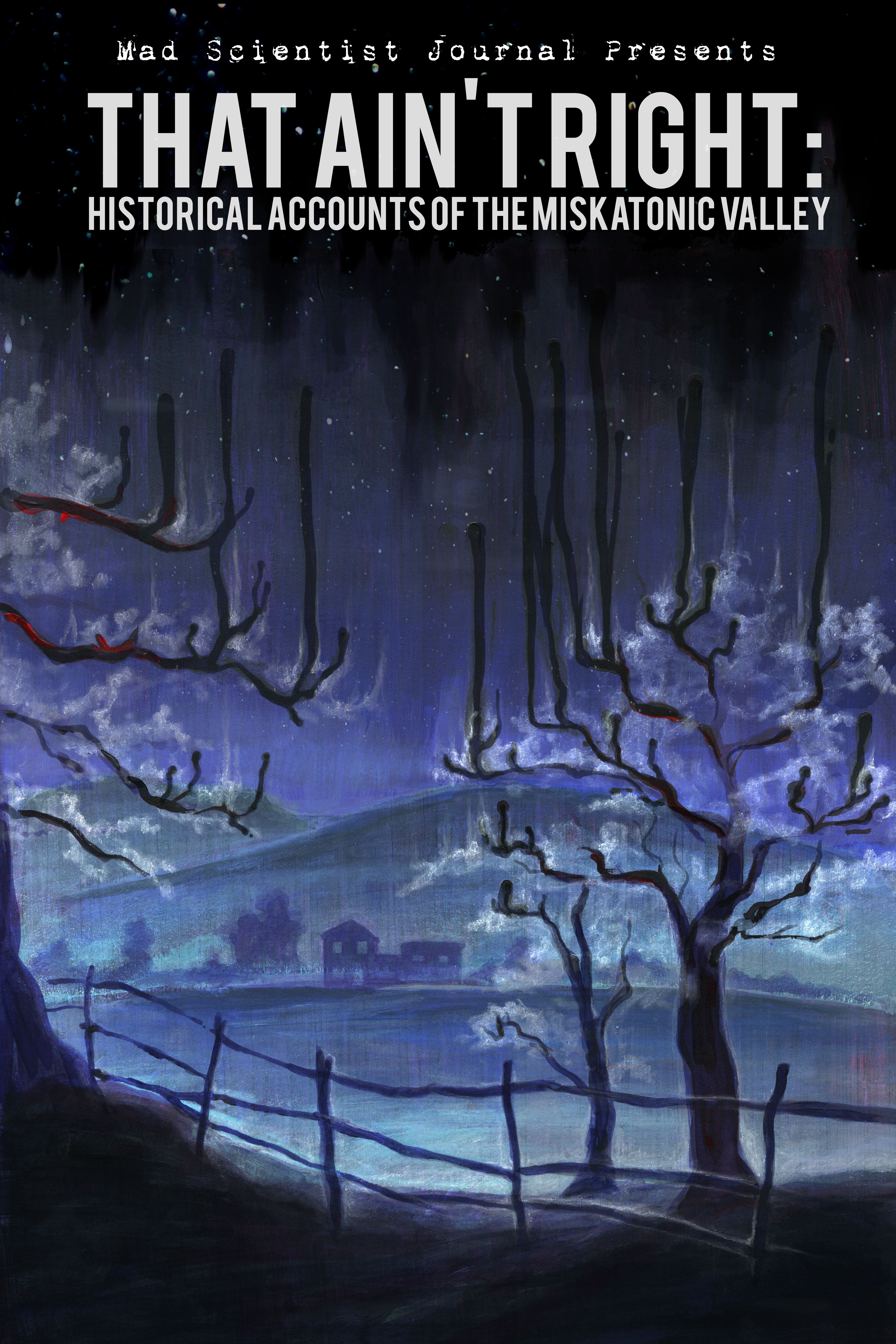
That Ain't Right: Historical Accounts of the Miskatonic ValleyWe’ve gotten all the contracts back and paid all the authors, so we feel comfortable sending out a bit more information about what the book will include. Because we were more successful than planned, but didn’t hit a new stretch goal, we decided to roll that money into more content for the book. The book now weighs in at about 80,000 words with 18 tales set in the witch-haunted hills of New England.

We haven’t decided on a final order for the stories, but here’s a full list of stories organized by author name. Over the next month or so we’ll be getting stories edited and back from authors for approval. We’ll have another month of laying out both the ebooks and print books, then a month of printing and shipping rewards!

  • “Come Down, Ma Evening Star” – Sanford Allen
  • “Hostel Night” – Brandon Barrows
  • “Arkquarium” – Folly Blaine
  • “In Defense of Professor Falcrovet” – Darin M. Bush
  • “Ride into the Echo of Another Life” – Kelda Crich
  • “Goat” – Nathan Crowder
  • “Dr. Circe and the Shadow over Swedish Innsmouth” – Erik Scott de Bie
  • “The Pull of the Sea” – Sean Frost
  • “The Ghost Circus” – Phil Gonzales
  • “The Reservoir” – Brian Hamilton
  • “So Praise Him” – Samuel Marzioli
  • “A Dog Named Shallow: The Testimony of Lilya Redmond” – Erick Mertz
  • “The Crumbling of Old Walls” – Craig D. B. Patton
  • “August and Autumn” – Jenna M. Pitman
  • “Passenger” – Evan Purcell
  • “The Hill” – Damir Salkovic
  • “A Matter of Scale” – Emily C. Skaftun
  • “The Laughing Book” – Cliff Winnig
Posted in Administrative | Tagged | 1 Comment

Atomic Supervillain: an interview with Ivo Wyrdstrom

An interview with Ivo Wyrdstrom from Evil Science Quarterly: The Leader in Mad Science News and Trends, as provided by Arinn Dembo


Professor Ivo WyrdstromESQ: Doctor Wyrdstrom, we’d like to begin by thanking you for your time. Our readers are very excited to have the chance to learn more about you and your work.

IW: Yes, that is understandable. But I must point out for the record that I am not actually a Doktor! My doctoral thesis in Nuclear Medicine was not accepted by the University of Geneva.

ESQ: Really? That’s very surprising. What reasons did the examiners give for rejecting it?

IW: They declined to give me a reason, at the time. Instead they sent Interpol to my lab to seize my notes and experiments. This was many years ago, and needless to say, I was in no position to argue the matter.

ESQ: And did this have anything to do with your recent decision to unleash Armagordon on the city of Geneva?

IW: Yes. Consider that my thesis defense, you petty, small-minded, short-sighted fools!

ESQ: Given the circumstances, may we call you “Professor” Wyrdstrom? You are, after all, teaching the world a valuable lesson.

IW: Amusing. Yes, you may.

Evil Science QuarterlyESQ: Thank you. Rumor has it that you use the recently discovered Purpletonium in your present research. Is this true, Professor?

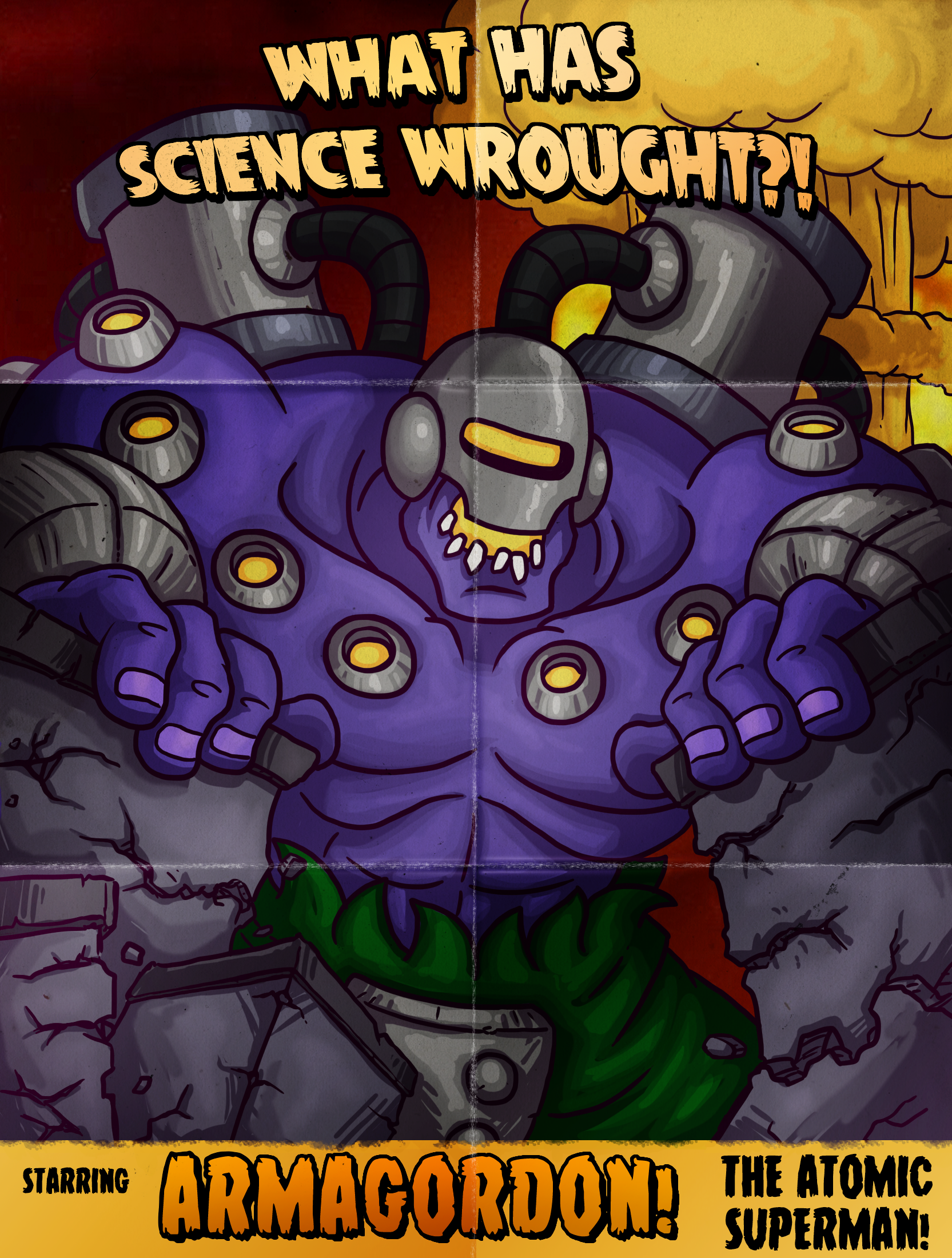
IW: Absolutely. My work in nuclear medicine was long frustrated by the more mundane transuranic elements. Even Plutonium, the heaviest primordial element on Earth, proved to be insufficient to fuel the metabolism of an atomic superman.

ESQ: Is Purpletonium an exotic form of Plutonium? There are oxides of Plutonium that are lavender-blue…

IW: Not at all! To think of Purpletonium as nothing but grape-flavoured Plutonium would be a dire error. It is an entirely new transuranic element, with its own unique properties. The substance has the potential to fuel a new Atomic Age.

ESQ: An Atomic Age ruled by you and Armagordon, Professor Wyrdstrom?

IW: Ideally, yes. But as a scientist I must accept that the outcome of any experiment is never certain. My current experiment in world domination is no exception to this rule.

ESQ: You’ve destroyed thirteen cities in the past year. Speculation is rampant as to how you choose your targets, and who might be next. Can you give us here at Evil Science Quarterly just a small hint?

Kaiju-a-Gogo Poster: ARMAGORDONIW: Ha! An interesting game. Well, let’s begin with a small confession: I am not myself a petty or vindictive man. I did not crush Geneva SOLELY for revenge on my thesis committee! The city had also collected a great deal of Purpletonium. Can you guess why–?

ESQ: Well, naturally it is very near the large hadron collider at CERN…

IW: Indeed. Armagordon is nearly recovered from his exertions last month. I think there are other famous science cities that deserve a visiting lecture from the Professor. If you catch my meaning.

ESQ: Oh, the suspense is unbearable, Professor! Could it be Los Alamos? Dubna? Beijing?

IW: *laughing* Why not Seattle?

ESQ: All we have is a little Van De Graaf accelerator! We couldn’t hurt a fly, Professor Wyrdstrom!

IW: All must bow to Armagordon in the end. I am not going to have this world enter the age of Kaiju without proper supervision!

ESQ: That’s very thoughtful of you, Professor.

IW: Don’t mention it.


Arinn Dembo is a multi-genre author and the Lead Writer of Kerberos Productions, a computer game development studio in Vancouver, BC. Her prize-winning short stories and poetry have appeared in The Magazine of Fantasy and Science Fiction, Weird Tales, Lamp Light Magazine, H.P. Lovecraft’s Magazine of Horror, and several anthologies. Although she is best known for the games and novels set in the Sword of the Stars universe that she created for Kerberos Productions, her guest post today is for a new game, Kaiju-a-Gogo.

To learn more about ruling the world with super-science and giant remote-controlled monsters, see the Kickstarter campaign for the game at http://www.kickstarter.com/projects/kerberosproductions/kaiju-a-gogo.

Kaiju-a-Gogo Logo

Posted in Fiction | Tagged , , , | Comments Off on Atomic Supervillain: an interview with Ivo Wyrdstrom

Special Call for Submissions and Other Submission Related News

It is that time of the year where we open up the doors of our Submissions Inbox to a wider array of stories to be used exclusively in our quarterly zine. Specifically we are looking for:

  • Questions for our “Ask a Mad Scientist” advice columns.
  • Flash or Short Fiction: 500-2000 words for flash, 2001-8000 for short. Any genre. Does not need to be first person or involve mad science.
  • Fictional Classified Ads: We have a Classified Ads section in every quarterly for classified ads from the world of Mad Science.

Submissions will be accepted from May 20th through June 20th. Check out our Submissions page for more information on what we’re looking for and what we’re paying.

ALSO

We will be closed to all submissions from June 21st through July 31st. We have a lot going on in July and this will help preserve our sanity.

Posted in Administrative | Comments Off on Special Call for Submissions and Other Submission Related News

The Last Unit

An essay by Jane Meadows, as provided by Judith Field
Art by Justine McGreevy


“Jane, that mad woman’s here again,” says Ben, my summer student pharmacist, looking out of the dispensary into the shop.

“Keep your voice down!” I hiss, following his gaze. A woman in her mid-thirties stands by the counter. I think she must be an albino. She has white hair and skin with a pearly, translucent quality, as though, if I look at her for long enough, I’ll be able to see right through it to the muscles, the blood vessels, even the bones. Oval mirror glasses cover most of the upper half of her heart-shaped face, obscuring the pink eyes I imagine lie underneath. When she speaks, it’s with a hard-to-place foreign accent. More of an intonation, really, just a clue that English isn’t her first language. She wears her usual white blouse, red skirt and matching jacket. On the lapel is a badge: “Priyanka Wong, Bewley Homes.”

Bewley Homes built a new housing estate on the wasteland at the other end of the High Street from the pharmacy. All the roads on the estate are called after birds, mainly water fowl–Avocet Mews, Goosander Way, Widgeon Path–affordable homes, if you didn’t mind living on a former industrial site where a permanent gale blasts off the river. They started building the estate around the same time that Alan and I managed to force our ageing fledglings out of the nest and decided to downsize. We went to look at a house configured like a cereal packet–tiny rooms with high ceilings, in Whinchat Lane, just off Merganser Gardens.

Shortly after that, Bewley’s went bankrupt and the site closed. I see Watson, the estate manager from time to time, spending the creditors’ money on cheap aftershave and flavoured condoms. Priyanka appeared after the firm went bust. I’ve seen Watson talking to her, standing too close, red-faced.

She tells us that the Receivers keep her on to try to sell what they built. But she doesn’t seem to have shifted any and the site is still locked up. Today she stands at the counter holding a piece of paper. From a distance it looks like a letter or a shopping list.

“Don’t leave her there, it’s not like we’re busy,” I say to Ben. All our druggy patients have been in, gulped down their “script”–their methadone–and left. The school run is over and it’s too early for the geriatric bus-pass jockeys.

Ben brings the paper back into the dispensary. “Have we got this? Can’t read it.”

A private prescription, written on fancy letterheaded paper from a psychiatric unit I’d never heard of before Priyanka started bringing them in. Unlike the usual National Health Service computer-generated jobs, it’s hand-written. Three different antipsychotic drugs.

I nod. “It’s the same as she always has. Make sure you make a note of it. Then you can tell me how long the law says we have to keep the private prescriptions.”

Ben starts writing. The last six entries in the book, stretching back over the same number of months, have been for Priyanka Wong. Identical prescriptions. Nobody else round here can afford private medicine.

The Last Unit


To read the rest of this story, check out the Mad Scientist Journal: Spring 2014 collection.


Jane Meadows is a pharmacist working in a community pharmacy shop in a windswept area of south London. She has two daughters, a son, a granddaughter, and a grandson and likes to spend what spare time she gets reading, knitting, and listening to music, sometimes all at the same time. She’s recently begun singing lessons: she likes to belt out show tunes in the style of Ethel Merman. This account of the incident with Priyanka Wong forms part of her evidence to the Statutory Committee considering her possible suspension from the register for a breach of regulations.


Judith Field was born in Liverpool, England and lives in London. She is the daughter of writers, and learned how to agonise over fiction submissions at her mother’s (and father’s) knee.

Her fiction, mainly speculative, has appeared in a variety of publications in the USA and UK. She speaks five languages and can say, “Please publish this story” in all of them. She is also a pharmacist, freelance journalist, editor, medical writer, and indexer. She blogs at www.millil.blogspot.com


Justine McGreevy is a slowly recovering perfectionist, writer, and artist. She creates realities to make our own seem slightly less terrifying. Her work can be viewed at http://www.behance.net/Fickle_Muse and you can follow her on Twitter @Fickle_Muse.

Posted in Fiction | Tagged , , , , | Comments Off on The Last Unit

That Man Behind the Curtain: April 2014

Oh my goodness, what a month. Let’s look at some numbers.

The Money Aspect

Amounts in parentheses are losses/expenses.

Hosting: ($17.06)
Stories: ($110.00)
Art: ($200.00)
Advertising: ($39.99)
Paypal Fees: ($0.15)
Donations: $0.00
Ad Revenue: $1.48
Book Sales: $23.60
Total: ($342.12)
QTD: ($342.12)
YTD: $1,684.38
All Time: ($5,828.19)

As per usual, I try to list costs for art and stories under the month that the stories run on the site rather than when I pay them. I also cover Paypal expenses when paying authors and artists.

Sales were remarkably good, especially those through Amazon. I’ve begun dabbling a little with advertising on Twitter, plus we still have some attention on us through the Kickstarter. 

Submissions

In April we received 13 regular submissions, and a whopping 25 additional submissions for the anthology. The total submissions for the anthology was 31. Of the regular submissions, we accepted 6 (46%). Of the anthology submissions we accepted 11 (35.5%). This puts our all-time acceptance rate at 54.26%.

This gives us enough content for the site through mid-January 2015.

Traffic

Google Analytics has changed some of their terminology. We had a total of 1,552 “sessions.” Which I think is what they called visits before. Our traffic consisted of 1,015 “users” (which I think is what was once called “unique visitors”) and 3,036 page views. Our highest daily traffic was 129. So a bit down from the excitement of the Kickstarter month, but not by a lot.

April’s search engine phrase of the month is “why r scientist considere as mad.” Because I want this anonymous person to feel ashamed of their horrible grammar.

That’s all for this month.

Posted in Administrative, Man Behind the Curtain | Tagged | Comments Off on That Man Behind the Curtain: April 2014

Audio Recording 5024

An essay by Dr. Todd Forest, as provided by Christine Layton. Salvaged from Seaforming Expedition (Program Terminated).
Art by Leigh Legler


“Do you think they ever travel?” I watched the mattress of the bunk above dip and shift as Donald rolled over onto his side. His round and florid face appeared over the edge of the top bunk and he fixed me with a beady stare.

“Are you going to keep asking me questions I don’t know the answer to? Or are we going to get some sleep?”

I cringed and pushed my glasses up on the bridge of my nose. “Sorry.”

“Some of us have work tomorrow,” Donald continued.

“Well so do I,” I said.

“I mean real work,” Donald smirked and then he withdrew. I stared at the mattress above me, which continued to dip and bend as Donald adjusted himself. “You keep asking questions about those Sea Monkeys but I got enough on my own plate, got me? I could give a flying flip about the Monkeys.”

“They’re not Sea Monkeys,” I said quietly, more to myself than to my bunkmate. They weren’t Sea Monkeys at all. And they weren’t Mermen either–the more affectionate but still incorrect moniker people were using on the continents. They were Aqua Sapiens–a term of my own coinage. And once I completed my research, the world would know a lot more about the mysterious creatures.

I drew my knees up and adjusted the small lamp attached to the post of my bunk. In the dim light, I arranged and rearranged the first chapter of my manuscript. It contained the background on the Aqua Sapiens, their original discovery, which occurred only last year, but already felt like a lifetime ago.

The first exploration team to the ocean floor had been purely scientific. In a bulky iron orb capable of withstanding the immense pressure of the ocean’s atmosphere, they descended over the course of two months, sinking slowly to the floor of the ocean. A more rapid descent was not possible, as the structural integrity of the submarine would be jeopardized. But they made it to the ocean floor–the first people to do so in history.

For the first time in the history of the Earth, light shone across the sea floor–a weak beam from an impossibly thick-glassed search light affixed to the iron submarine. Back on the continents, people had crowded around their flat screen TVs to see. At first they held their breath in anticipation of something momentous, like the moon walk a century before. Then after half an hour of dark and blurry footage of an ocean floor that looked no different from the carpet in their living rooms, people began to lose interest. Many had turned the channel by the time of the occurrence. The time stamp reads 37 minutes, 45 seconds when a gray figure suddenly darts past the corner of the screen. The reaction of one of the scientists–“Jesus Christ!” is recorded loud and clear on the footage. Ten seconds later the figure reappears, darting at the corner of the screen at first, and then, finally, it drifts fully into the shot. The figure is humanoid from the waist up. The legs do not end in feet, though. Instead they melt into a rippling ribbon of thin flesh, which moves in constant waves. The rippling dermis both propels and stabilizes the figure, as it floats a few inches above the sea floor. When the figure turns toward the camera to snatch at a particle suspended in the weak light of the lantern, the large gray head is fully revealed. Eyeless, hairless, only a mouth, and when the form catches the particle with slender long fingers and quickly opens its mouth to receive the food, it has no teeth–only a long bony strip, like the mouth of a fish that munches on coral and grinds its food into mash.

Audio Recording 5024


To read the rest of this story, check out the Mad Scientist Journal: Spring 2014 collection.


Dr. Todd Forest, professor of linguistic theory, syntax, semantics, and the philosophy of language, was last seen on submersion day, 2013. A floating buoy marks the approximate location of the abandoned Seaforming site in the Pacific Ocean. On it, the names of the many engineers lost are recorded. At the bottom of the list, under his bunkmate Donald Manly, Dr. Forest’s name is preserved forever.


Christine Layton lives and writes in the Chihuahua Desert. Her nonfiction work can be found on Cracked.com. Her fiction work can be found at the bottom of the sea.


Leigh’s professional title is “illustrator,” but that’s just a nice word for “monster-maker,” in this case. More information about them can be found at http://leighlegler.carbonmade.com/.
Posted in Fiction | Tagged , , , , , | Comments Off on Audio Recording 5024

Inside You

An essay from an unnamed entity, as provided by Iulian Ionescu
Art by Luke Spooner


I’m a monster, let’s get that right off the bat.

I’ve been a monster since the day I was spawned, but I really hate that word, to be honest. It’s such a label. When you people hear it, your mind jumps to scales and teeth and claws and tentacles. I like to think of myself as parallel life, a companion of sorts, if you would indulge this particularly cruel comparison.

I love my job, don’t get me wrong, but even a monster has ups and downs. Let me explain.

I can’t remember the last time I had the luxury to take it easy, but I finally got a break with old Ms. Donnelly. I attached to Ms. Donnelly in March or April, something like that; it was a bit chilly, I remember that.

As soon as I clicked I knew I was up for a peaceful season. I swear I haven’t been in such a clear mind in years. I mean, she had her bingo nights and romance novels, but that’s nothing compared to the horrors I’ve been through in the past.

On top of that, she lived alone, Ms. Donnelly, in a tall townhouse she kept sparkling clean, so nobody bothered us most of the time. She was up every day at the crack of dawn and she wouldn’t sit still until sundown. Up and down the stairs, outside, inside, market, pier. No wasted time, and barely any human interaction, which works for me.

The moment I got in, though, I knew it wasn’t gonna last too long. I sensed immediately her body was decayed. I could see it and feel it–her organs were eaten from the inside out by years of restlessness, I guess. Her face was smooth as silk, no wrinkles, believe me, but on the inside–a dead apple.

At first I got angry. Why would the Committee send me here? I’ve been roaming this neighborhood for decades now, and I know there are better hosts. But I guess they have some rotation programs and I had finally earned my break.

Once I realized this was going to be more vacation than work, I decided to delay the process as much as I could. I tried to keep my spawns in check, let them loose slowly, but, unlucky for her, it’s not easy to control them once they’re out, roaming through the blood stream. They know one thing and one thing only, and there’s not a lot I can do about it.

I tried to keep her happy at least–I didn’t touch the brain. It was way too clean, even for me.

I held back, but at some point she did start to deteriorate rapidly, progressively worse as days went by. That’s when she went to see them.

Oh, I hate them, hate them with a passion … They mess with up our act pretty badly, even if just for a brief period. It’s extremely uncomfortable and the best of us still dread the experience, no matter how short.

Inside You


To read the rest of this story, check out the Mad Scientist Journal: Spring 2014 collection.


He doesn’t remember being born, but became aware of his being when he was first spawned by a Supreme. He was given the task to roam and seek new hosts where he could unleash his own spawns, helping to clear the way for the final invasion. Since life is not just work, but also play, he often enjoys a vacation inside a pet or even an insect. But deep down inside, he hopes for an early retirement on a beach, back on the home planet. His only regret is to have never been given a name.


Iulian was born and raised in Bucharest, Romania, where he earned his Bachelor’s in Finance. He moved to the US in 2001, and became a CPA (oh, the excitement!). Despite his career choice, Iulian’s creative side kept him awake at night. At this point he calls himself an aspiring sci/fi and fantasy writer. He published several short stories and is currently working on two novels. He lives in New Jersey with his wife and son and he blogs at www.fantasyscroll.com and www.iulianionescu.com. He is also the editor of http://fantasyscrollmag.com.


Luke Spooner a.k.a. ‘Carrion House’ currently lives and works in the South of England. Having recently graduated from the University of Portsmouth with a first class degree he is now a full time illustrator for just about any project that piques his interest. Despite regular forays into children’s books and fairy tales his true love lies in anything macabre, melancholy or dark in nature and essence. He believes that the job of putting someone else’s words into a visual form, to accompany and support their text, is a massive responsibility as well as being something he truly treasures. You can visit his web site at www.carrionhouse.com.

Posted in Fiction | Tagged , , , , | Comments Off on Inside You